Related Blogs

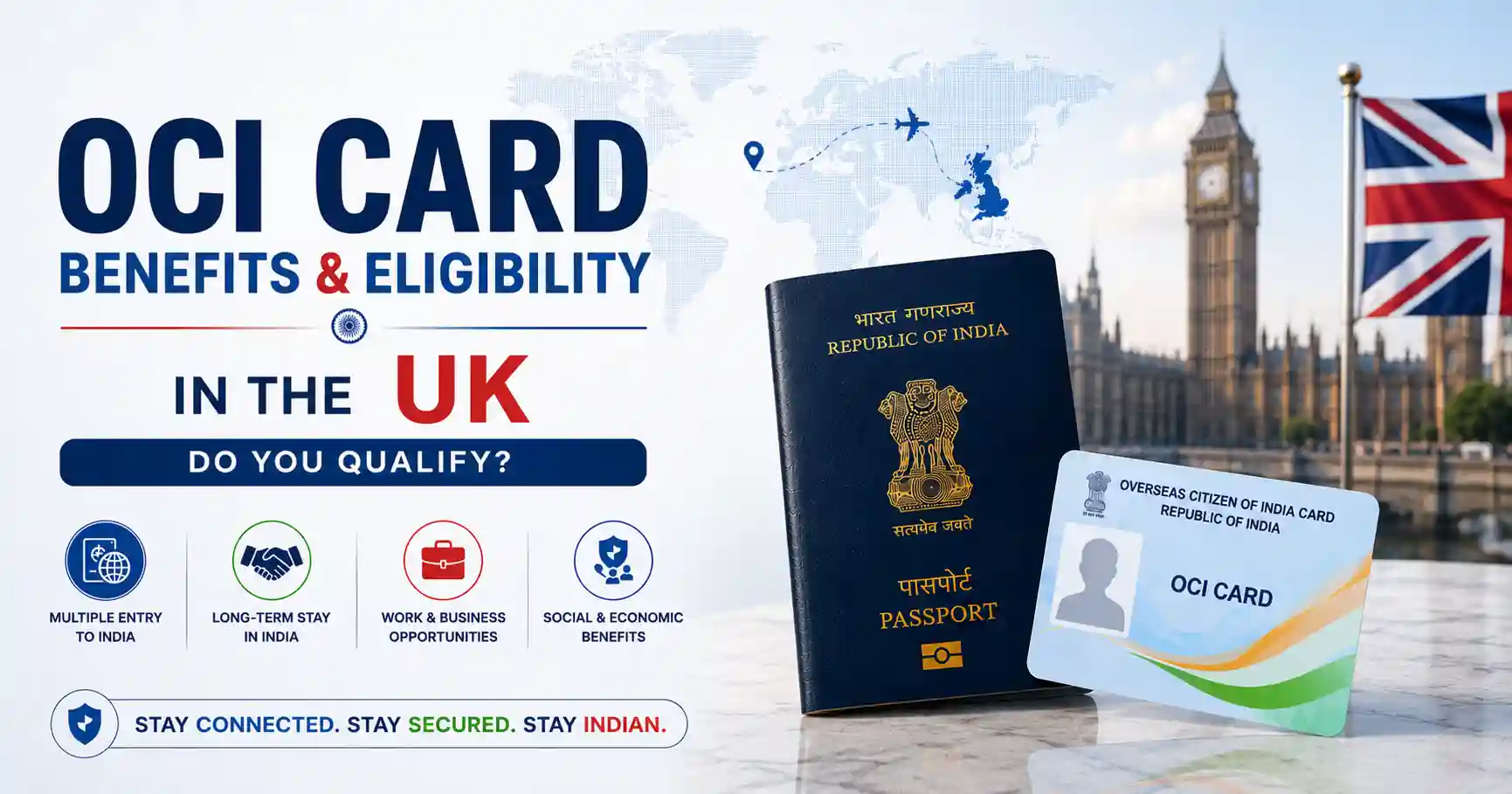
For British citizens of Indian origin, an Overseas Citizen of India (OCI) Card can make visiting and maintaining long-term connections with India much easier. The benefits include a lifelong multiple-entry visa, exemption from certain registration requirements, specified parity with Indian citizens and NRIs, and access to certain education, property, and professional opportunities. However, an OCI Card does not provide Indian citizenship or all the rights of an Indian citizen.
The main advantage of an OCI Card is that it provides eligible British citizens of Indian origin with a long-term connection to India without requiring a separate visa for every visit. The Government of India's OCI Services portal lists a lifelong multiple-entry visa, exemption from FRRO/FRO registration, specified parity with Indian nationals and NRIs, and certain professional and educational benefits.
For someone living in the UK who regularly visits family in India, owns eligible property, studies or works in India, or expects to spend extended periods there, these benefits can be particularly useful.
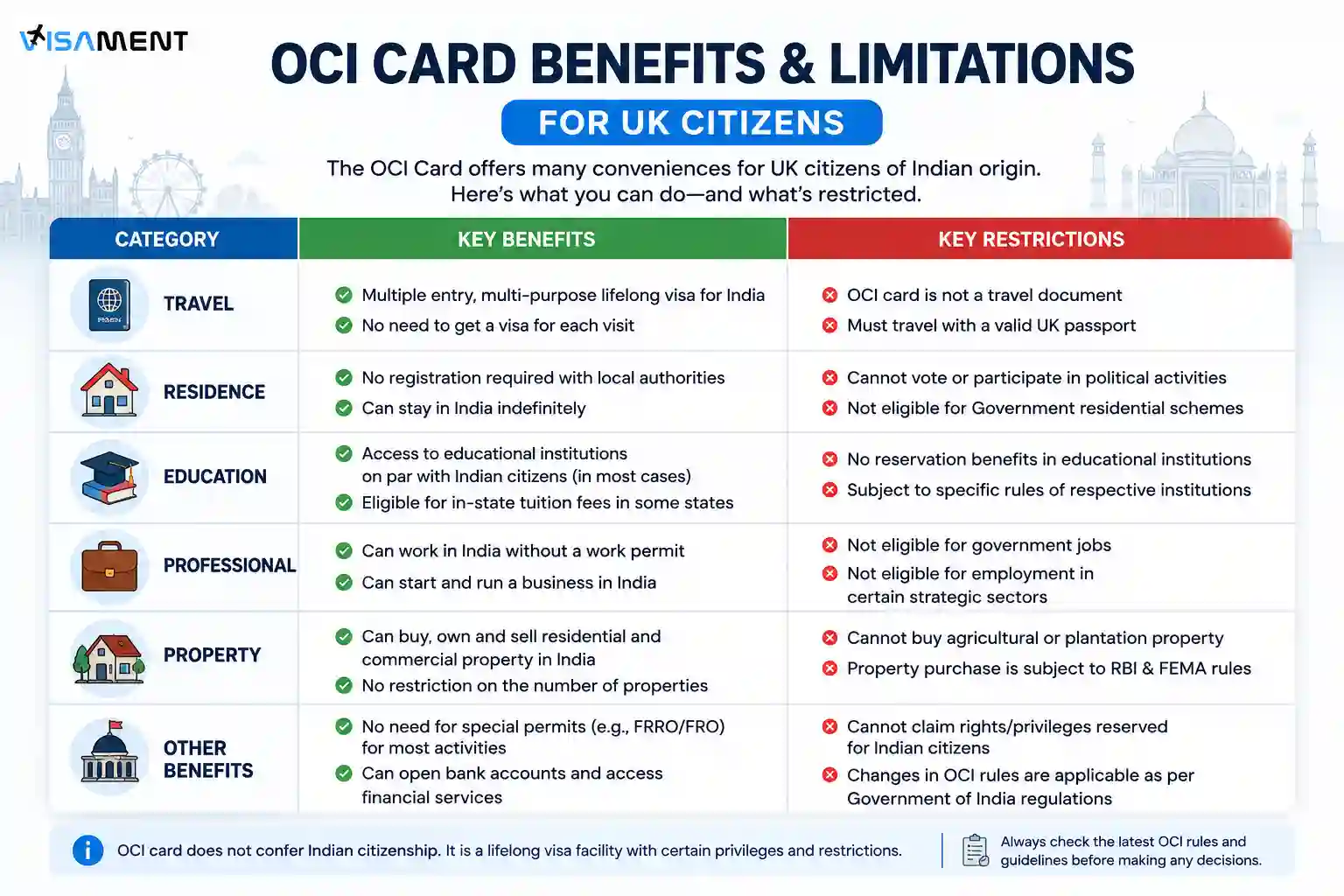
A valid OCI Card provides a multiple-entry lifelong visa for visiting India. This means an eligible OCI holder does not generally need to apply for a separate Indian tourist visa each time they travel to India.
For British citizens, GOV.UK confirms that a valid OCI Card can be used together with a valid British passport to visit India without a visa.
The lifelong visa benefit does not mean every activity is automatically permitted. Special permission may be required for activities such as research, journalism, missionary or Tabligh activities, mountaineering, certain internships or employment with foreign diplomatic missions, and visits to Protected, Restricted or prohibited areas.
Another significant benefit is exemption from registration with the Foreigners Regional Registration Officer (FRRO) or Foreigners Registration Officer (FRO) for any length of stay in India, subject to the applicable conditions.
This can be particularly useful for UK citizens who spend extended periods in India rather than visiting only for short holidays.
OCI holders who are normally resident in India must still notify the relevant FRRO/FRO by email when there is a change in permanent residential address or occupation, according to the current OCI guidance.
Can an OCI Card holder work in India? In specified circumstances, yes. OCI holders receive parity with NRIs for certain professions, subject to the applicable Indian laws and professional regulations. The official OCI guidance specifically lists:
This should not be interpreted as unrestricted employment permission for every occupation. OCI holders are still foreign nationals, and activities outside the specified framework can remain subject to rules applicable to foreigners.
If your main reason for moving to India is employment, check the rules for the particular profession rather than relying solely on the OCI Card.
OCI holders receive specified parity with NRIs for certain educational entrance examinations and admissions.
The Government of India's OCI guidance specifically refers to examinations such as NEET, JEE (Main), and JEE (Advanced), allowing OCI holders to qualify for admission against an NRI seat or supernumerary seat where applicable. However, an OCI holder is not eligible for admission against a seat reserved exclusively for Indian citizens.
This distinction is important for British families considering Indian universities for their children. An OCI Card can provide significant educational advantages, but admission rules vary by institution, course, and applicable regulations.
Can a UK citizen with an OCI Card buy property in India? OCI holders have specified parity with NRIs for the purchase or sale of immovable property in India. However, this benefit has an important limitation: OCI holders cannot acquire agricultural land, farmhouses, or plantation property under the OCI framework.
| Property category | OCI position |
|---|---|
| Residential property | Generally permitted under applicable rules |
| Commercial property | Generally permitted under applicable rules |
| Agricultural land | Not permitted under OCI benefit |
| Farm house | Not permitted under OCI benefit |
| Plantation property | Not permitted under OCI benefit |
Property transactions can involve additional foreign-exchange and regulatory requirements. Therefore, anyone planning a significant property transaction should check the current applicable rules rather than relying only on the general OCI benefit.
OCI holders receive parity with Indian nationals for certain domestic travel and visitor charges.
The official OCI framework provides parity with Indian nationals for domestic air-fare tariffs and entry fees for national parks, wildlife sanctuaries, national monuments, historical sites and museums in India.
OCI holders also receive specified NRI parity in certain economic, financial and educational areas. Where a particular benefit has not been specifically granted to OCI holders, the OCI framework states that they generally have the rights and privileges applicable to foreigners.
OCI holders can also be eligible for appointment as teaching faculty in specified Indian institutions.
The current OCI guidance identifies institutions including IITs, NITs, IIMs, IISERs, IISc, Central Universities and specified AIIMS institutions. Any appointment remains subject to the applicable institutional, professional and legal requirements.
This can be particularly relevant to British academics or professionals of Indian origin who are considering teaching or academic opportunities in India.
Have questions? Our experts guide you through every step of the OCI Card Application – no confusion, no delays.
Consult an Expert TodayAn OCI Card is not Indian citizenship. An OCI holder is a foreign national who holds a foreign passport.
This distinction is essential when evaluating OCI benefits.
| OCI provides | OCI does not provide |
|---|---|
| Lifelong multiple-entry visa | Indian citizenship |
| Specified NRI parity | An Indian passport |
| Certain property rights | Right to acquire agricultural land, farm houses or plantation property |
| Specified education benefits | Admission to seats reserved exclusively for Indian citizens |
| Certain professional rights | Unrestricted employment in every occupation |
| Exemption from FRRO/FRO registration subject to conditions | Voting rights |
OCI holders are also not entitled to appointment to public services and posts connected with the affairs of the Union or a State, except where the Central Government specifically provides otherwise.
The OCI framework therefore provides substantial practical benefits without creating dual Indian citizenship.
For many eligible British citizens with strong personal, family or professional connections to India, an OCI Card can be highly useful.
It may be particularly relevant if you:
The value depends on how you use your connection with India. Someone visiting India once for a short holiday may have different needs from a former Indian citizen who returns several times a year or spends months at a time in India.
What OCI Does Not Give UK Citizens
A British citizen travelling to India with OCI status should have a valid British passport and valid OCI documentation as applicable. GOV.UK confirms that valid OCI holders can use their OCI with their valid British passport to visit India without a visa.
GOV.UK also states that an Electronic Overseas Citizen of India (e-OCI) was launched in June 2026 and that holders of an e-OCI do not need to carry a physical copy of the card. Current travel requirements should always be checked before departure because Indian entry rules can change.
For eligible British citizens of Indian origin, the OCI benefits in the UK-to-India context are mainly about maintaining a convenient, long-term connection with India. A lifelong multiple-entry visa, exemption from certain registration requirements, specified NRI parity for property and education, and selected professional and travel benefits can make OCI valuable for frequent or long-term India visitors.
At the same time, OCI should not be treated as equivalent to Indian citizenship. Voting, certain public-service positions and other citizenship-specific rights remain unavailable, while activities such as research, journalism and access to protected or restricted areas can require additional permission.
Before applying or relying on a particular OCI benefit, check the latest Government of India OCI guidance and current UK travel advice, especially where your circumstances involve employment, education, property or extended residence.
In the UK, obtaining an Overseas Citizen of India (OCI) card typically takes four to eight weeks.
Yes, an Overseas Citizen of India (OCI) can get an Aadhaar card.
Yes, Indian citizens living abroad (OCIs) are able to purchase both residential and commercial real estate in India.
Foreign military or defense personnel, foreign diplomats, individuals with Pakistani or Bangladeshi ancestry, and foreign nationals on certain visas.
OCI holders receive specified NRI parity for buying and selling immovable property, but agricultural land, farm houses and plantation property are excluded under the OCI framework.
OCI holders can pursue certain specified professions under the applicable laws, including medicine, nursing, pharmacy, advocacy, architecture and chartered accountancy. Other employment may be subject to rules applicable to foreign nationals.
Vipul Jain is the Co-Founder of Visament, a trusted platform dedicated to simplifying Indian immigration, consular, and NRI services for applicants across the globe. With extensive expertise in OCI cards, Indian passport services, visa assistance, apostille and document legalization,... See Full Bio

Talk to our documentation experts for free guidance on your application.
How to Check OCI Application Status Online?
OCI Card UK Application: Eligibility, Documents & How to Apply
OCI Renewal Fees: Current OCI Card Renewal and Reissue Charges
Overseas Citizenship of India (OCI) Card - Complete Eligibility, Criteria and Application Guide (2026)
What are the Required Documents for OCI Application in UK?




When you visit a website, it may store data about you using cookies and similar technologies. Cookies can be important for the basic operations of the website and for other purposes. You get the option of deactivating certain types of cookies, even so, doing that may affect your experience on the website.
It is required to permit the basic functionality of the website. You may not disable necessary cookies.
Used to provide advertising that matches you and your interests. May also be used to restrict the number of times you see an advertisement and estimate the effectiveness of an advertising campaign. The advertising networks place them after obtaining the operator's permission.
Permits the website to recognize the choices you make (like your username, language, or the region you are in). Also provides more personalized and enhanced features.
Aid the website operator to determine how the website performs, how visitors interact with the site, and whether there are any technical issues.