Related Blogs

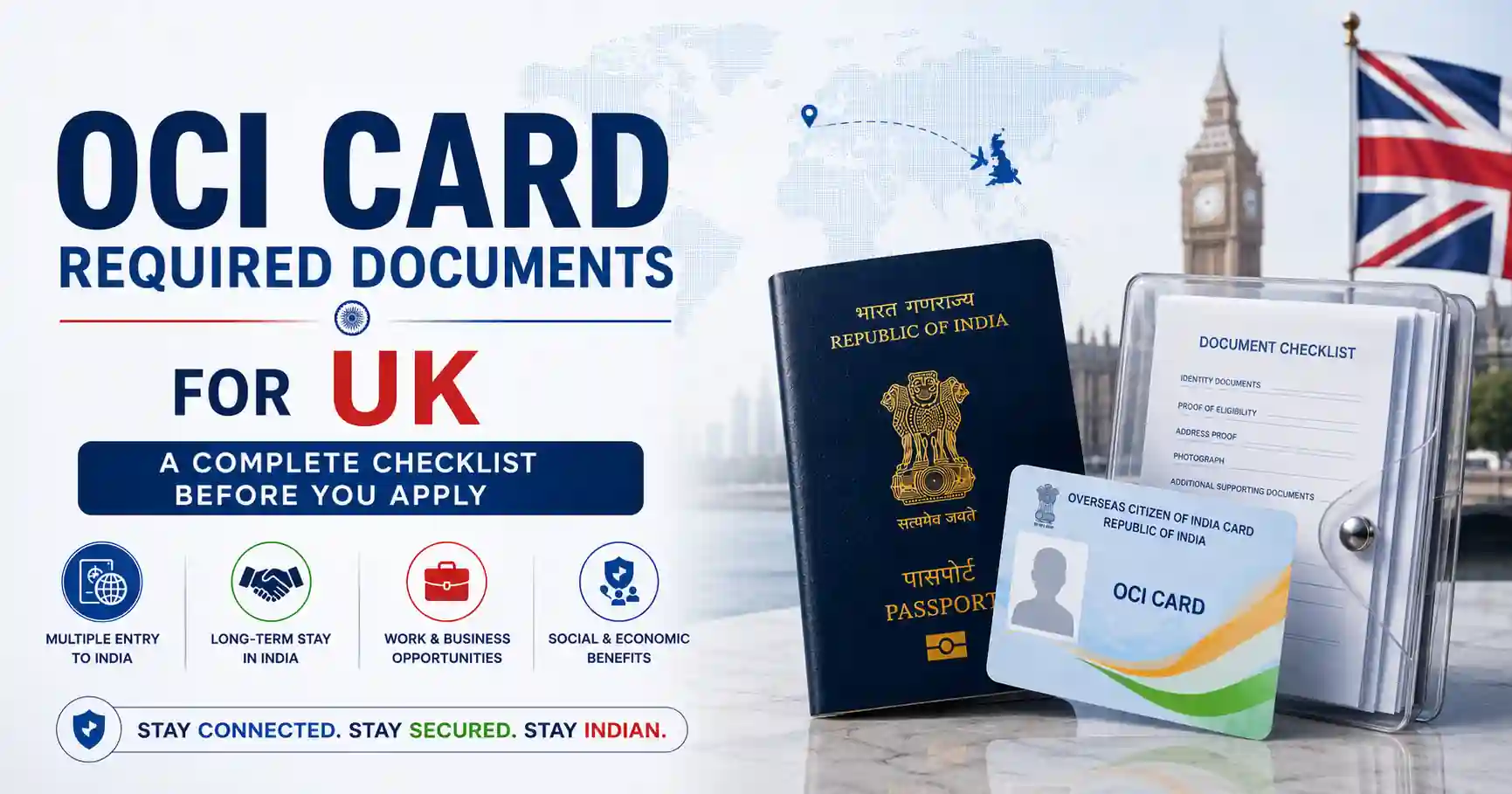
If you are applying for an Overseas Citizenship of India (OCI) card in the UK, then you need to provide all the supporting documents.
Document submission is an important part of the OCI application, affecting your application processing.
There are various types of OCI application documents that you need to provide, depending on whether you are applying based on:
In this blog, we will highlight all the types of OCI documents required for the UK, so you can have a smooth OCI application process without errors or rejection.
Here are some of the mandatory documents mentioned below that you need to provide for every OCI card application UK.
Make sure you provide all the documents valid and correct to avoid any complications with your OCI application in the further process.
Also, you need to check all the documents before submitting to ensure that all the information matches the supporting documents.
Submitting the proof of Indian origin is one of the most important documents to apply for the OCI card application. Without providing a valid proof of Indian origin, you cannot apply for the OCI card.
Here are the documents that you can submit as proof of Indian origin.
Former Indian citizens need to provide the following documents as proof of Indian origin.
By submitting these documents, you can have a simple and error-free OCI application processing.
Here are the documents that you need to provide if you are applying based on family lineage.
All the documents must be valid and clearly show the relationship between the applicant and the Indian origin ancestor.
If you hold an Indian passport, then you need to provide the following documents to apply for OCI after getting UK citizenship.
Applicants who are born outside India and apply for the OCI card on their Indian origin parents must provide the following documents as mentioned below.
If you're applying for an OCI card application UK based on your grandparents, then you need to submit the following documents mentioned below.
 Also Want to Know About OCI Biometric Appointment? Check Now!
A foreign spouse of any OCI cardholder or any Indian citizen applying for an OCI card in the UK can apply if their marriage is more than 2 years, you need to provide the following documents.
For the minor OCI application in the UK, you need to provide the documents mentioned below.
Also Want to Know About OCI or Indian Passport for UK born Baby? Check Now!OCI applicants living in the UK without UK nationality need to provide their legal immigration status by providing the following documents.
If somehow you have lost your Indian passport, then you can use the following documents mentioned below as evidence for the proof of Indian origin.
Here are some of the points that every OCI applicant needs to keep in mind when applying for an OCI application and submitting documents for the OCI application in the UK.
Knowing all the documents for the OCI application UK to help you with a smooth and error-free application. Providing the correct documents for your OCI application plays a major role in the application process. There are different types of documents based on former Indian citizens, parents, grandparents, or great-grandparents, minors, or someone applying based on their spouse.
For all the OCI application types, you need to provide the correct documents. For more assistance, you can take help from Visament, which provides OCI applicants a safe and secure application process. At Visament, you will get a simplified process with easy documents and years of skilled and experienced agents.
For any queries or doubts, you can contact the Visament support team, who are ready 24/7 to help you and provide you with an instant answer to all your questions.
If your OCI card application gets approved, then it will take around 8-10 weeks. This time includes the card processing, printing, and dispatch as well.
The cost for a new OCI application is £ 194.00, and for converting PIO to OCI the fee is £ 66.00. For OCI renewal, £21.00, and for OCI renewal in case of lost OCI the fee is £73.00. An additional charge of £7.44 as a VFS charge and £1.44 as an SMS charge is also required.
Yes, the photograph must be in color and the size of 2*2 inch (51mm*51mm). It must be clear and must have a full face front view and eyes open view. The center head must be within the frame and the background must be plain and white. These are some things to consider when uploading a photograph in an OCI application.
The common mistakes that may lead to rejection are as follows: Not uploading photo/signature as per the specifications. Uploading the documents under the wrong category. Providing the wrong passport number/date of issue. Not mentioning the full name of parents or spouse, etc.
Yes, you will need a valid surrender certificate, which is a mandatory document to apply for the OCI card application in the UK. You can get a surrender certificate by surrendering your Indian passport to the Indian authorities.
Yes, a birth certificate is an mandatory documents which also act as proof of Indian origin, and it is also used mostly for minor OCI card applications.
Generally, minors need to provide birth documents for their OCI application, but if a minor has only a single parent, then he or she needs to provide a valid document such as a divorce decree, court order, or a death certificate.
Yes, you can submit photocopies of the documents for your OCI application, just make sure all the photocopies are self-attested.
Yes, the documents for the OCI application vary by category. There are different types of OCI applications that an individual can apply for, and you need to provide different documents for each application.
Vipul Jain is the Co-Founder of Visament, a trusted platform dedicated to simplifying Indian immigration, consular, and NRI services for applicants across the globe. With extensive expertise in OCI cards, Indian passport services, visa assistance, apostille and document legalization,... See Full Bio

Talk to our documentation experts for free guidance on your application.

When you visit a website, it may store data about you using cookies and similar technologies. Cookies can be important for the basic operations of the website and for other purposes. You get the option of deactivating certain types of cookies, even so, doing that may affect your experience on the website.
It is required to permit the basic functionality of the website. You may not disable necessary cookies.
Used to provide advertising that matches you and your interests. May also be used to restrict the number of times you see an advertisement and estimate the effectiveness of an advertising campaign. The advertising networks place them after obtaining the operator's permission.
Permits the website to recognize the choices you make (like your username, language, or the region you are in). Also provides more personalized and enhanced features.
Aid the website operator to determine how the website performs, how visitors interact with the site, and whether there are any technical issues.