Related Blogs

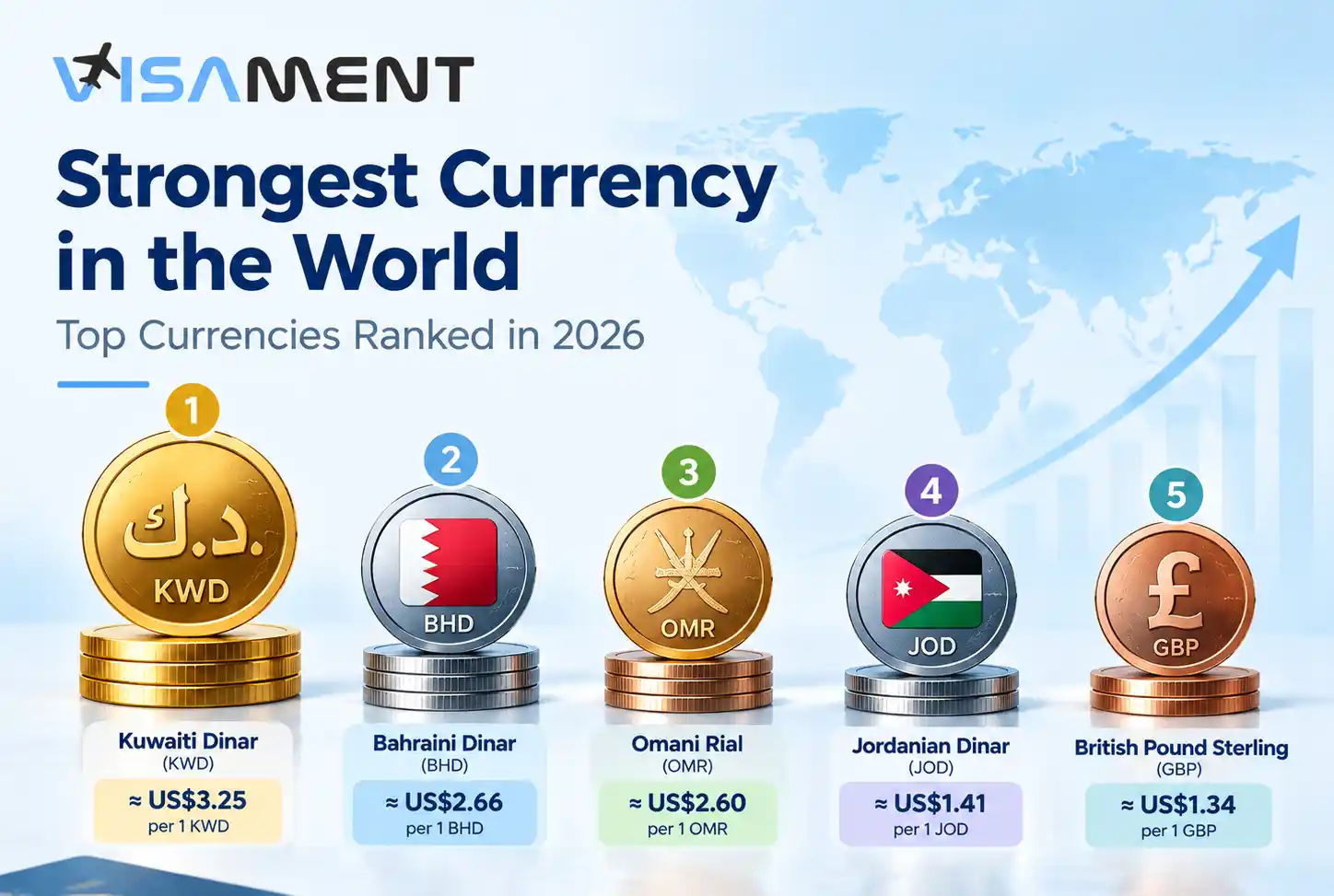
When people ask about the strongest currency in the world, they often mean the currency that has the highest value compared with the US dollar. By that measure, the Kuwaiti dinar (KWD) ranks first in 2026. But a high exchange value does not automatically make a currency the world's most influential or widely used currency.
This guide ranks leading currencies by their nominal value per unit against the US dollar, explains why the Kuwaiti dinar has such a high value, and shows why the US dollar can remain globally dominant despite having a lower value per unit.
There is no single official definition of a "strongest currency." For currency rankings, the simplest and most measurable definition is nominal exchange value: how much one unit of a currency is worth in US dollars.
Using this definition, a currency with a higher value per unit ranks above one with a lower value.
This should not be confused with:
These measures can produce very different results.
The Kuwaiti dinar (KWD) is the strongest currency by nominal value against the US dollar in this ranking.
The Central Bank of Kuwait reported 307.350 fils per US dollar on September 21, 2026. Since 1 Kuwaiti dinar contains 1,000 fils, this works out to approximately:
1 KWD ≈ US$3.25
The high value of the dinar reflects Kuwait's exchange-rate framework and monetary management, along with broader economic factors. The numerical value of a currency unit is also influenced by how that currency is denominated; it should not be interpreted on its own as a measure of national wealth.
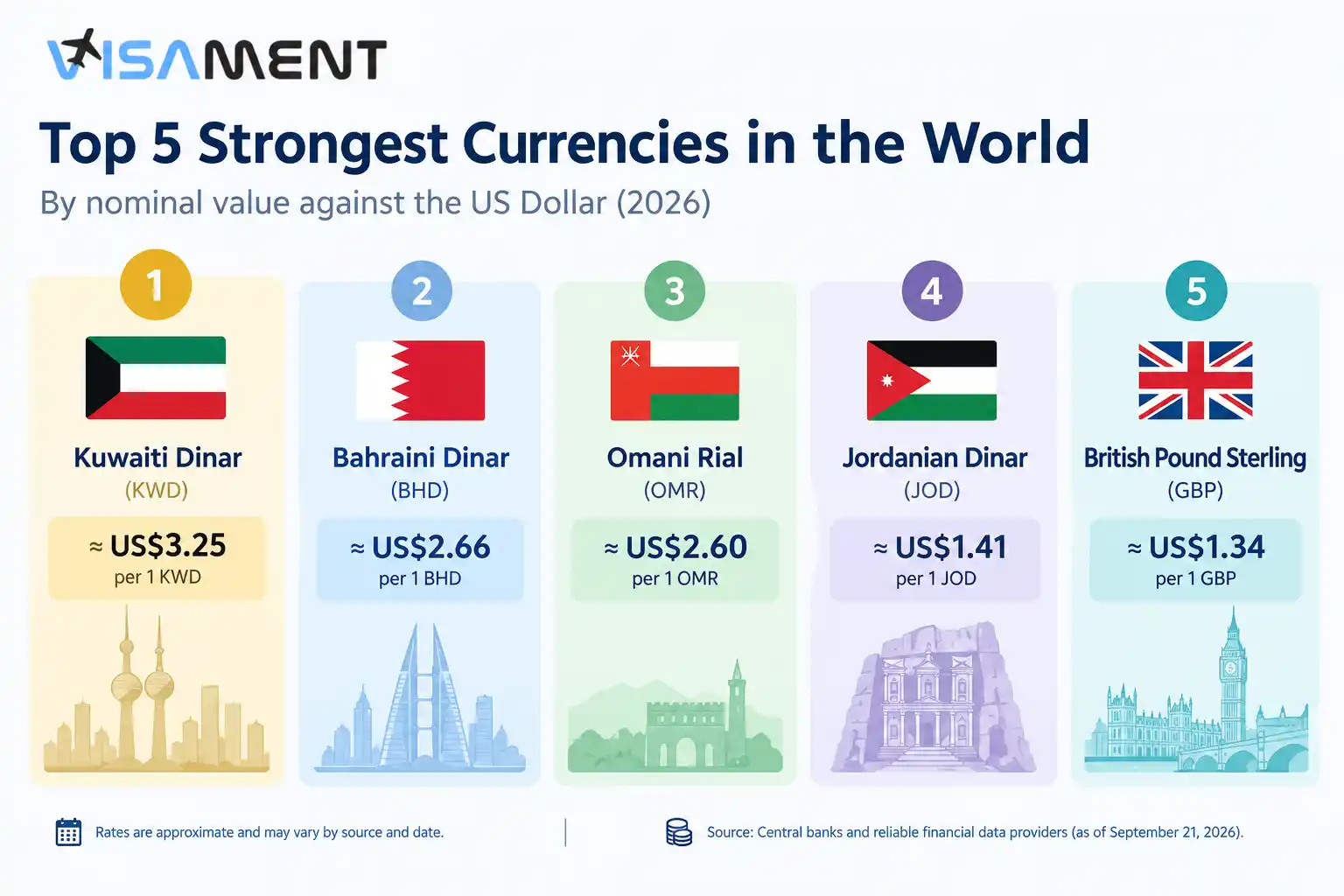
The following ranking uses approximate nominal value against the US dollar around September, 2026.
|
Rank |
Currency |
Code |
Approx. value of 1 unit in USD |
|---|---|---|---|
|
1 |
Kuwaiti dinar |
KWD |
$3.25 |
|
2 |
Bahraini dinar |
BHD |
$2.66 |
|
3 |
Omani rial |
OMR |
$2.60 |
|
4 |
Jordanian dinar |
JOD |
$1.41 |
|
5 |
British pound sterling |
GBP |
$1.34 |
|
6 |
Gibraltar pound |
GIP |
$1.34 |
|
7 |
Swiss franc |
CHF |
$1.21 |
|
8 |
Cayman Islands dollar |
KYD |
$1.20 |
|
9 |
Euro |
EUR |
$1.15 |
|
10 |
US dollar |
USD |
$1.00 |
The figures are approximate and can change with market movements or changes in official exchange-rate arrangements. For example, the Central Bank of Bahrain states that the Bahraini dinar is fixed at US$2.659 per BHD, while Oman's central bank maintains the Omani rial at approximately US$2.6008.
The Jordanian dinar is also pegged to the US dollar, at around 709 fils per dollar, giving it a value of approximately US$1.41.
Market-based currencies such as the British pound, Swiss franc, and euro can move from day to day. Federal Reserve and Banque de France data for September 21, 2026 put the pound at roughly US$1.34, the Swiss franc at about US$1.21, and the euro at approximately US$1.15.
The Kuwaiti dinar's high nominal exchange value is the result of several factors rather than a single economic indicator.
Kuwait manages the dinar's exchange-rate framework through its central bank. Exchange-rate policy can help reduce excessive volatility and maintain monetary stability.
Kuwait is a major oil-producing economy. Energy exports contribute substantially to government revenue and foreign-exchange earnings, although oil prices and production conditions can still affect the country's economy.
Central-bank policy, liquidity management, and the country's broader financial conditions also influence the value and stability of the dinar.
A currency's numerical value depends partly on how its unit is defined. Therefore, saying that one KWD is worth more than one USD does not mean Kuwait's economy is larger than the United States economy.
Several factors can influence a currency's value and stability:
No single factor determines whether a currency is "strong."
Not if strength is measured by nominal value per currency unit. One US dollar is worth less than one Kuwaiti dinar, Bahraini dinar or Omani rial under the ranking used in this article.
However, the US dollar has a much greater role in the international financial system.
The Bank for International Settlements reported that the US dollar was on one side of 89% of all foreign-exchange trades in April 2025, making it the most-traded currency in the global FX market.
The US dollar also remains the largest currency component of official foreign-exchange reserves. IMF data for the fourth quarter of 2025 showed the dollar accounting for 56.77% of allocated global foreign-exchange reserves.
This distinction is important: the highest-valued currency per unit is not necessarily the world's most important currency.
Not necessarily.
A currency's unit value does not directly measure the size or strength of its economy. For example, countries can choose different denominations for their currencies. One unit may naturally be worth several dollars while another may be worth only a fraction of a dollar.
To assess an economy, analysts may instead examine factors such as:
Similarly, a high exchange rate does not automatically mean that residents have greater purchasing power.
Currency rankings can change when floating exchange rates move against the US dollar.
For example, the British pound, euro and Swiss franc fluctuate according to market conditions, monetary policy expectations, capital flows and other economic factors. Official exchange-rate data from September 21, 2026 showed the pound at about US$1.34 and the Swiss franc at about US$1.21, illustrating that their relative positions can move over time.
Currencies with fixed or tightly managed exchange-rate arrangements behave differently. Their values against the US dollar can remain comparatively stable because monetary authorities maintain the relevant exchange-rate framework.
That is why a “strongest currency” ranking should always include a measurement date and methodology.
If you want to compare currencies using today's rates rather than a static ranking, a currency converter can provide a more practical reference.
These terms are often used interchangeably, but they describe different ideas.
|
Measurement |
What it tells you |
|---|---|
|
Nominal exchange value |
How much one currency unit is worth against another |
|
Purchasing power |
What the currency can actually buy |
|
FX trading share |
How frequently the currency is used in foreign-exchange markets |
|
Reserve-currency share |
How much of official global reserves are held in the currency |
|
Economic size |
The scale of the underlying economy |
The Kuwaiti dinar leads this article's ranking because of its nominal value per unit. The US dollar leads by a very different measure: international use and financial-market importance. BIS data shows the dollar on one side of 89% of FX trades, while IMF data shows it represented 56.77% of allocated global reserves in Q4 2025.
The Kuwaiti dinar is the strongest currency in the world when “strongest” means the highest nominal value of one currency unit against the US dollar. In September 2026, one KWD was worth approximately US$3.25 based on Central Bank of Kuwait data.
But currency value is only one way to measure strength. The US dollar has a substantially larger role in global FX trading and official foreign-exchange reserves, demonstrating why nominal exchange value and global currency influence should not be treated as the same thing.
For anyone comparing currencies, always check the exchange-rate date, benchmark currency and source before relying on a ranking, because floating exchange rates can change.
No. The value of one currency unit depends partly on how the currency is denominated and managed. Economic strength is better evaluated using factors such as GDP, productivity, purchasing power, trade, inflation, and financial conditions.
The Kuwaiti dinar has the highest nominal value per unit among the currencies compared in this 2026 ranking, at approximately US$3.25 per KWD.
Yes. Exchange rates for floating currencies can change daily because of market conditions, economic data, interest-rate expectations, and capital flows. Fixed or managed currencies may remain more stable against the US dollar.
The Kuwaiti dinar's high nominal value is influenced by Kuwait's exchange-rate framework, monetary management, economic conditions, and strong external position. Its high value per unit does not, by itself, indicate overall economic strength.
Yes. Exchange rates for floating currencies can change daily because of market conditions, economic data, interest-rate expectations, and capital flows. Fixed or managed currencies may remain more stable against the US dollar.
The strongest currency by nominal value has the highest value per unit against a benchmark currency such as the US dollar. The most traded currency is the one most frequently involved in foreign-exchange transactions. The US dollar is the world's most traded currency despite not having the highest nominal unit value.
The ranking compares how many US dollars one unit of each currency can buy at a specified date. Because exchange rates change, the date and data source should always be included when publishing a ranking.
Vipul Jain is the Co-Founder of Visament, a trusted platform dedicated to simplifying Indian immigration, consular, and NRI services for applicants across the globe. With extensive expertise in OCI cards, Indian passport services, visa assistance, apostille and document legalization,... See Full Bio

Talk to our documentation experts for free guidance on your application.
Top NRI Investment Options Available in India: Best Plans for 2026
NRI Bank Account: Types, Benefits, Eligibility & How to Choose
Difference Between an NRE and NRO Account: Tax & Eligibility
Understanding FCNR Account: Features, Eligibility & Benefits
Non-Resident Ordinary (NRO) Bank Account: What It Is and How It Works




When you visit a website, it may store data about you using cookies and similar technologies. Cookies can be important for the basic operations of the website and for other purposes. You get the option of deactivating certain types of cookies, even so, doing that may affect your experience on the website.
It is required to permit the basic functionality of the website. You may not disable necessary cookies.
Used to provide advertising that matches you and your interests. May also be used to restrict the number of times you see an advertisement and estimate the effectiveness of an advertising campaign. The advertising networks place them after obtaining the operator's permission.
Permits the website to recognize the choices you make (like your username, language, or the region you are in). Also provides more personalized and enhanced features.
Aid the website operator to determine how the website performs, how visitors interact with the site, and whether there are any technical issues.