Applying for an OCI card in the UK involves more than completing an online form. Applicants need to confirm their eligibility, prepare category-specific documents, complete the Government of India OCI application, select the correct UK jurisdiction, and submit the application through the applicable VFS India Consular Application Centre.
This guide explains the OCI card UK application process step by step, including eligibility, documents, passport surrender, VFS submission, fees, tracking, and common mistakes to avoid.
Key Takeaways
- A fresh OCI application is started online through the Government of India's OCI Services portal.
- UK applicants must select the correct jurisdiction and follow the applicable VFS India submission process.
- Applicants who have previously held Indian citizenship must complete the applicable Indian passport surrender process before applying for OCI.
- Required documents depend on the applicant's OCI eligibility category.
- Applicants should use details from their current passport consistently throughout the online application.
- Fees, document requirements, and VFS procedures can change, so the latest official guidance should be checked before submission.
- After submission, applicants can track the OCI application through the Government of India's OCI status system and relevant VFS tracking facilities.
Who Can Apply for an OCI Card in the UK?
OCI registration is available to eligible foreign citizens with qualifying Indian-origin connections. Under the current Government of India eligibility framework, this can include a former Indian citizen, a person who would have been eligible for Indian citizenship under the specified historical criteria, certain children, grandchildren or great-grandchildren of eligible persons, qualifying minor children, and certain foreign-origin spouses of Indian citizens or OCI cardholders.
The OCI eligibility rules can be more complicated when the application is based on ancestry or marriage. The Government of India also specifies nationality and ancestry-related exclusions, so applicants should confirm their individual eligibility before starting the application.
If you are unsure whether you qualify, use an OCI eligibility checker before preparing the application.
Fresh OCI Application vs OCI Renewal or Reissue
This guide focuses on a fresh OCI application. It is different from updating or reissuing an OCI card that you already hold.
If you already have an OCI card and need to update passport details, replace a damaged card, or deal with another post-registration change, use the relevant OCI Miscellaneous Services process instead of submitting a fresh registration.
What Documents are Required for an OCI Application in the UK?
The exact document list depends on why you qualify for OCI. Applicants should therefore use the current UK-specific OCI checklist applicable to their category rather than relying on a generic list.
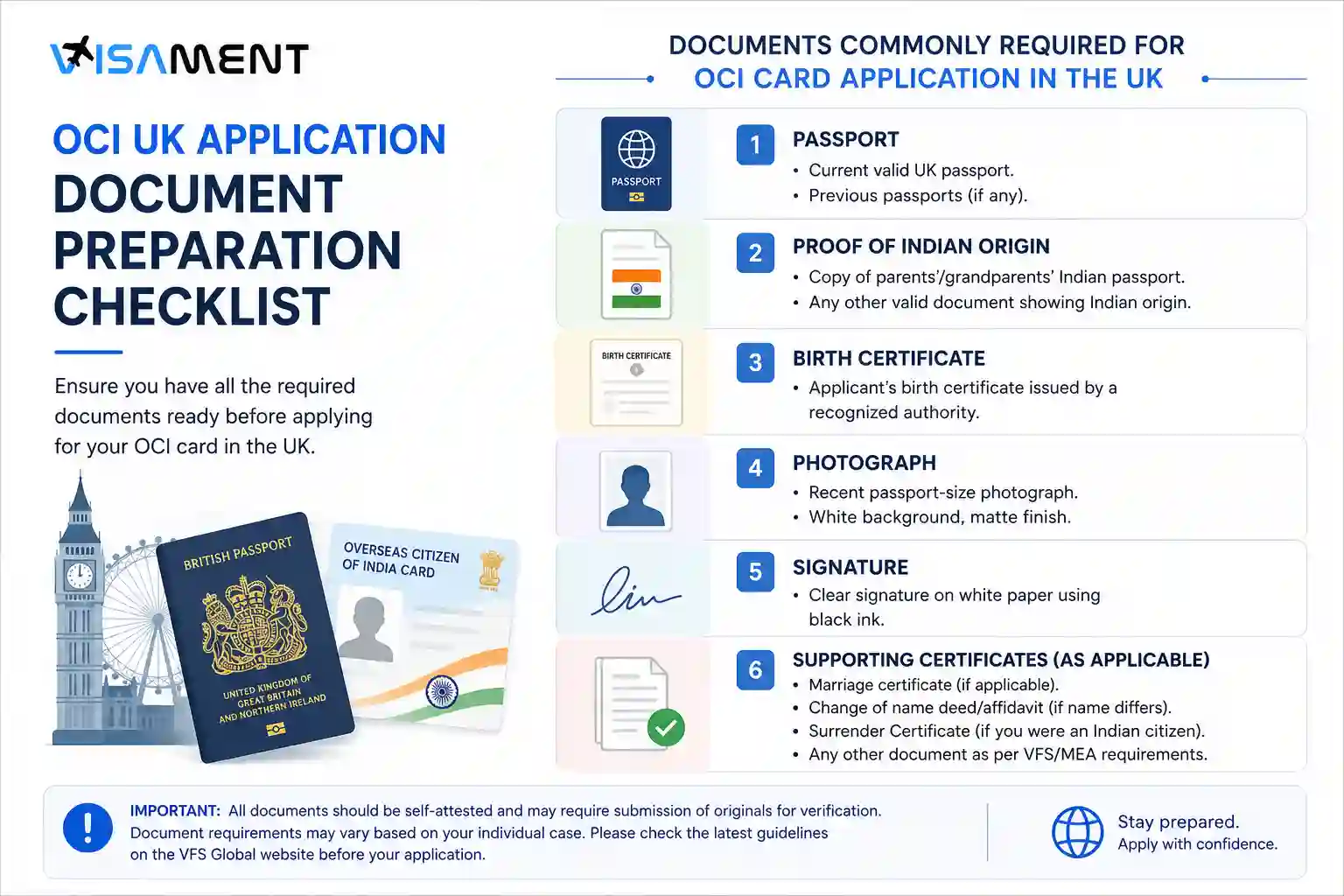
For a typical Indian-origin application, documents can include:
- Current valid foreign passport
- Proof of Indian origin
- Naturalisation certificate, where applicable
- Indian passport and surrender certificate, where applicable
- Birth certificate or other evidence establishing the Indian-origin connection
- Recent photograph for OCI meeting the required specifications
- Signature
- Marriage, divorce or death certificate where relevant
- Spouse's passport or OCI card for applicable spouse cases
- UK immigration status where applicable
- UK address proof
- Name-change documentation, if applicable
The current VFS UK checklist states that applicants should carry originals and self-attested photocopies and upload the required documents online. It also identifies documents such as a current passport, photograph, naturalisation certificate, Indian-origin evidence, and UK address or immigration documentation for relevant cases.
If you are unsure about documents required to qualify for an OCI application, use an OCI documents checklist generator before preparing the application.
Do UK Documents Need an Apostille?
Not every document automatically requires an apostille. Authentication requirements depend on the type of document and the basis of the OCI application.
For example, foreign birth or marriage documents may have additional authentication requirements in certain OCI categories. Check the current VFS India UK document checklist for your specific application type before submitting documents.
Do not assume that a document accepted for one OCI category will automatically satisfy the requirements of another.
Get Expert Help for OCI Card Application UK!
Have questions? Our experts guide you through every step of the OCI Card Application UK– no confusion, no delays.
Consult an Expert Today How to Apply for an OCI Card in the UK?
The UK application has two connected stages: online OCI registration with the Government of India and physical submission through the applicable VFS India Consular Application Centre.
1. Confirm Your OCI Eligibility and Application Type
Before opening the application, establish the basis on which you qualify for OCI. This may be Indian origin, descent, minor-child eligibility, or an eligible foreign-origin spouse relationship.
Also determine whether you need a fresh OCI registration or an OCI Miscellaneous Service. Selecting the wrong service type can create avoidable problems later.
If you previously held Indian citizenship, complete the required Indian passport surrender process before proceeding with the OCI application. Current VFS UK guidance specifically states that surrender of the Indian passport is the first step for applicants who have held Indian citizenship.
2. Complete the Online OCI Application
Create your account on the official OCI Services portal and enter your personal information.
The Government of India instructs applicants to:
- Enter their name and other details according to their current passport.
- Provide an active email address.
- Confirm eligibility before applying.
- Keep the application credentials and OTP secure.
Pay particular attention to spelling, dates of birth, passport numbers, and nationality. The information in the application should correspond with your current passport and supporting documents.
3. Upload Your Photo, Signature and Supporting Documents
The OCI application requires digital uploads before the VFS submission stage. Current VFS UK instructions state that applicants should upload their photograph, signature, passport copy and supporting documents through the OCI registration website.
The physical photograph should correspond with the photograph uploaded online. Follow the current official photograph specifications rather than using an image prepared for another passport or visa application.
Some supporting documents may need to be carried physically even when the online system does not provide a separate upload option for every document. The current VFS UK guide advises applicants to carry originals separately from photocopies.
4. Select the Correct UK Jurisdiction
Jurisdiction is an important part of an OCI application from the UK.
The current VFS UK fresh OCI guide states that applicants must select the correct jurisdiction - London, Birmingham or Edinburgh - when completing the application.
Do not simply choose the centre that is geographically closest without first checking the jurisdiction applicable to your residence.
Jurisdiction information can change, so verify the current VFS guidance immediately before completing the application.
5. Book a VFS Appointment
After completing the required online steps, arrange the appropriate appointment through VFS.
VFS describes the UK OCI process as:
- Identify the OCI service.
- Prepare the application.
- Book an appointment.
- Attend an application centre.
- Track the application.
Make sure you book the correct service and prepare the required documents before the appointment. A separate appointment may be required for each application being submitted.
6. Submit Your Application and Supporting Documents
Attend the applicable VFS India Consular Application Centre with your completed application and document set.
Keep original documents and photocopies in separate bundles. The current VFS UK OCI guide specifically advises applicants to carry both originals and photocopies and to retain the unique application reference number beginning with GBR.
VFS performs administrative and logistical functions, including receiving applications and supporting documents. The final decision on an OCI application is made by the relevant Indian Mission/Post or Government of India authority, not by VFS.
OCI Application UK Fees
The total amount payable for an OCI application in the UK can include the applicable Government of India fee and VFS service charges, along with optional services if selected.
Because fees and optional service charges can change, check the current VFS UK fee information immediately before payment rather than relying on an older article or checklist.
VFS currently lists optional services such as courier, digital document checking, photography, photocopying and SMS updates separately from the standard application process.
Important: Optional VFS services are not the same as the government OCI fee and should not be presented as mandatory unless the current official instructions specifically require them.
How Long Does an OCI Application Take in the UK?
OCI processing time is not a guaranteed fixed period for every applicant. Processing can depend on the application category, document completeness, verification requirements, and the relevant Indian Mission or Consulate.
VFS provides the administrative submission process, while decisions and processing timeframes are controlled by the relevant Mission/Post or Government of India authority.
For that reason, avoid making non-refundable travel arrangements based only on an estimated OCI processing period. Check the latest official guidance when planning your travel.
How to Track an OCI Application in the UK
After the application has been submitted to the Indian Mission or Consulate, OCI status can be checked through the Government of India's OCI tracking system.
Current VFS UK guidance directs applicants to the Government of India status system once the application has been submitted for processing. VFS also provides application-tracking facilities for the submission and return stages.
Keep your application reference number and submission receipt available. These details can be useful when checking the progress of the application or communicating with the relevant service provider.
Common OCI Application Mistakes to Avoid
A few preventable OCI application mistakes can create problems:
- Choosing the wrong OCI service: Make sure you are applying for fresh registration rather than an OCI Miscellaneous Service.
- Using outdated information: Always check the current VFS UK checklist and fee information.
- Entering passport details incorrectly: The Government of India specifically instructs applicants to enter details according to their current passport.
- Uploading incomplete documents: Review the upload requirements before submitting the online application.
- Ignoring physical document requirements: Online uploads do not necessarily eliminate the requirement to carry originals and photocopies.
- Using inconsistent photographs: The photograph uploaded online should match the physical photograph required for submission.
- Skipping passport surrender: Former Indian citizens should complete the applicable surrender process before OCI application.
- Selecting the wrong jurisdiction: Confirm whether your application falls under London, Birmingham or Edinburgh before proceeding.
- Relying on an old checklist: OCI requirements can change, so use the current official UK guidance.
What Happens After You Submit Your OCI Application?
After VFS accepts the application for onward processing, the application is transmitted to the relevant Indian Mission/Post. The Government of India or the relevant Mission/Post makes the decision on the OCI application.
You can monitor the application through the relevant OCI status system. Once processing is complete and the OCI card is returned to the application centre, the applicable collection or delivery procedure can be followed.
If you selected an optional courier service, check the current VFS arrangements for document delivery. VFS currently lists courier as an optional service for UK applicants.
Conclusion
An OCI card UK application requires careful preparation at both the online and physical submission stages. Start by confirming eligibility and, if you previously held Indian citizenship, completing the applicable passport surrender process. Then complete the OCI application using your current passport details, upload the required documents, select the correct UK jurisdiction, and attend the appropriate VFS appointment.
Because OCI requirements, fees, and submission procedures can change, always compare your application against the latest Government of India and VFS India UK guidance before submitting it.