If you are an Overseas Citizen of India (OCI) cardholder living outside India, you may be wondering whether you can buy or own a house, apartment, commercial property, or land in India. The answer is generally yes for eligible residential and commercial property, but important restrictions apply to agricultural land, plantation property, and farmhouses. OCI property ownership is governed primarily by the Foreign Exchange Management Act (FEMA), the applicable Foreign Exchange Management (Non-Debt Instruments) Rules, and Reserve Bank of India (RBI) directions.
Key Takeaways
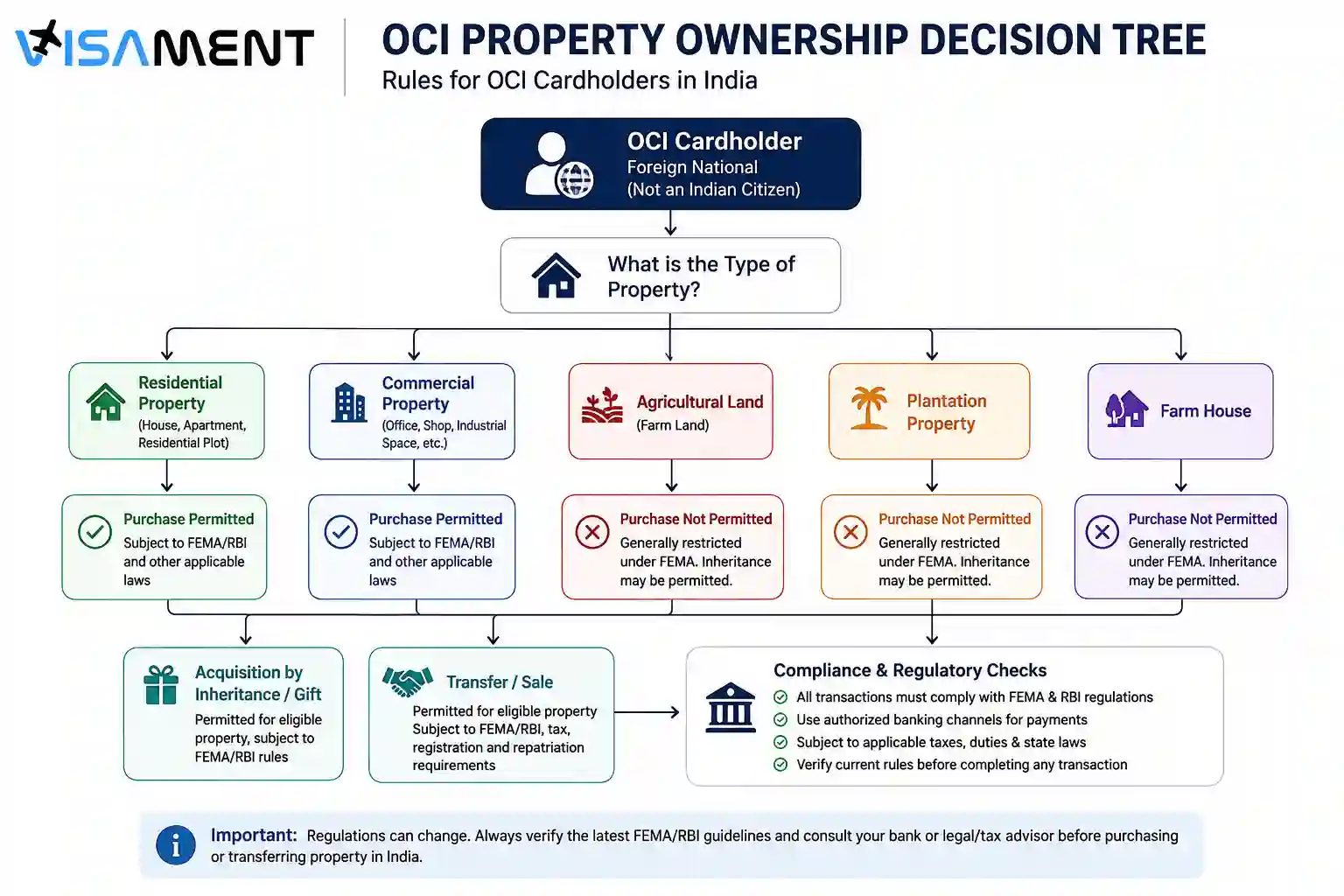
- OCI cardholders can generally purchase eligible residential and commercial immovable property in India.
- OCI holders generally cannot purchase agricultural land, plantation property, or a farmhouse.
- An OCI cardholder can acquire eligible Indian property through inheritance, subject to the applicable FEMA rules.
- Property that an OCI legally owns can generally be transferred, subject to the rules applicable to the type of property and recipient.
- An OCI cardholder is a foreign national, not an Indian citizen.
- Property ownership and repatriation of sale proceeds are separate issues.
- Current RBI/FEMA requirements should be checked before completing a property transaction because regulatory rules and directions can change.
Can OCI Cardholders Buy Property in India?
Yes. An OCI cardholder can generally acquire immovable property in India, provided the property falls within the categories permitted under the applicable FEMA framework.
RBI guidance states that an NRI or OCI may acquire immovable property in India other than agricultural land, farmhouse, or plantation property. An OCI may acquire eligible property through purchase, subject to the applicable payment and regulatory requirements.
This means an OCI cardholder can generally purchase property such as:
- A residential house
- An apartment or flat
- A residential plot, where the transaction otherwise qualifies as permitted immovable property
- Commercial property
However, being an OCI cardholder does not give unrestricted rights to purchase every type of land in India. The distinction between permitted property and restricted property is important.
The Ministry of Home Affairs also lists the purchase or sale of immovable property other than agricultural land, farm house, or plantation property among the privileges available to OCI cardholders, subject to the applicable legal framework.
What Types of Property Can an OCI Own?
The following distinction is useful when evaluating OCI property ownership in India:
| Property type |
General position for OCI cardholders |
Key consideration |
| Residential property |
Generally permitted |
Must comply with FEMA/RBI and other applicable laws |
| Commercial property |
Generally permitted |
Transaction must comply with applicable regulations |
| Agricultural land |
Generally restricted for purchase |
Different rules can apply to inheritance and subsequent transfer |
| Plantation property |
Generally restricted for purchase |
Subject to specific FEMA provisions |
| Farm house |
Generally restricted for purchase |
Should not be treated like an ordinary residential property |
Residential Property
An OCI cardholder can generally purchase residential property in India, such as a house or apartment, under the applicable FEMA rules. RBI guidance specifically permits an NRI or OCI to acquire immovable property other than agricultural land, plantation property, or a farm house.
For example, an OCI living in the United States who wants to purchase an apartment in Mumbai for personal use would generally be dealing with a permitted category of property. The transaction would still need to comply with applicable property, registration, tax, payment, and foreign-exchange requirements.
Commercial Property
Commercial property is also generally within the permitted category for OCI cardholders. The property could include eligible commercial premises, subject to the applicable rules and any requirements under other Indian laws.
The important point is that commercial property is not treated the same way as agricultural land or a farm house under the FEMA framework.
Agricultural Land, Plantation Property and Farm Houses
This is the most important restriction to understand.
An OCI cardholder generally cannot purchase agricultural land, plantation property, or a farm house in India under the general permission available for residential and commercial property. RBI's current guidance expressly excludes these categories from the property that an NRI or OCI can acquire by purchase.
Therefore, an OCI should not assume that being of Indian origin automatically allows them to purchase farmland or agricultural land.
However, acquisition through inheritance is treated differently from purchase, so the source and manner of acquisition matter.
Get Expert Help for Your OCI Card Service!
Have questions? Our experts guide you through every step of the OCI Card Service – no confusion, no delays.
Consult an Expert Today Can an OCI Inherit Property in India?
Yes, inheritance is treated separately from purchasing property.
RBI guidance provides that an NRI or OCI can acquire immovable property in India by inheritance from a person resident in India. An NRI or OCI can also inherit property from a person resident outside India where the property was acquired in accordance with the foreign-exchange law applicable at the time of acquisition.
This distinction is particularly important for restricted property categories.
For example, an OCI may inherit agricultural land under circumstances permitted by the applicable law even though the OCI generally cannot purchase agricultural land directly. Inheritance should not be interpreted as creating a general right to purchase the same category of property.
Succession, inheritance, title, and state-level property laws may also affect an individual transaction. Anyone dealing with inherited property should therefore verify the specific circumstances before transferring or selling it.
Can an OCI Sell or Transfer Property in India?
Generally, yes, but the permitted transfer depends on the type of property and the person receiving it.
RBI rules allow an NRI or OCI to transfer immovable property to a person resident in India. An NRI or OCI can also transfer eligible immovable property other than agricultural land, plantation property, or a farm house to another NRI or OCI. Where the transfer is by gift, additional conditions apply, including the requirement concerning a qualifying relative.
For example, an OCI who legally owns an apartment in India may generally sell that apartment, subject to the applicable FEMA, tax, registration, and banking requirements.
The situation can be different for agricultural land, plantation property, or a farm house acquired through inheritance. The recipient and method of transfer must be examined under the applicable rules rather than assuming the same transfer rights that apply to residential property.
Ownership Is Different From Repatriation
Selling property and moving the sale proceeds outside India are two separate issues.
An OCI may be permitted to sell eligible property, but repatriation of the sale proceeds is subject to additional FEMA requirements. RBI guidance identifies conditions concerning the property's lawful acquisition, the source of funds used for acquisition, and, for residential property, limits relating to the number of properties for which sale proceeds may be repatriated.
Therefore, an OCI should not assume that the entire sale amount can automatically be transferred overseas simply because the property was legally sold.
Tax obligations and other applicable duties or levies also need to be considered.
What Rules Govern OCI Property Ownership?
OCI property transactions are primarily governed by FEMA and the rules and directions issued under FEMA, including the Foreign Exchange Management (Non-Debt Instruments) Rules, 2019 and the RBI's directions concerning acquisition and transfer of immovable property in India.
The RBI explains that the Non-Debt Instruments Rules, 2019 superseded the earlier Foreign Exchange Management (Acquisition and Transfer of Immovable Property in India) Regulations, 2018. The RBI's Master Direction consolidates the relevant framework for acquisition and transfer of immovable property by non-residents.
The RBI also states that transactions involving acquisition or transfer of immovable property by a person resident outside India should take place through banking channels in India and remain subject to applicable taxes, duties, and other levies.
An important practical point is that FEMA compliance is not the only consideration. State-level property laws, registration requirements, stamp duty, title verification, and tax rules may also apply.
How Should an OCI Approach a Property Purchase in India?
Before paying a seller or signing a binding agreement, an OCI cardholder should verify the following:
- Property classification: Confirm whether the property is residential, commercial, agricultural, plantation property, or a farm house.
- Eligibility: Confirm that the proposed acquisition is permitted under the current FEMA/RBI framework.
- Title: Conduct appropriate title and ownership checks before committing funds.
- Payment route: Use the permitted banking channels and account mechanisms applicable to the transaction. RBI guidance states that payment for eligible immovable property may be made through banking channels or from permitted NRE, FCNR(B), or NRO account funds.
- Taxes and duties: Account for applicable taxes, stamp duty, registration charges, and other levies.
- Registration requirements: Check the requirements of the relevant state or local registration authority.
- Future sale: If you may sell the property later, understand the applicable tax and repatriation rules before purchasing.
- Professional review: For complex transactions, obtain advice from a qualified property lawyer, tax professional, or authorised dealer bank as appropriate.
Does an OCI Card Give the Same Property Rights as Indian Citizenship?
No. An OCI cardholder remains a foreign national holding a foreign passport and does not become an Indian citizen through OCI status. The Government of India's OCI guidance expressly distinguishes OCI cardholders from Indian citizens.
OCI property rights therefore come from the specific privileges and FEMA/RBI rules applicable to OCI cardholders. They should not be understood as unrestricted property rights based on Indian citizenship.
This distinction is particularly important when evaluating agricultural land, plantation property, farm houses, inheritance, transfers, and repatriation.
Conclusion
OCI property ownership in India is permitted for many types of immovable property, but it is not unrestricted. OCI cardholders can generally purchase residential and commercial property, while agricultural land, plantation property, and farm houses are subject to important restrictions on purchase. Inheritance and subsequent transfer are governed by separate rules.
Before purchasing or transferring property, an OCI cardholder should verify the property's classification, FEMA/RBI requirements, payment method, title, taxes, registration requirements, and any applicable repatriation conditions. Because regulatory requirements can change, the latest RBI and government guidance should be checked before completing a transaction.



 Also Want to Know About