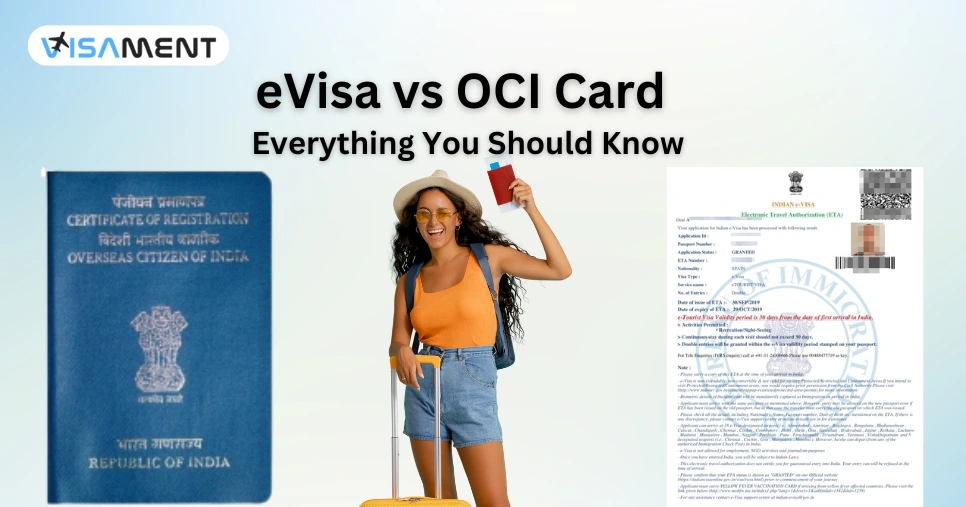
If you are planning to travel to India as a foreign national, you may be wondering whether you need an Indian e-Visa or an OCI Card. The two are not interchangeable: an Indian e-Visa is a visa available to eligible foreign nationals for specified travel purposes, while an OCI Card is available to eligible foreign nationals of Indian origin and provides a multiple-entry lifelong visa facility for visiting India, subject to applicable rules and restrictions.
The right option depends mainly on your nationality, purpose of travel, eligibility for OCI, and how you expect to use the facility. This guide compares the two so you can determine which route is more appropriate for your circumstances.
Key Takeaways
- An Indian e-Visa is intended for eligible foreign nationals visiting India for permitted purposes.
- An OCI Card is available to qualifying foreign nationals with an eligible connection to India.
- An OCI Card provides a multiple-entry lifelong visa facility for visiting India, subject to applicable restrictions.
- An OCI cardholder remains a foreign national and is not an Indian citizen.
- A person who is not eligible for OCI may need an appropriate Indian visa, including an e-Visa where eligible.
- For eligible people with an ongoing need to visit India, OCI can be more suitable than obtaining visas for individual travel needs.
- Always check current eligibility and entry requirements against official Government of India guidance before travel.
Indian e-Visa vs OCI Card at a Glance
| Factor |
Indian e-Visa |
OCI Card |
| What is it? |
An electronic visa for eligible foreign nationals |
A registration/status document for eligible foreign nationals of Indian origin that provides a lifelong visa facility |
| Who can use it? |
Eligible nationals of countries covered by the e-Visa scheme and meeting applicable requirements |
Foreign nationals who meet OCI eligibility criteria |
| Main purpose |
Permitted visits such as tourism, business, medical treatment, and other eligible categories |
Long-term, repeated visits to India by eligible foreign nationals of Indian origin |
| Validity |
Depends on the e-Visa category granted |
Lifelong visa facility, subject to applicable rules |
| Entries |
Depends on the particular e-Visa category |
Multiple entry |
| Indian origin required? |
No, provided the applicant meets the applicable e-Visa requirements |
Generally yes, or another qualifying OCI relationship/category must apply |
| Indian citizenship? |
No |
No |
| Best suited for |
Eligible travelers making a specific visit or visits |
Eligible foreign nationals with an ongoing connection to India |
The exact conditions of an e-Visa depend on its category. The official e-Visa portal currently lists categories including tourist, business, medical, medical attendant, student, transit, and other eligible categories, with different validity and entry conditions.
What Is an Indian e-Visa?
An Indian e-Visa is an electronic visa facility for eligible foreign nationals traveling to India for permitted purposes. The application is submitted online, and an Electronic Travel Authorization (ETA) is issued when the application is approved. The traveler presents the ETA and passport at an immigration checkpoint in India.
The e-Visa system covers several travel purposes. For example, eligible travelers may apply under tourist, business, medical, and other specified categories. The validity, number of entries, and permitted stay depend on the particular e-Visa category rather than being identical for every applicant.
Eligibility also depends on factors such as nationality, passport requirements, and the purpose of travel. Therefore, having a foreign passport does not automatically mean that every type of Indian e-Visa is available.
For detailed requirements, travelers should check the current Indian e-Visa requirements and application guidance before applying.
What Is an OCI Card?
An Overseas Citizen of India (OCI) Card is available to eligible foreign nationals who meet the conditions specified under India's OCI framework. Eligibility can be based on previous Indian citizenship, Indian origin through parents or grandparents, certain family relationships, or other categories specified under the applicable rules.
An important point is that an OCI Card does not confer Indian citizenship. The official OCI guidance expressly describes an OCI cardholder as a foreign national holding a foreign passport.
The OCI framework provides a multiple-entry lifelong visa facility for visiting India, although certain activities may require prior permission and OCI cardholders remain subject to the restrictions applicable to their status.
An OCI Card should therefore be understood as a long-term immigration and travel facility for eligible foreign nationals of Indian origin—not as an Indian passport or a form of Indian citizenship.
Get Expert Help for Your OCI Card Service!
Have questions? Our experts guide you through every step your OCI Card Service – no confusion, no delays.
Consult an Expert Today Key Differences Between Indian e-Visa and OCI Card
The biggest difference is why the person qualifies for the document.
An e-Visa is primarily based on whether a foreign national meets the current requirements for a particular Indian visa category. OCI, by contrast, is based on meeting the statutory eligibility conditions for OCI registration.
1. Eligibility
An e-Visa can be available to eligible foreign nationals from countries covered by India's e-Visa system, provided they satisfy the applicable conditions for the selected category.
OCI eligibility is different. It is linked to qualifying Indian-origin or family circumstances defined under Section 7A of the Citizenship Act and related rules.
2. Purpose
An e-Visa is connected to a particular permitted travel purpose. Depending on the category, this can include tourism, business, medical treatment, attending a conference, and other permitted activities.
OCI is designed for eligible foreign nationals who have an ongoing connection with India and want the benefit of a long-term, multiple-entry visa facility.
3. Validity and repeat travel
The validity of an e-Visa varies by category. For example, the official e-Visa portal currently provides one-month, one-year, and five-year e-Tourist Visa options, with category-specific conditions.
OCI, in contrast, provides a lifelong visa facility for visiting India, subject to applicable requirements and restrictions.
This distinction can be particularly important for someone who expects to travel to India repeatedly over many years.
4. Citizenship status
Neither document makes the holder an Indian citizen.
An e-Visa simply authorizes eligible foreign travel to India under the relevant visa category. An OCI cardholder remains a foreign national, even though OCI provides certain rights and privileges under Indian law.
Do OCI Cardholders Need an Indian e-Visa?
Generally, an OCI cardholder does not need to obtain an Indian e-Visa for ordinary visits to India because the OCI Card itself provides a multiple-entry lifelong visa facility.
However, OCI is subject to conditions and restrictions. Certain activities may require prior permission, and the OCI framework does not give a cardholder unrestricted rights equivalent to those of an Indian citizen. The OCI Portal also states that a passport remains the primary travel document and that an OCI cardholder must have a valid foreign passport while in India.
Therefore, OCI holders should check the current official requirements applicable to their planned activity and travel before departure.
When Is an Indian e-Visa the Better Option?
An Indian e-Visa may be more appropriate when:
- You are not eligible for OCI.
- You are traveling to India for a permitted purpose covered by the e-Visa system.
- You need a visa for a specific trip rather than a long-term India travel facility.
- You meet the current nationality, passport, and other e-Visa requirements.
- You do not have a qualifying Indian-origin connection for OCI.
For example, a foreign traveler visiting India for tourism who has no qualifying Indian-origin relationship may have no reason to pursue OCI. If that traveler meets the current e-Tourist Visa requirements, an e-Visa may be the more relevant route.
The e-Visa portal should always be checked for current nationality eligibility and category-specific requirements before an application is submitted.
When Does an OCI Card Make More Sense?
OCI may be worth considering when you are eligible and expect to maintain an ongoing connection with India.
For example, an eligible former Indian citizen who now holds foreign citizenship and expects to visit India regularly may find the OCI framework more appropriate than relying on individual visa applications.
OCI can also be relevant to eligible children, grandchildren, and certain spouses or other qualifying applicants, depending on the specific eligibility rules.
The key question is not simply whether OCI provides "more benefits." Instead, ask:
Am I eligible for OCI, and do I expect to have an ongoing need to visit India?
If the answer to both is yes, OCI may be the more suitable long-term option. If you are not eligible for OCI, you should instead determine which Indian visa category applies to your circumstances.
Which One Should You Choose?
A simple way to approach the decision is:
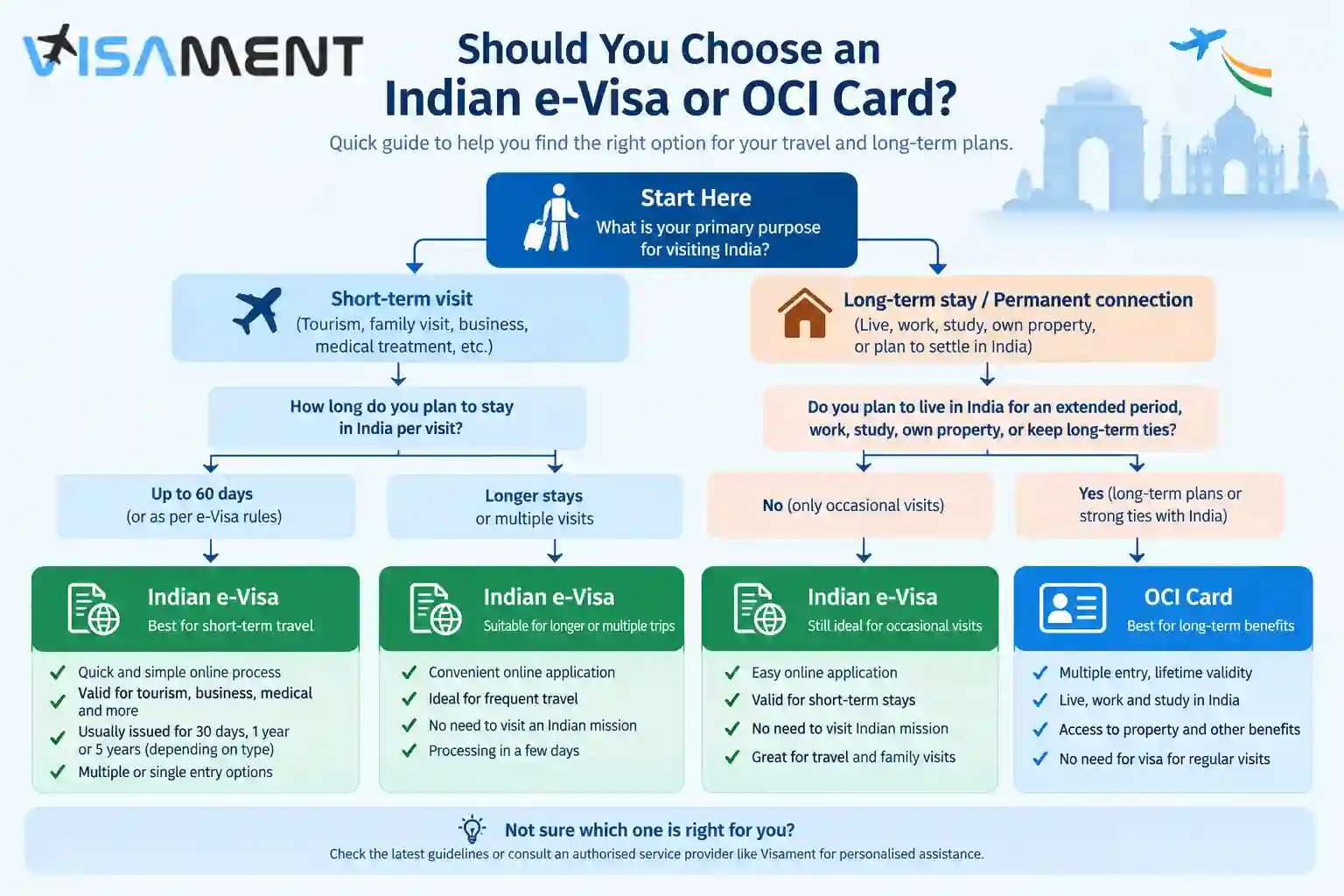
Are you eligible for OCI?
- No: Check whether an Indian e-Visa or another appropriate visa is available for your nationality and travel purpose.
- Yes: Consider whether you have an ongoing need to visit India.
- Occasional or specific-purpose travel: Compare your immediate travel requirements with the applicable visa options.
- Frequent or long-term travel: OCI may provide a more suitable long-term visa facility.
The choice should ultimately be based on eligibility and the purpose of travel, not simply on which document appears to have a longer validity.
Important Things to Check Before Applying
Before choosing between an Indian e-Visa and OCI, verify:
- Your current nationality and passport details.
- Whether your nationality is currently eligible for the relevant e-Visa category.
- Whether you meet the current OCI eligibility requirements.
- Your purpose of travel to India.
- The current validity and entry conditions of the visa category you are considering.
- Any restrictions or prior-permission requirements associated with OCI.
- Current entry requirements published by the Government of India and relevant Indian authorities.
Requirements can change, particularly for immigration and travel documents. Always verify the latest rules before submitting an application or traveling.
Conclusion
The choice between an Indian e-Visa and an OCI Card depends primarily on eligibility and how you intend to travel to India. An e-Visa is for eligible foreign nationals traveling for permitted purposes, while OCI provides eligible foreign nationals of Indian origin with a multiple-entry, lifelong visa facility, subject to applicable rules and restrictions.
If you are eligible for OCI and expect to maintain a long-term connection with India, OCI may be the more appropriate option. If you are not eligible for OCI or need a visa for a specific permitted purpose, check whether an Indian e-Visa is available for your nationality and circumstances.
For either route, verify the latest Government of India requirements before applying or traveling, because visa and immigration rules can change.