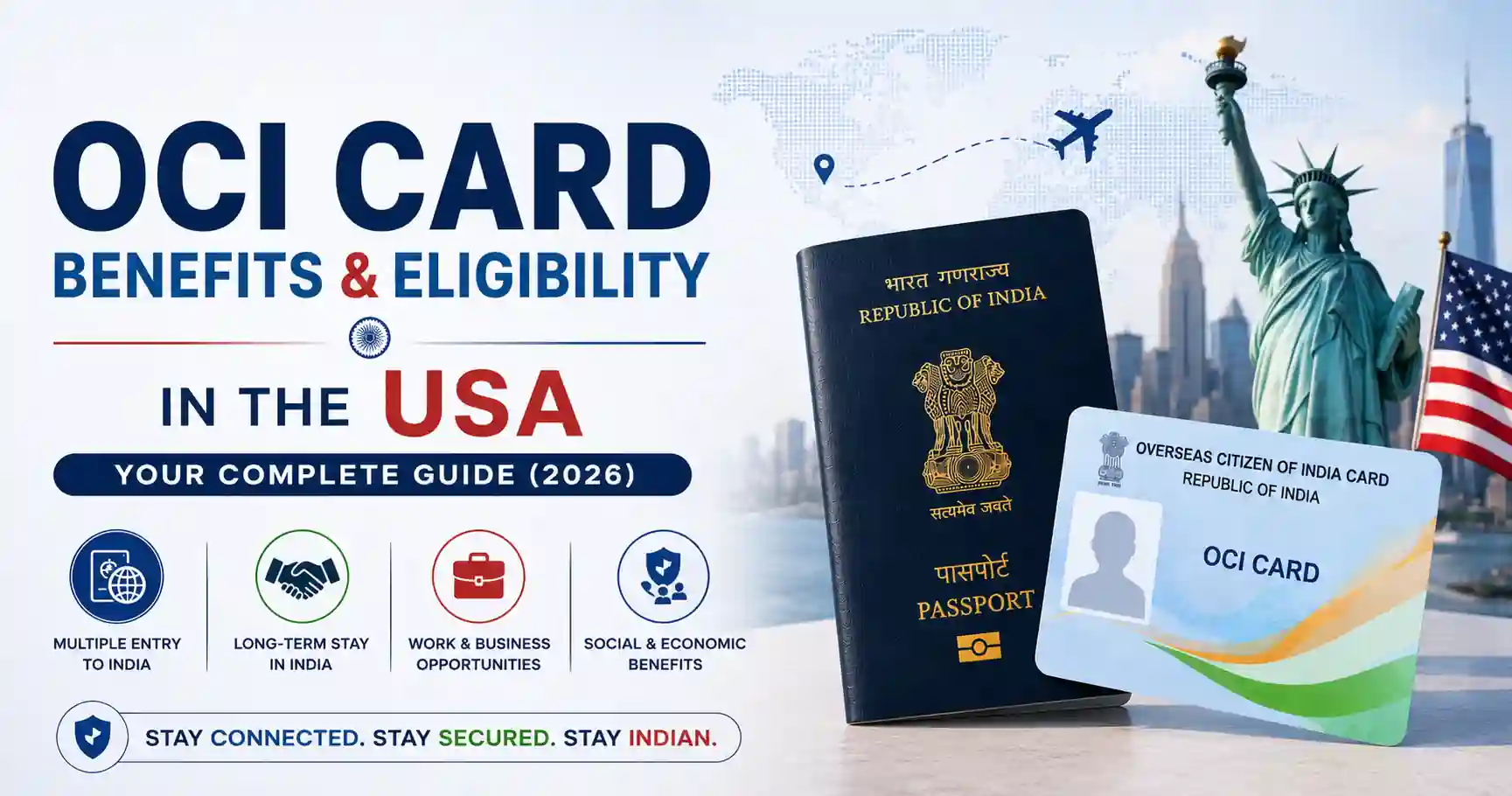
For U.S. citizens of Indian origin, an OCI Card can make long-term travel, family visits, education, employment, and certain property-related activities in India easier. However, OCI is not Indian citizenship. Eligibility depends on your former Indian citizenship, Indian ancestry, parentage, or qualifying spouse relationship under Section 7A of the Citizenship Act, 1955.
This guide explains OCI Card benefits and eligibility for USA-based applicants, including who may qualify, what OCI permits, and which rights remain reserved for Indian citizens.
Key Takeaways
- U.S. citizens may qualify for OCI through former Indian citizenship, eligible Indian ancestry, parentage, or a qualifying foreign-origin spouse relationship.
- An OCI Cardholder remains a foreign national, not an Indian citizen.
- OCI provides a multiple-entry, lifelong visa for visiting India, subject to specified exceptions and permission requirements.
- OCI Cardholders receive specified parity with NRIs in areas such as certain property, education, and professional activities.
- OCI does not provide Indian voting rights or eligibility for constitutional offices.
- OCI Cardholders cannot acquire agricultural land, farmhouses, or plantation properties under the stated OCI privileges.
- Eligibility must be supported by appropriate citizenship, ancestry, parentage, or marriage documentation.
Who Is Eligible for an OCI Card in the USA?
The fact that an applicant lives in the United States does not itself create OCI card eligibility. The applicant must fall within one of the eligibility categories established under Section 7A.
Former Indian Citizens
A U.S. citizen who was an Indian citizen on or after January 26, 1950, can fall within an OCI eligibility category, subject to the applicable requirements and restrictions.
This is a common route for Indian citizens who later became U.S. citizens.
Children, Grandchildren and Great-Grandchildren
Certain foreign citizens who are children, grandchildren, or great-grandchildren of qualifying Indian citizens may also be eligible.
Applicants using an ancestry-based route should be prepared to establish the relevant family relationship and the Indian citizenship or qualifying status of the ancestor. The exact evidence depends on the applicant's circumstances.
Minor Children
A minor child can qualify where the child meets the applicable Section 7A conditions. This includes certain children of qualifying persons and a minor child whose both parents are Indian citizens or one parent is an Indian citizen.
For U.S.-born children, parents should distinguish the child's U.S. citizenship from the child's potential OCI eligibility. The two are separate legal concepts.
Foreign-Origin Spouse
A foreign-origin spouse of an Indian citizen or an OCI Cardholder registered under Section 7A may qualify for OCI if the marriage has been registered and has subsisted continuously for at least two years immediately before the application. Such spouse-based applications are also subject to prior security clearance.
Who May Be Excluded?
The OCI framework contains an important ancestry restriction. A person is not eligible if the person, or either of the person's parents, grandparents, or great-grandparents, is or was a citizen of Pakistan, Bangladesh, or another country specifically notified by the Central Government.
Because eligibility can depend on several generations of family history, applicants should verify the current official requirements rather than relying only on a family description.
What Are the Main OCI Card Benefits for U.S. Citizens?
The OCI scheme provides several important benefits to eligible foreign nationals.
1. Multiple-Entry Lifelong Visa
An OCI Cardholder receives a multiple-entry lifelong visa for visiting India. This is one of the primary practical advantages for U.S. citizens who regularly travel to India.
The benefit should not be interpreted as unlimited permission to conduct every activity in India. Certain activities require prior permission, as discussed below.
2. Exemption From Routine Registration
OCI Cardholders are generally exempt from registration with the Foreigners Regional Registration Officer (FRRO) or Foreigners Registration Officer (FRO) for any length of stay in India under the applicable OCI framework.
This can be particularly useful for U.S. citizens who spend extended periods in India.
3. Certain Property Rights
OCI Cardholders have specified parity with Non-Resident Indians (NRIs) for the purchase or sale of immovable property, but this does not extend to agricultural land, farmhouses, or plantation properties.
Property transactions can involve additional FEMA and other legal requirements, so a specific transaction should be reviewed under the rules applicable at the time.
4. Education and Entrance Examinations
OCI Cardholders receive specified parity with NRIs for certain educational matters. The official OCI framework includes eligibility to appear for entrance examinations such as NEET, JEE Main and JEE Advanced for admission against an NRI seat or supernumerary seat, but not seats reserved exclusively for Indian citizens.
5. Employment and Certain Professional Activities
OCI Cardholders can take up employment in India under the applicable OCI framework without requiring an ordinary employment visa for that employment. However, specific professions and activities remain subject to the applicable laws and regulations.
The OCI framework also provides specified professional rights, including in areas such as medicine, dentistry, nursing, pharmacy, law, architecture and chartered accountancy, subject to the relevant professional legislation and requirements.
What an OCI Card Does Not Allow
OCI should not be treated as a substitute for Indian citizenship.
An OCI Cardholder does not have the following rights available to Indian citizens:
| Area |
OCI position |
| Voting in Indian elections |
Not permitted |
| Membership of Parliament |
Not permitted |
| Membership of State legislatures |
Not permitted |
| Certain constitutional offices |
Not permitted |
| General Indian public-service employment |
Not available except where specifically permitted |
| Agricultural land |
Cannot acquire under the stated OCI privileges |
| Farmhouse |
Cannot acquire under the stated OCI privileges |
| Plantation property |
Cannot acquire under the stated OCI privileges |
The official OCI guidance specifically excludes voting, membership of Parliament or State legislatures, specified constitutional posts and general public-service appointments.
Therefore, an OCI Cardholder should not describe the status as Indian citizenship or unrestricted dual citizenship.
Activities That May Require Special Permission
The lifelong multiple-entry visa does not mean an OCI Cardholder can undertake every activity in India without prior approval.
The OCI framework provides special-permission requirements for certain activities, including specified research, missionary or Tabligh activities, mountaineering, journalism, internships or employment involving foreign diplomatic missions or governments, and visits to protected, restricted or prohibited areas.
Applicants planning such activities should check the latest OCI and immigration requirements before beginning them.
Is OCI Suitable for a U.S. Citizen of Indian Origin?
Consider these examples as general illustrations, not individual eligibility determinations:
- Former Indian citizen: A person who became a U.S. citizen after previously holding Indian citizenship may fall under the former-Indian-citizen category.
- U.S.-born child: A child born in the United States with an Indian citizen parent may fall within an applicable minor-child category.
- Indian ancestry: A U.S. citizen with a qualifying Indian parent, grandparent, or great-grandparent may potentially qualify through the ancestry provisions.
- Foreign-origin spouse: A U.S. citizen married to an Indian citizen, or qualifying OCI Cardholder may potentially qualify after meeting the registered-marriage and continuous two-year requirement.
In each case, documentary evidence and the applicable statutory requirements determine eligibility. A family connection alone should not be treated as automatic approval.
What Should You Check Before Applying?
Before beginning an OCI application from the United States, check:
- Your current valid U.S. passport and citizenship records.
- Evidence establishing your former Indian citizenship or Indian ancestry, where applicable.
- Birth records establishing parent-child relationships.
- Marriage registration and supporting records for a spouse-based application.
- Citizenship history and any previous Indian passport or citizenship documentation.
- Current OCI requirements published by the Government of India and the Indian Mission having jurisdiction over your application.
For detailed requirements, use the relevant OCI application process and OCI document checklist resources rather than relying on a general eligibility article.
Conclusion
For U.S. citizens with Indian connections, OCI can provide substantial practical benefits, particularly for frequent or extended travel to India. The key is to separate OCI status from Indian citizenship: eligibility is determined under Section 7A, while the benefits and limitations are defined under the OCI framework and related government notifications.
Before applying, confirm your eligibility category, family-history evidence, and current requirements through the official OCI Services portal and the Indian Mission responsible for your U.S. jurisdiction. Government guidance can change, so current requirements should be checked before submission.