Related Blogs

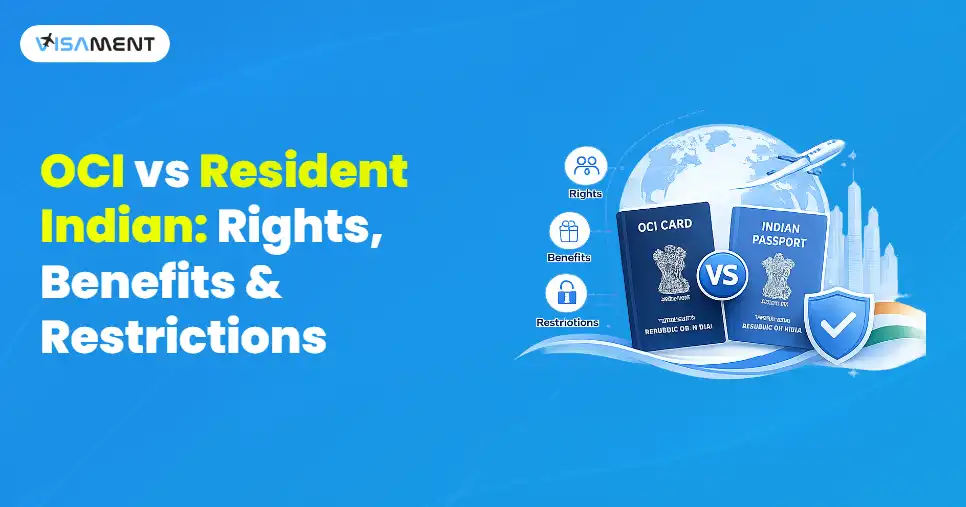
Most of the individuals of Indian origin living in a foreign country often want to know what rights they get with an OCI (Overseas Citizen of India) card. They also want to compare their rights with those of a Resident Indian citizen. Although the OCI card offers many long-term benefits, it is not similar to full Indian citizenship. It is important to understand these differences before applying for an OCI card or planning work, studies, long-term status, or investments in India.
In this guide, we have explained the major differences between an OCI cardholder and a Resident Indian citizen. With the simplified format, you can compare both residential statuses based on various rights.
An Overseas Citizen of India (OCI) cardholder is a foreign citizen of Indian origin who gets lifelong visa and some specific economic and educational benefits in India. There are some limitations to the OCI cardholder, such as they cannot access political or constitutional rights similar to Indian citizen. With an OCI card, its holders do not need to make repeated visa applications and can still stay for the long term in India.
In this table, we have compared the OCI cardholders and Resident Indian Citizens based on various Rights and Benefits:
| Rights & Benefits | OCI Cardholder | Resident Indian Citizen |
|---|---|---|
| Indian Citizenship Status | No | Yes |
| Lifetime Visa to India | Yes | Not Required |
| Multiple Entry to India | Yes | Yes |
| Voting Rights in India | No | Yes |
| Can Contest in Elections | No | Yes |
| Eligible to participate in Government Jobs | Limited/No for most job posts | Yes |
| Can hold an Indian Passport | No | Yes |
| Foreign Passport Allowed | Yes | Dual citizenship is not allowed |
| Purchase Residential Property | Yes | Yes |
| Purchase Agricultural Land | No | Yes |
| Can work and conduct Business in India | Yes | Yes |
| PAN Card Eligibility | Yes | Yes |
| Aadhaar Eligibility | Subject to conditions | Yes |
| Access to NRE/NRO Bank Accounts | Yes | NRO is not applicable as a resident |
| Need FRRO Registration for Long Stay | No | No |
| Eligible for Scholarships/Government Benefits | Limited | Yes |
| Access to Protected/Restricted Areas | Requires Permission | Easier access depending on the rules |
| Adoption Rights | Permitted under the applicable laws | Permitted |
| Study in India | Yes | Yes |
| Political Rights | No | Full Rights |
One of the best advantages of an OCI card is that it provides a lifelong Visa-free entry to India. The OCI cardholders can enter India various times without applying for their separate visas for family visits, tourism, business activities, or studies. However, the resident Indian citizens do not need visas because they are Indian nationals.
The OCI cardholders are allowed to purchase:
However, they cannot directly purchase the following:
All the resident Indians can easily purchase all the categories of property in India, including the plantation and agricultural properties.
 Also Want to Know About OCI Card Reissue After Divorce? Check Now!
The OCI cardholders can:
However, the OCI cardholders cannot usually apply for:
The Resident Indian citizens do not have such types of restrictions.
There is one of the biggest differences between the OCI cardholders and Resident Indian citizens.
The OCI cardholders cannot do the following activities:
The OCI cardholders usually get parity with NRIs in:
However, some reservations, subsidies, and government scholarship benefits are only applicable to Indian citizens.
The OCI cardholders are eligible to perform the following actions:
The resident Indians mainly use their resident account savings, and they have different FEMA compliance rules.
Also Want to Know About Protected & Restricted Areas in India for OCI? Check Now!An OCI cardholder:
All the Resident Indian Citizens can have Indian passports and retain full rights of their citizenship.
There are many limitations of the OCI status, such as:
There are many advantages of an OCI card for people of Indian origin. They should be:
However, the OCI card is not a replacement for full Indian citizenship because most of the important political rights and constitutional rights remain restricted.
An OCI card offers significant convenience and long-term benefits for foreign citizens of Indian origin, especially for property ownership, travel, family connections, and business in India. However, an OCI card cannot provide its holders the same rights as a resident Indian citizen. It is necessary to know the benefits and limitations of the OCI card before applying for its status. The decision between OCI status and full Indian citizenship depends on your nationality, residency plans, long-term goals, and financial interests connected to India.
You can also take assistance from the authorised service providers, such as Visament. We have a team of experienced professionals who can provide guidance on OCI cards and assist you with the application process.
No, India does not allow dual citizenship. OCI is not citizenship; it is only a special immigration and residency status.
Yes, the OCI cardholders are allowed to work and conduct business activities in India except for some restricted government positions.
No, the OCI cardholders cannot apply for an Indian passport. They must use their foreign passport to travel to India along with their OCI card.
No, the OCI cardholders do not need a visa for India. The OCI card provides a lifelong multiple-entry visa facility for India.
Vipul Jain is the Co-Founder of Visament, a trusted platform dedicated to simplifying Indian immigration, consular, and NRI services for applicants across the globe. With extensive expertise in OCI cards, Indian passport services, visa assistance, apostille and document legalization,... See Full Bio

Talk to our documentation experts for free guidance on your application.
What is OCI? Meaning, OCI Card Benefits & Eligibility
Difference Between PIO & OCI: Key Differences and Current Status
Indian eVisa vs OCI Card: What Is the Difference and Which Do You Need?
OCI Property Ownership in India: What Can OCI Cardholders Own?
OCI Card for NRIs: Eligibility, Requirements & How It Works
When you visit a website, it may store data about you using cookies and similar technologies. Cookies can be important for the basic operations of the website and for other purposes. You get the option of deactivating certain types of cookies, even so, doing that may affect your experience on the website.
It is required to permit the basic functionality of the website. You may not disable necessary cookies.
Used to provide advertising that matches you and your interests. May also be used to restrict the number of times you see an advertisement and estimate the effectiveness of an advertising campaign. The advertising networks place them after obtaining the operator's permission.
Permits the website to recognize the choices you make (like your username, language, or the region you are in). Also provides more personalized and enhanced features.
Aid the website operator to determine how the website performs, how visitors interact with the site, and whether there are any technical issues.