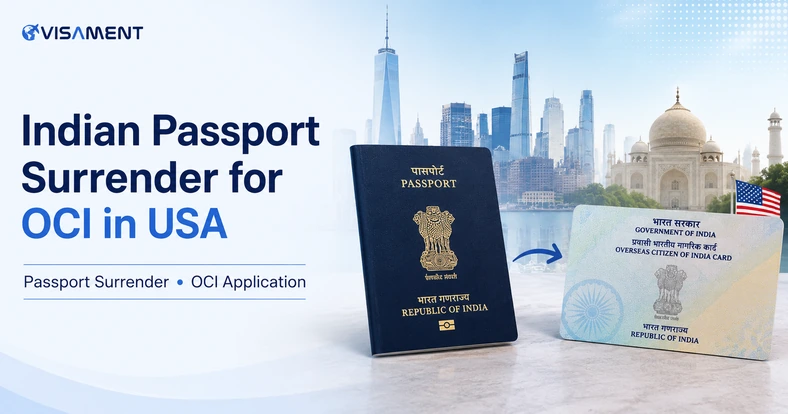
If you are a foreign citizen of Indian origin, you may have come across the term OCI while researching travel, residence, property, work, or long-term connections with India. But what exactly is OCI, and does an OCI Card give you Indian citizenship?
OCI stands for Overseas Citizen of India. An OCI Card is a status available to eligible foreign nationals of Indian origin that provides specific immigration, travel, economic, educational and other benefits in India. However, an OCI Cardholder remains a foreign national and does not become an Indian citizen.
Understanding this distinction is important before applying. This guide explains what OCI means, who can apply for an OCI Card, OCI eligibility, benefits and restrictions, required documents, application process, fees, processing time, and how OCI differs from Indian citizenship, NRI and PIO status.
Key Takeaways
-
OCI means Overseas Citizen of India.
-
An OCI Cardholder is a foreign national, not an Indian citizen.
-
OCI provides a multiple-entry lifelong visa for visiting India, subject to applicable restrictions and special-permission requirements.
-
Certain former Indian citizens, descendants of eligible Indian citizens, qualifying minor children and qualifying foreign-origin spouses may be eligible for OCI registration.
-
OCI Cardholders cannot vote in Indian elections or hold specified constitutional offices.
-
OCI provides specific rights and privileges but is not dual Indian citizenship.
-
OCI Cardholders can generally purchase residential and commercial property in India, subject to applicable rules, but cannot generally acquire agricultural land, farmhouses or plantation property.
-
OCI applications are submitted online through the official OCI system.
-
Since July 8, 2026, new OCI applicants have been issued digital e-OCI Cards under the current system.
What Does OCI Stand For?
OCI stands for Overseas Citizen of India.
The OCI scheme was introduced in 2005 for eligible people of Indian origin who hold foreign citizenship. The scheme provides certain rights and privileges in India while allowing the person to retain their foreign citizenship.
The term can be confusing because of the word "Citizen." An OCI Cardholder is not an Indian citizen. The person remains a citizen of the foreign country whose passport they hold.
OCI registration instead provides specified immigration, travel, economic, educational and other privileges under Indian law.
This distinction matters when considering voting rights, public employment, property ownership, constitutional offices, Indian passport eligibility and other rights reserved for Indian citizens.
Is an OCI Card the Same as Indian Citizenship?
No. OCI is not the same as Indian citizenship.
An OCI Cardholder is a foreign national holding a foreign passport. OCI registration does not automatically restore or grant Indian citizenship.
| OCI Cardholder |
Indian Citizen |
| Holds foreign citizenship |
Holds Indian citizenship |
| Uses a foreign passport |
Eligible for an Indian passport |
| Receives specified OCI rights and privileges |
Has the rights of Indian citizenship, subject to law |
| Cannot vote in Indian elections |
Can vote if otherwise eligible |
| Cannot hold specified constitutional offices |
May be eligible for constitutional offices subject to applicable requirements |
| Generally cannot acquire agricultural land, farmhouses or plantation property under OCI privileges |
Property rights are governed by rules applicable to Indian citizens |
An OCI Card can therefore provide a strong connection to India without making the holder an Indian citizen.
Who Can Get an OCI Card?
OCI eligibility is principally governed by Section 7A of the Citizenship Act, 1955.
Broadly, eligible foreign nationals can include:
-
A foreign citizen who was an Indian citizen at any time on or after January 26, 1950.
-
A foreign citizen who was eligible to become an Indian citizen on January 26, 1950.
-
A foreign citizen who belonged to a territory that became part of India after August 15, 1947.
-
A child, grandchild or great-grandchild of a person meeting the relevant eligibility criteria.
-
A minor child of an eligible person.
-
A minor child whose parents meet the specified Indian citizenship conditions.
-
A qualifying foreign-origin spouse of an Indian citizen or OCI Cardholder, where the applicable marriage requirements are satisfied.
For a foreign-origin spouse, the current OCI guidance requires the marriage to have been registered and continuously subsisting for at least two years immediately before the application.
Who Cannot Apply for OCI?
There are statutory exclusions from OCI eligibility.
For example, a person may not be eligible if they, or their parents, grandparents or great-grandparents, are or were citizens of Pakistan, Bangladesh or another country specifically notified by the Central Government.
Because OCI eligibility can depend on ancestry, citizenship history, family relationships and the applicant's circumstances, applicants should verify their specific eligibility against the latest official OCI requirements before applying.
What Are the Benefits of an OCI Card?
An OCI Card provides eligible foreign citizens of Indian origin with several important benefits.
1. Multiple-Entry Lifelong Visa
One of the main benefits of OCI is the multiple-entry lifelong visa for visiting India.
This allows OCI Cardholders to travel to India repeatedly without applying for a separate Indian visa for every visit, subject to applicable rules and special-permission requirements.
2. Exemption From FRRO/FRO Registration
OCI Cardholders are generally exempt from registration with the Foreigners Regional Registration Officer (FRRO) or Foreigners Registration Officer (FRO) for their stay in India.
However, OCI Cardholders residing in India may have reporting requirements when certain personal details, such as their permanent address or occupation, change.
3. Certain Economic, Financial and Educational Benefits
OCI Cardholders receive specified parity with NRIs in certain financial, economic and educational matters.
These benefits can include specified treatment relating to:
-
Purchase or sale of permitted immovable property
-
Certain educational opportunities
-
Certain professional activities
-
Specified entrance examinations and admissions
These rights are subject to the applicable law, regulations and notifications. OCI should not be interpreted as providing unrestricted rights equivalent to Indian citizenship.
4. Can OCI Cardholders Work in India?
Yes, OCI Cardholders can undertake employment in India where permitted under the applicable OCI rules and generally do not need a separate employment visa for permitted employment.
However, certain activities require prior permission or a Special Permit.
These can include activities such as:
-
Research
-
Missionary activities
-
Tabligh
-
Mountaineering
-
Journalism
-
Certain internships or employment with foreign diplomatic missions
-
Certain activities involving foreign government organisations in India
-
Visits to Protected or Restricted Areas
Applicants planning specialized or regulated professional activities should verify the latest requirements before beginning the activity.
5. Can OCI Cardholders Buy Property in India?
OCI Cardholders can generally purchase or sell permitted immovable property in India, subject to applicable laws and regulations.
OCI privileges generally extend to residential and commercial property but do not generally allow the acquisition of:
-
Agricultural land
-
Farmhouses
-
Plantation property
Property transactions can also involve separate foreign-exchange and regulatory requirements. Therefore, OCI status should not be treated as the only factor when planning an Indian property transaction.
Can OCI Cardholders Buy Property in India?
What Can OCI Cardholders Not Do?
OCI provides important benefits, but it does not provide the full rights of Indian citizenship.
Political and Constitutional Restrictions
OCI Cardholders cannot:
-
Vote in Indian elections
-
Become members of Parliament
-
Become members of a State Legislative Assembly
-
Become members of a State Legislative Council
-
Hold specified constitutional offices such as President or Vice President
-
Serve as Judges of the Supreme Court or High Courts
OCI Cardholders are also generally not entitled to appointment to public services and posts connected with the affairs of the Union or a State, except where specifically permitted.
Property Restrictions
OCI Cardholders cannot generally acquire:
-
Agricultural land
-
Farmhouses
-
Plantation property
They may, however, acquire permitted residential and commercial property subject to applicable laws.
Activities Requiring Special Permission
Certain activities may require prior permission from the appropriate authorities, including:
-
Research
-
Missionary activities
-
Tabligh
-
Mountaineering
-
Journalism
-
Certain internships
-
Certain employment with foreign diplomatic missions
-
Certain foreign government-related activities
-
Visits to Protected or Restricted Areas
The exact requirements should be checked against the current OCI rules before undertaking such activities.
How to Apply for an OCI Card
The OCI application process starts online through the official OCI Services portal. Applicants should first confirm their eligibility and then prepare the documents relevant to their eligibility category.
Step 1: Complete the OCI Online Application
OCI registration applications are submitted through the official online OCI system.
Applicants should:
-
Create an account on the OCI portal.
-
Enter personal information.
-
Enter details exactly as shown on the current foreign passport.
-
Complete the required application information.
-
Upload the required documents, photograph and signature.
-
Review the information carefully before submission.
The official OCI registration system specifically instructs applicants to enter details according to their current passport and use an active email address.
Step 2: Upload the Required OCI Documents
The exact OCI required documents depend on the basis of the application.
Common documents can include:
-
Current valid foreign passport
-
Citizenship or naturalization certificate
-
Surrendered/cancelled Indian passport and Surrender Certificate, where applicable
-
Proof of Indian origin
-
Birth certificate, where applicable
-
Marriage certificate, where applicable
-
Proof of address
-
Other supporting documents required for the applicant's eligibility category
The official OCI FAQ specifies a current passport with at least six months' validity at the time of submission and supporting evidence of citizenship, Indian origin and address, as applicable.
Step 3: Upload the OCI Photograph and Signature
The OCI photograph requirements are important because incorrect photographs can result in rejection or processing delays.
The official OCI guidance specifies a square photograph with minimum dimensions of 51 mm × 51 mm, approximately 80% face coverage, and prescribed digital image dimensions. The photograph and signature must be uploaded in JPEG/JPG format within the specified size limits.
Always check the current official photo specifications before uploading your image.
Step 4: Pay the OCI Application Fee
The OCI application fee depends on where the application is submitted.
The official OCI FAQ currently lists a fee of US$275 or equivalent local currency for applications submitted through an Indian Mission/Post abroad, while applications submitted in India are charged the equivalent amount in INR.
Additional service or outsourcing charges may apply depending on the country and submission arrangement.
Applicants should check the applicable jurisdiction-specific fee before making payment.
Step 5: Submit Original Documents for Verification
After completing the online OCI application and uploading the required documents, applicants may be required to present the original supporting documents for verification to the relevant Indian Mission/Post or FRRO, depending on where they apply.
The official OCI FAQ states that applicants generally need to bring the originals for prior verification rather than bringing printed copies of all uploaded documents.
Step 6: Track Your OCI Application Status
Applicants can use the official OCI Status Enquiry facility to check the status of applications submitted through Indian Missions or FRROs.
When checking your OCI application status, keep your application details available and use the official OCI portal rather than relying on third-party status websites.
Step 7: Receive Your OCI / e-OCI
OCI processing time can vary depending on the application, verification requirements and jurisdiction.
The official OCI FAQ states that registration normally takes about 30 days from acknowledgement of the application on the online system, although actual timelines can vary depending on circumstances.
Important 2026 Update: e-OCI Card
The Government of India introduced the e-OCI facility in 2026.
According to current Indian consular guidance, from July 8, 2026, only digital OCI Cards (e-OCI) are being issued to new OCI applicants. Existing physical OCI Cards remain valid, and eligible OCI Cardholders can generate and store their digital OCI Card on a mobile device.
The introduction of e-OCI does not change the underlying OCI eligibility or application process.
OCI Application in the USA
If you are applying for an OCI Card in the USA, you should follow the instructions applicable to your Indian Mission and the authorized service provider for your jurisdiction.
The submission process can involve VFS Global, depending on the relevant US jurisdiction. For example, current Indian consular guidance states that VFS Global is the authorized outsourcing service provider for OCI services in the relevant US jurisdiction.
Applicants in the USA should therefore verify:
-
Current OCI application requirements
-
Jurisdiction
-
Document checklist
-
Applicable OCI fee
-
VFS submission procedure
-
Appointment or mailing requirements
-
Current processing instructions
-
e-OCI requirements
OCI vs NRI vs Indian Citizen
These three terms describe different legal situations.
| Status |
Basic Meaning |
Citizenship |
Passport |
| OCI Cardholder |
Eligible foreign national with OCI registration |
Foreign citizenship |
Foreign passport |
| NRI |
Indian citizen residing outside India under applicable definitions |
Indian citizenship |
Indian passport |
| Indian Citizen |
Person who holds Indian citizenship |
Indian citizenship |
Indian passport |
An NRI is an Indian citizen living outside India under the applicable legal definition.
An OCI Cardholder is a foreign national who has OCI registration.
This distinction can affect immigration, taxation, property transactions, banking, financial regulations and other legal matters.
OCI vs PIO: What's the Difference?
The PIO and OCI schemes are not the same.
PIO refers to the former Person of Indian Origin card scheme, while OCI is the current Overseas Citizen of India registration framework.
The Government of India discontinued the PIO-to-OCI conversion facility after December 31, 2025. PIO cardholders who need OCI registration are now advised to apply afresh under the applicable OCI requirements.
Therefore, applicants should not rely on older articles that describe an ongoing PIO-to-OCI conversion facility.
How Long Is an OCI Card Valid?
OCI status provides a lifelong multiple-entry visa framework for visiting India, subject to applicable rules.
However, an OCI Cardholder must travel with a valid foreign passport.
OCI Cardholders should also follow the current requirements for updating passport and personal information in the OCI system when applicable.
Can OCI Cardholders Live in India Permanently?
OCI status allows eligible foreign nationals to visit and remain in India under the lifelong multiple-entry visa framework.
However, OCI is not Indian citizenship.
An OCI Cardholder does not receive citizenship rights such as voting or eligibility for specified constitutional offices.
Anyone planning to relocate to India permanently should separately consider immigration, tax residency, property, banking and other legal implications.
Can OCI Cardholders Open a Bank Account in India?
OCI status can allow eligible individuals to maintain financial relationships and accounts in India, subject to applicable banking, foreign-exchange and KYC rules.
The type of account and applicable requirements depend on the person's citizenship, residential status, tax status and banking circumstances.
OCI status alone does not determine whether a person should hold a resident, NRE or NRO account.
Do OCI Cardholders Have to Pay Tax in India?
OCI status does not itself provide a tax exemption.
Tax liability depends on the person's income, residential status, source of income and the applicable Indian tax rules.
For example, income arising in India may have Indian tax implications even if the individual is an OCI Cardholder.
Cross-border taxpayers should separately evaluate Indian tax residency, foreign income, DTAA provisions and applicable reporting obligations.
What Happens to an OCI Card When the Passport Expires?
An OCI Cardholder remains a foreign citizen and must use the OCI status with a valid foreign passport.
When obtaining a new passport, applicants should check the current OCI requirements for updating passport details and ensure that the OCI information is properly updated where required.
Keeping passport and OCI information current can help avoid issues during international travel and immigration checks.
Can OCI Cardholders Work in India?
Yes. OCI Cardholders can generally undertake permitted employment in India without obtaining a separate employment visa.
However, this does not mean that OCI holders have unrestricted employment rights.
Certain activities and regulated professions may require additional permission, registration, qualifications or compliance with Indian laws.
Can OCI Cardholders Vote in India?
No.
OCI Cardholders cannot vote in Indian elections because they remain foreign citizens.
OCI also does not give a person the same political or constitutional rights as Indian citizenship.
Can OCI Cardholders Become Indian Citizens?
OCI registration itself does not make a person an Indian citizen.
However, the official OCI FAQ states that an OCI Cardholder may be eligible to apply for Indian citizenship under the applicable provisions of the Citizenship Act after satisfying the prescribed conditions, including the relevant period of OCI registration and residence in India.
Citizenship is therefore a separate legal process from OCI registration.
Conclusion
OCI means Overseas Citizen of India. It is a legal status available to eligible foreign nationals of Indian origin and provides important travel, immigration, economic, educational and other privileges in India.
However, an OCI Cardholder remains a foreign citizen and does not receive the full rights of Indian citizenship.
Before applying for an OCI Card, it is important to determine your OCI eligibility, understand the required documents, verify the applicable fee and follow the current application procedure for your jurisdiction.
If you are applying from the USA or another country, also check the latest instructions of the relevant Indian Mission, Post or authorized service provider because submission procedures can vary by jurisdiction.
For help with your OCI Card application, eligibility, documents, application process or USA-specific requirements, explore Visament's OCI services and application guides before submitting your application.