Related Blogs

Living outside India can make managing Indian income, overseas earnings and savings more complicated than it needs to be. A Bank of Baroda NRI Account can help eligible non-resident customers manage their finances in India, but the right account depends on where your money comes from and how you plan to use it.
Bank of Baroda offers several NRI banking options, including NRE, NRO and FCNR(B) accounts and deposits. This guide explains the main differences, eligibility, documents and account-opening process so you can identify the option that fits your needs.
A Bank of Baroda NRI account is an account or deposit product designed for eligible non-resident customers to manage funds connected with India and their overseas earnings.
The bank's current NRI banking portfolio includes NRE savings and current accounts, NRO savings and current accounts, NRE and NRO fixed deposits, FCNR(B) deposits and other specialized NRI products.
The most important decision is therefore not simply whether to open an NRI account, but which type of account matches your source of funds, currency requirements and repatriation needs.
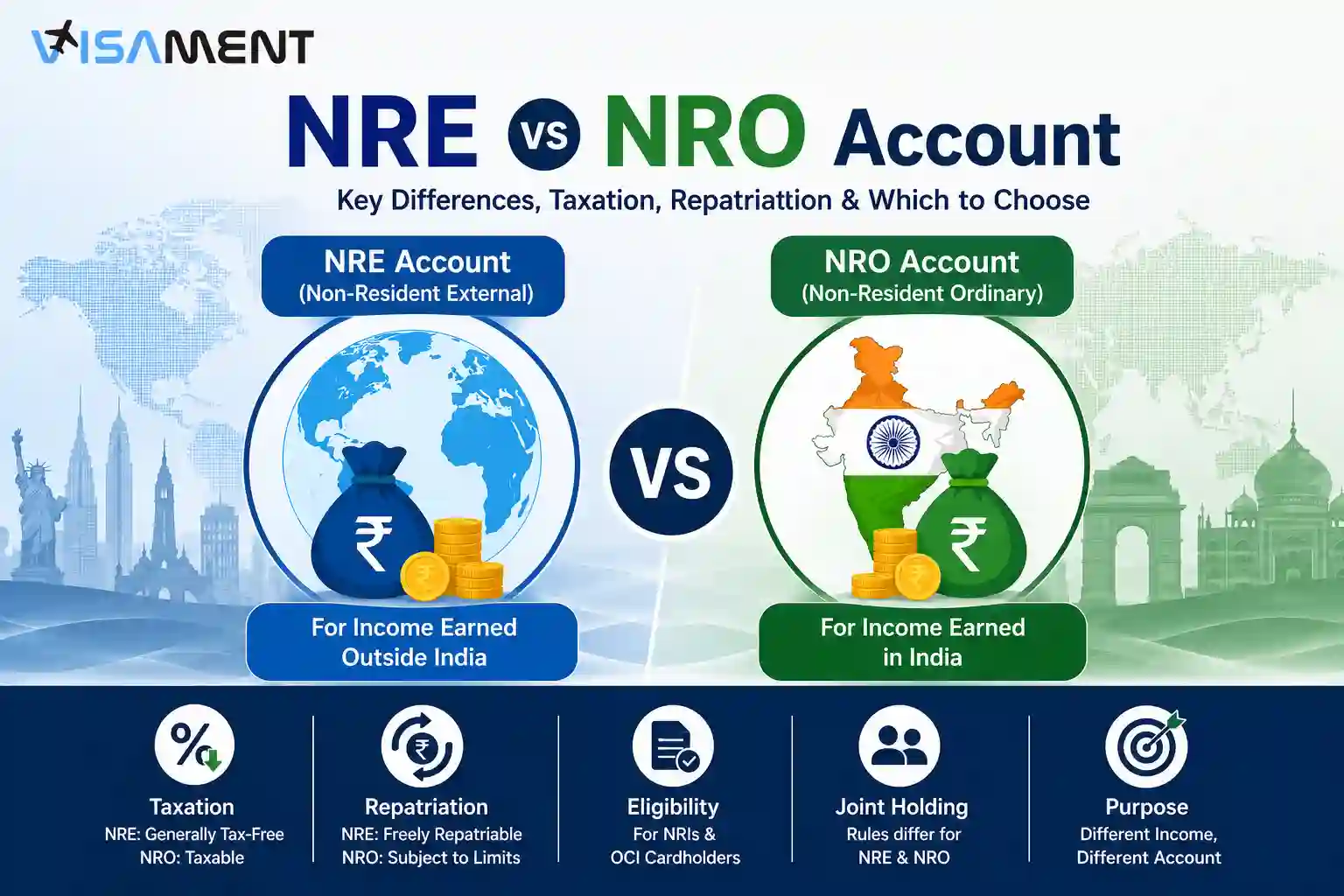
An NRE (Non-Resident External) account is a rupee-denominated account generally used for funds transferred from overseas. Bank of Baroda offers NRE savings, current and fixed-deposit products. Its NRE savings account can receive eligible inward remittances through normal banking channels and certain transfers from other NRE or FCNR accounts.
An NRE account can be useful when an NRI wants to hold overseas earnings in India while retaining the applicable repatriation facility.
An NRO (Non-Resident Ordinary) account is generally used to manage legitimate income or funds arising in India. Bank of Baroda offers NRO savings, current and fixed-deposit products.
For example, an NRI receiving eligible Indian income may use an NRO account to manage those rupee funds. The applicable repatriation and tax rules should be checked before transferring money outside India.
An FCNR(B) deposit is a foreign-currency term deposit for eligible non-resident customers. Bank of Baroda currently lists FCNR(B) deposits in designated currencies including USD, GBP, EUR, AUD and CAD. The bank states that principal and interest held in its FCNR deposits can be repatriated in foreign currency, subject to applicable rules and product conditions.
Unlike an NRE or NRO savings account, FCNR(B) account is specifically a term-deposit product, so it is more relevant when maintaining eligible savings in a designated foreign currency is important.
The simplest way to approach the choice is to consider where the money comes from and what you need to do with it.
|
Account type |
Main purpose |
Currency |
Typical use |
|---|---|---|---|
|
NRE |
Managing eligible overseas funds in India |
Indian rupee |
Overseas earnings and savings |
|
NRO |
Managing eligible income/funds arising in India |
Indian rupee |
Rent, pension and other Indian income |
|
FCNR(B) |
Holding eligible deposits in foreign currency |
Designated foreign currencies |
Foreign-currency term deposits |
These are broad distinctions rather than personalized financial advice. The exact features, eligibility, taxation and repatriation conditions depend on the applicable rules and the Bank of Baroda product you select.
If you are unsure whether an NRE or NRO account is appropriate, review the specific product conditions before transferring funds.
Eligibility depends on the specific account or deposit product.
Bank of Baroda's NRI account-opening information states that eligible NRIs and Persons of Indian Origin (PIOs) can open specified NRE/FCNR products, subject to the bank's requirements. The bank also provides NRI services and products for different customer categories.
Before applying, check:
Overseas Citizen of India (OCI) Card holders should also verify the eligibility conditions applicable to the particular product rather than assuming that every NRI product has identical rules.
 Also Want to Know About NRI Buying Property in India Check Now!
The exact documentation depends on the account and the bank's current KYC requirements. Common documentation may include:
Bank of Baroda advises customers to check the documents required by the financial institution because requirements can vary.
Before submitting an application, make sure your personal details are consistent across your identification and address documents. If a document needs certification, attestation or verification, follow the bank's current instructions rather than relying on an older checklist.
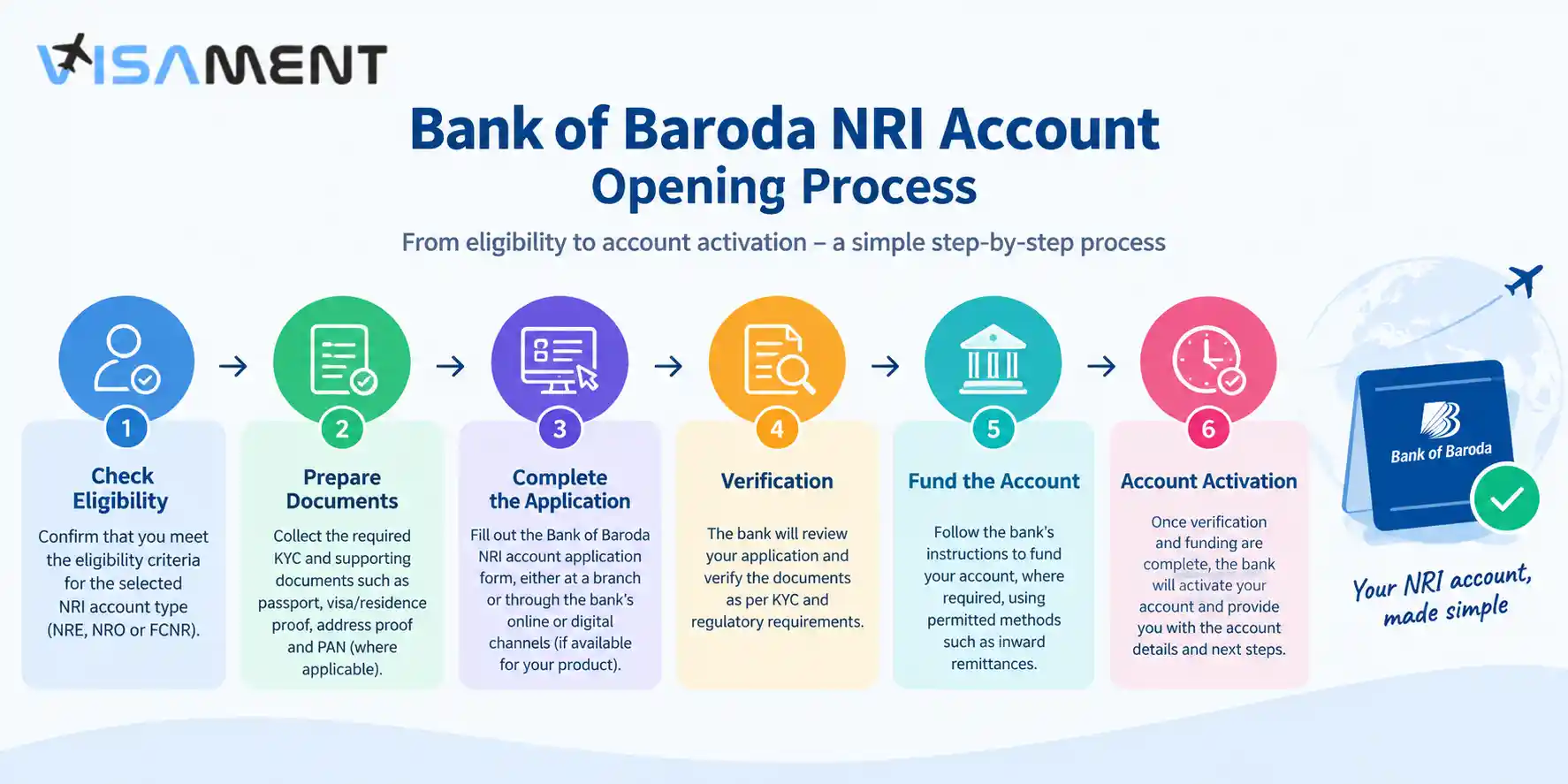
Also Want to Know About Can OCI Cardholders Open NRI Account? Check Now!The account-opening process depends on the selected product and the applicant's circumstances. A typical process involves:
Because onboarding procedures can change, confirm the current process directly with Bank of Baroda before submitting an application.
Becoming an NRI can affect the status of an existing resident bank account. You should not assume that an ordinary resident account can simply continue unchanged after your residential status changes.
Bank of Baroda's guidance explains that NRO accounts are converted to resident accounts when an account holder returns to India and becomes a resident, while NRE and FCNR accounts can be redesignated according to the applicable circumstances when an NRI returns to India.
If you have recently moved abroad or returned to India permanently, contact the bank to determine how your existing accounts should be handled under the applicable rules.
Also Want to Know About Canara Bank NRI Account Check Now!Before opening an NRI account, check:
Do not rely on an old article for current rates, charges or eligibility conditions. Bank of Baroda's product pages and applicable regulatory guidance should be checked immediately before applying.
Stop worrying about delays. Apply now and get Indian Counsellor Services.
Chat NowChoosing a Bank of Baroda NRI account starts with understanding why you need the account and where your funds originate. NRE accounts can be relevant for eligible overseas funds, NRO accounts are designed to manage eligible Indian income and FCNR(B) deposits provide a foreign-currency deposit option.
Before applying, verify your eligibility, documentation, current charges, tax implications and repatriation conditions for the specific product. For regulated financial information, always rely on the latest Bank of Baroda and RBI guidance rather than outdated third-party information.
The Customer care number for the Bank of Baroda NRI account is: For India: 1800 258 44 55 or 1800 102 4455 and For Outside India: +91 7949044100
The minimum balance required to open a Bank of Baroda account is different for savings and current accounts. For a savings account For the NRO and NRE savings account, the minimum amount required is INR 1000. For the current account For the NRO and NRE current account, the minimum amount required is INR 10,000 for metro, INR 5,000 for Urban, and INR 2,000 for Rural/Semi-urban.
You can open different types of accounts in Bank of Baroda as an NRI. These accounts are NRE accounts, NRO accounts, and FCNR accounts. For these types of accounts, you can open savings, current, and deposit accounts.
Bank of Baroda provides the interest rates on its savings accounts and deposits of funds. Here are the interest rates for the NRI accounts below Rs 2 crores: For Bank of Baroda NRE accounts: 2.75% p.a. on the entire balance For Bank of Baroda NRO accounts: 2.75% p.a. over the whole balance
Vipul Jain is the Co-Founder of Visament, a trusted platform dedicated to simplifying Indian immigration, consular, and NRI services for applicants across the globe. With extensive expertise in OCI cards, Indian passport services, visa assistance, apostille and document legalization,... See Full Bio

Talk to our documentation experts for free guidance on your application.
When you visit a website, it may store data about you using cookies and similar technologies. Cookies can be important for the basic operations of the website and for other purposes. You get the option of deactivating certain types of cookies, even so, doing that may affect your experience on the website.
It is required to permit the basic functionality of the website. You may not disable necessary cookies.
Used to provide advertising that matches you and your interests. May also be used to restrict the number of times you see an advertisement and estimate the effectiveness of an advertising campaign. The advertising networks place them after obtaining the operator's permission.
Permits the website to recognize the choices you make (like your username, language, or the region you are in). Also provides more personalized and enhanced features.
Aid the website operator to determine how the website performs, how visitors interact with the site, and whether there are any technical issues.