Related Blogs

Applying for an OCI Card involves more than completing an online form. Small errors in personal details, passport information, document uploads, photographs, signatures, or supporting evidence can create avoidable problems during verification. The official OCI portal itself advises applicants to check the instructions carefully and enter details according to their current passport.
If you are preparing an OCI application, reviewing these common mistakes before submission can help you identify problems while there is still time to correct them.
The most common mistakes generally fall into a few categories: entering incorrect personal information, creating inconsistencies between documents, uploading incomplete or incorrect supporting documents, using photographs or signatures that do not meet the required specifications, entering incorrect passport details, and submitting the application without a final review.
The official OCI registration system specifically instructs applicants to ensure their eligibility and enter their details according to their current passport.
Here are the mistakes worth checking most carefully.
One of the most important OCI application mistakes is entering information that does not accurately reflect the applicant's official documents.
Before submitting, carefully check:
Do not rely on memory when completing these fields. Keep your current passport and relevant civil or citizenship documents beside you and compare the information as you complete the form.
The OCI registration portal specifically states that applicants should enter details as per their current passport.
Name differences are particularly important for OCI applicants because supporting documents may span several stages of a person's life.
For example, an applicant may have a current foreign passport, an old Indian passport, a birth certificate, a marriage certificate, and a citizenship or naturalization certificate. The name may appear differently on some documents because of marriage, a legal name change, transliteration, or historical documentation.
Do not change information in the OCI application simply to make documents appear identical.
Instead, determine why the difference exists and provide the appropriate supporting evidence where required. The goal is to ensure that the documents clearly establish the applicant's identity and eligibility.
A useful pre-submission check is to compare the name shown on the:
If you are unsure how a legitimate name difference should be documented, verify the current requirements applicable to your application and jurisdiction before submitting.
Passport and citizenship information should receive particular attention because these details are central to establishing the applicant's current identity and nationality.
Check the application against your current passport for details such as:
The official OCI FAQ states that proof of present citizenship includes a copy of the applicant's valid current passport and, as applicable, evidence of citizenship registration or naturalization.
Former Indian citizens should also carefully review documentation connected with their previous Indian citizenship. The official guidance identifies a cancelled or surrendered Indian passport with a Surrender Certificate for applicants who surrendered an Indian passport in or after 2010.
If your OCI application depends on previous Indian citizenship or Indian ancestry, do not assume that one generic document will satisfy every applicant's circumstances. Check the applicable document requirements before filing.
Another common OCI document mistake is uploading a document that does not satisfy the requirement for the applicant's particular category.
The problem is not limited to forgetting a document. An upload can also be problematic when:
The official OCI guidance specifies supporting documentation for areas such as present citizenship, address, and evidence establishing Indian origin, with additional documents depending on the applicant's circumstances.
For a complete list of documents applicable to your circumstances, review the documents required for an OCI application rather than relying only on a general list of common documents.
Technical upload errors are another area applicants should not overlook.
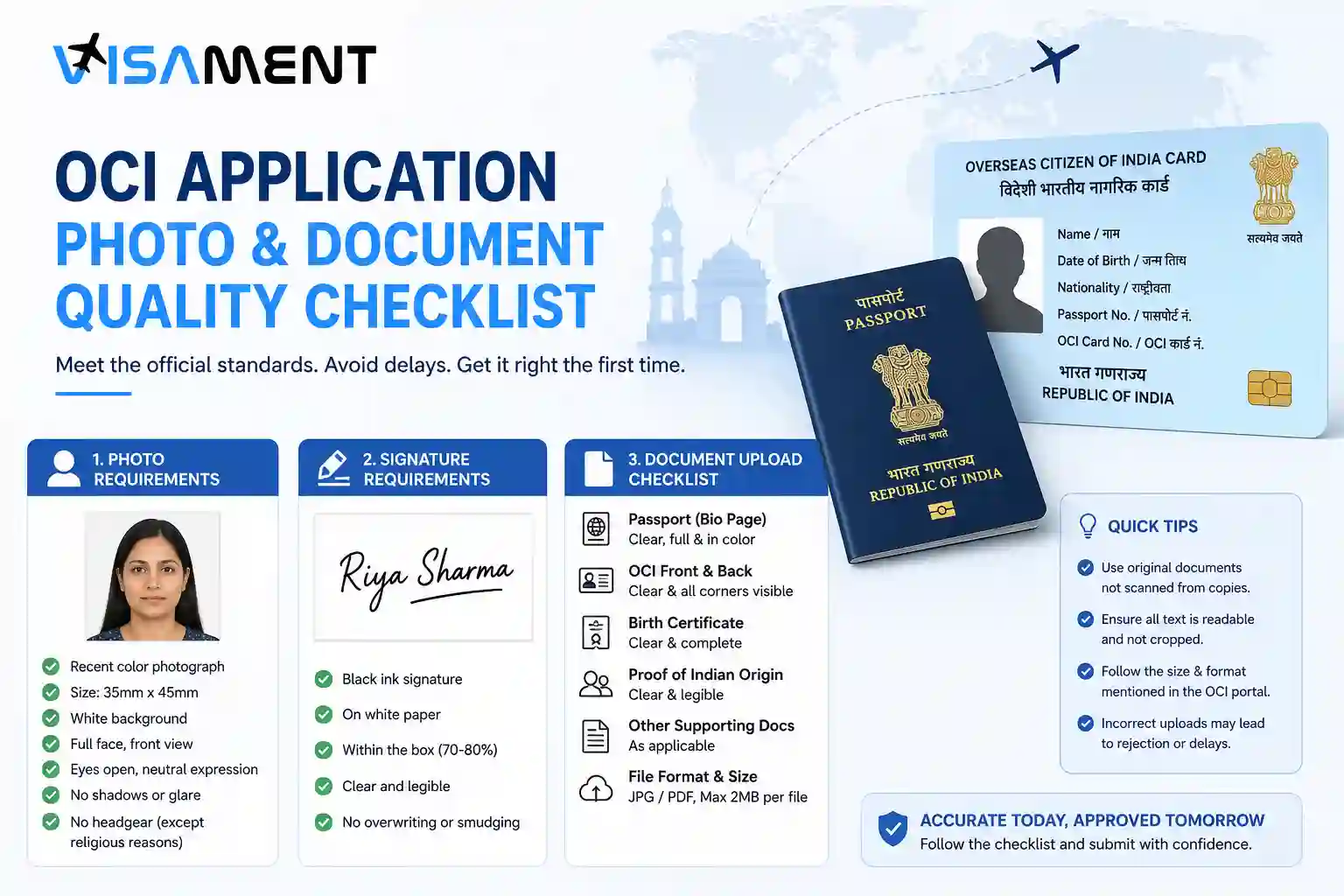
The current OCI FAQ specifies that the uploaded photograph should be square, with minimum dimensions of 200 × 200 pixels and maximum dimensions of 900 × 900 pixels. It also states that the photograph and signature images should be in JPEG/JPG format with a maximum size of 200 KB. The photograph must meet additional requirements concerning facial positioning and background.
A photograph that does not meet the required specifications can be rejected and may cause processing delays.
Before uploading, check:
Do not assume that a photograph acceptable for another visa, passport, or immigration application automatically meets OCI requirements. Always verify the current OCI specifications before submission.
Applicants should determine which OCI eligibility route applies to their circumstances before completing the application.
OCI eligibility can be based on different relationships to India, including qualifying Indian origin and certain spouse-based circumstances. The relevant supporting evidence can therefore vary.
Selecting an application category simply because it appears convenient can create problems if the documents do not support that category.
Before proceeding, verify:
The official OCI system instructs applicants to ensure their eligibility before proceeding with registration.
For detailed eligibility rules, use the dedicated OCI eligibility requirements guide rather than trying to determine eligibility from a mistake-prevention article.
A document may be genuine and still create a problem if the information entered in the application does not accurately correspond with the supporting evidence.
Before submitting, compare important information across the application and documents, particularly:
| Information to check | Compare against |
|---|---|
| Name | Current passport and relevant civil documents |
| Date of birth | Passport and birth/civil records |
| Nationality | Current passport and citizenship evidence |
| Passport number | Current passport |
| Indian citizenship history | Previous Indian passport and applicable surrender documentation |
| Relationship information | Relevant birth, marriage, or relationship documents |
| Address | Current address evidence where required |
This does not mean every document must contain identical wording. Historical or legally valid differences can exist. The important point is that the application should accurately represent the underlying documents and the applicant's circumstances.
A surprisingly simple mistake is failing to perform a final review.
The official OCI portal advises applicants to read the instructions before filling out the application so that mistakes in submission can be avoided.
Before clicking the final submission option, review the application from beginning to end.
Check:
Keep copies of important documents and application information for your records.
A few minutes spent comparing the completed application against the original documents can catch errors that may otherwise become difficult to address later.
If you discover an error after submitting an OCI application, do not assume that every field can be edited immediately or that submitting a second application is automatically the correct solution.
The appropriate action depends on the type of mistake and the stage of the application.
The official OCI Miscellaneous Services guidance specifically includes updating certain wrong personal particulars, such as name, father's name, and date of birth, among services available to registered OCI Cardholders.
However, that does not mean every error in a new application can be corrected through the same mechanism.
Check the current instructions on the OCI portal and, where applicable, the Indian Mission/Post or FRRO handling your application before taking corrective action.
Use this quick checklist before submitting your application:
The exact document and submission requirements can vary according to the applicant's circumstances and jurisdiction. The official OCI portal and relevant Indian Mission should therefore remain the final reference for current requirements.
If you are unsure whether your documents are complete or whether the information in your application is consistent, professional application support can provide an additional review before submission.
Visament can assist applicants with OCI application and document-support services, helping them organize the requirements relevant to their circumstances. Such assistance does not replace the Government of India's review or guarantee OCI approval.
The safest way to avoid common OCI application mistakes is to treat the final submission as a document-verification exercise, not simply a form-filling task. Check your personal information against your current passport, make sure supporting documents match your circumstances, follow the latest photograph and upload specifications, and review the entire application before submission.
For any requirement that may have changed, always verify the latest instructions on the official OCI portal and with the relevant Indian Mission or Post.
If you have provided some false information or material information in the application, and the government found out, then your OCI will be canceled by an order. You might also be blacklisted for further entry in India.
The photo for the OCI application should be recent and taken within the past six months.
The Refugees/Stateless individuals of any country are not eligible to apply for the OCI card, and they cannot register themselves as OCI cardholders on a spouse basis.
You can check the status of your OCI application by visiting the official website for OCI services and clicking on "Status Inquiry" or "Check Status".
You should have a neutral expression during the photo session for the OCI application. There should not be any smiling or frowning, and your mouth should be closed.
The photo should be taken in a colored attire, and there should not be any patterns or textures. There should not be any distracting shadows on the background or face.
Yes, you should update the details of your OCI card if you have a new passport by using the OCI miscellaneous services.
The photograph for the OCI should be in color, and the size of the photo should be 2x2 inches. The tone quality of the photo should be continuous, and the photo print should be clear. It should have a full and front view of your face, and your eyes should be wide open.
Vipul Jain is the Co-Founder of Visament, a trusted platform dedicated to simplifying Indian immigration, consular, and NRI services for applicants across the globe. With extensive expertise in OCI cards, Indian passport services, visa assistance, apostille and document legalization,... See Full Bio

Talk to our documentation experts for free guidance on your application.
NRI, PIO and OCI Eligibility: What’s the Difference and Who Qualifies?
OCI Property Ownership in India: What Can OCI Cardholders Own?
Know About The Advantages And Disadvantages of OCI Card
OCI Card for NRIs: Eligibility, Requirements & How It Works
OCI Application Timeline in the USA (2026): Real Timeline & Application Steps

When you visit a website, it may store data about you using cookies and similar technologies. Cookies can be important for the basic operations of the website and for other purposes. You get the option of deactivating certain types of cookies, even so, doing that may affect your experience on the website.
It is required to permit the basic functionality of the website. You may not disable necessary cookies.
Used to provide advertising that matches you and your interests. May also be used to restrict the number of times you see an advertisement and estimate the effectiveness of an advertising campaign. The advertising networks place them after obtaining the operator's permission.
Permits the website to recognize the choices you make (like your username, language, or the region you are in). Also provides more personalized and enhanced features.
Aid the website operator to determine how the website performs, how visitors interact with the site, and whether there are any technical issues.