For an overseas Indian planning to return to India, an OCI Card can make long-term travel and residence significantly simpler. It provides a lifelong multiple-entry visa and specific rights and privileges in areas such as property, education, employment, and certain domestic services. However, an OCI Cardholder remains a foreign national, not an Indian citizen, so some rights and benefits remain unavailable.
Key Takeaways
- An OCI Card provides a multiple-entry lifelong visa for visiting India, subject to specific activities that require prior permission.
- OCI Cardholders are generally exempt from FRRO/FRO registration regardless of the length of their stay in India.
- OCI Cardholders receive specified parity with NRIs in areas including eligible property transactions, certain entrance examinations and specified professions.
- OCI holders can purchase or sell eligible residential and commercial immovable property, but agricultural land, farmhouses and plantation property are excluded.
- An OCI Card does not give the holder Indian citizenship, an Indian passport, or unrestricted political and public-service rights.
- A valid foreign passport remains essential because the OCI Card itself is not a substitute for a passport.
What Is an OCI Card and Why Does It Matter When Returning to India?
An Overseas Citizen of India (OCI) Card is a status available to eligible foreign citizens of Indian origin under the Citizenship Act, 1955. Despite the name, an OCI Cardholder is a foreign national holding a foreign passport and is not a citizen of India.
This distinction is especially important for people returning to India after acquiring foreign citizenship. OCI can provide several practical advantages without requiring the person to travel to India on a new visa for each visit.
For someone planning to spend an extended period in India, the most relevant benefits generally relate to entry and stay, property, employment, education, and certain economic or financial matters.
An OCI Card also does not replace the foreign passport. The official OCI portal states that a foreign national cannot legally stay in India without a valid passport, even when that person holds an OCI Card.
Key OCI Card Advantages for NRIs Returning to India
1. Lifelong Multiple-Entry Visa
One of the most significant OCI benefits is the multiple-entry lifelong visa for visiting India.
This means an OCI Cardholder does not generally need to obtain a separate Indian visa for each visit. This can be particularly useful for a former Indian citizen or person of Indian origin who plans to move between India and their country of citizenship.
The benefit is not completely unrestricted. OCI Cardholders need special permission or a Special Permit for activities such as research, certain missionary or Tabligh activities, mountaineering, journalism, specified internships or employment with foreign diplomatic missions, and visits to protected, restricted, or prohibited areas.
2. Long-Term Stay Without Routine FRRO/FRO Registration
Can an OCI holder stay in India long term? Yes. OCI Cardholders are exempt from registration with the Foreigners Regional Registration Officer (FRRO) or Foreigners Registration Officer (FRO) for any length of stay in India.
This can remove an important administrative requirement for an overseas Indian who decides to spend months or longer in India.
There is still an obligation for OCI Cardholders who are normally resident in India to intimate the jurisdictional FRRO/FRO by email when their permanent residential address or occupation changes. Therefore, exemption from registration should not be interpreted as exemption from every reporting requirement.
3. Specified NRI Parity in Property and Other Areas
OCI benefits should not be described as giving an OCI holder all the rights of an NRI. The official framework provides parity with NRIs in specifically identified areas.
For someone returning to India, these areas can be particularly relevant:
- Certain immovable-property transactions
- Specified entrance examinations
- Certain professional activities
- Inter-country adoption, subject to the applicable procedure
For other economic, financial, and educational areas not specifically covered by the applicable notifications, an OCI Cardholder generally has the rights and privileges applicable to a foreigner.
This distinction is important because OCI status and NRI status are not interchangeable legal concepts.
4. Ability to Purchase Eligible Property in India
Can an OCI holder buy property in India? OCI Cardholders have parity with NRIs for the purchase or sale of immovable property, other than agricultural land, farmhouses, and plantation property.
For an overseas Indian returning to India, this can make purchasing a residential home or other eligible immovable property more straightforward under the applicable rules.
However, property transactions can also involve FEMA and other regulatory requirements. Anyone planning a significant property transaction should verify the current rules rather than assuming that every type of Indian property is available to an OCI holder.
For detailed property rules, a dedicated OCI property ownership guide is preferable to expanding this article into a full FEMA explanation.
5. Employment and Certain Professional Opportunities
Can OCI holders work in India? The OCI framework permits employment in India without requiring an employment visa, subject to applicable laws and restrictions.
The official OCI framework also provides NRI parity for certain specified professions, including:
- Doctors, dentists, nurses and pharmacists
- Advocates
- Architects
- Chartered accountants
Professional practice remains subject to the relevant professional legislation, registration and regulatory requirements. An OCI Card therefore should not be treated as a blanket authorization to practise every regulated profession in India.
OCI Cardholders are also eligible for appointment as teaching faculty in specified institutions, including IITs, NITs, IIMs, IISERs, IISc, Central Universities and certain new AIIMS established under the PMSSY scheme.
6. Education and Entrance-Test Benefits
OCI status can also be relevant when a family returns to India with children who want to pursue higher education.
OCI Cardholders can appear for specified national entrance examinations, including NEET and JEE Main/Advanced, for admission against an NRI seat or a supernumerary seat, subject to the applicable admission framework. However, an OCI Cardholder is not eligible for admission against a seat reserved exclusively for Indian citizens.
The exact admission rules can vary by institution and course. Therefore, students should verify the current rules of the relevant examination authority and educational institution before applying.
7. Certain Domestic Travel and Entry-Fee Benefits
OCI Cardholders also receive parity with Indian nationals for specified domestic airfares and entry fees for certain national parks, wildlife sanctuaries, national monuments, historical sites and museums in India.
These benefits may be especially useful for people who plan to travel extensively within India after returning from overseas.
Get Expert Help to OCI Card Service!
Have questions? Our experts guide you through every step of the OCI Card Services– no confusion, no delays.
Consult an Expert Today What an OCI Card Does Not Give You
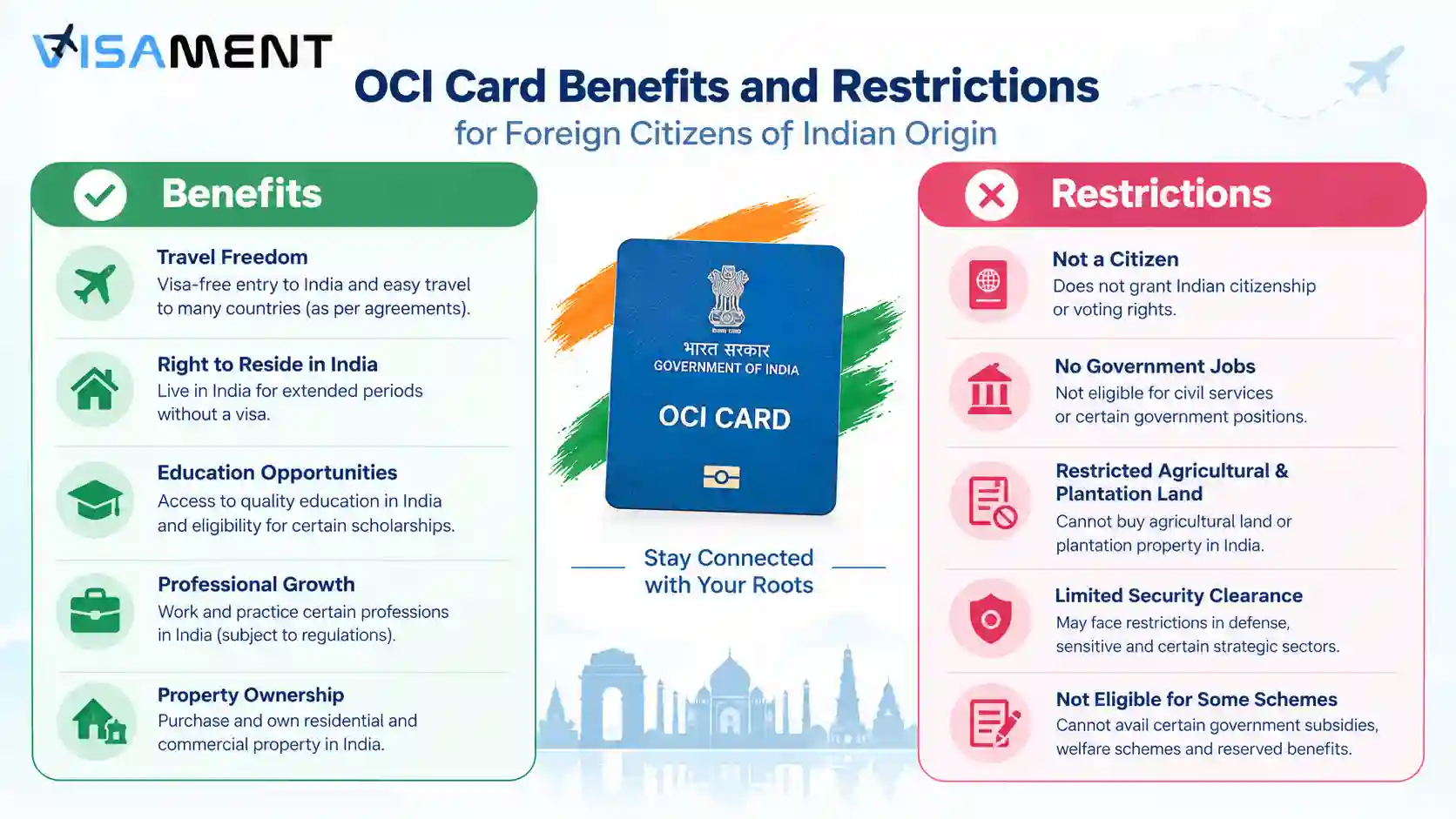
Understanding the limitations is just as important as understanding the advantages.
| OCI provides |
OCI does not provide |
| Lifelong multiple-entry visa |
Indian citizenship |
| Exemption from FRRO/FRO registration for any length of stay |
An Indian passport |
| Specified NRI parity |
Unrestricted NRI rights in every legal or financial matter |
| Eligible property purchase/sale |
Agricultural land, farmhouse or plantation property acquisition |
| Access to specified professional opportunities |
Automatic eligibility for every regulated profession |
| Specified education and entrance-test benefits |
Admission to seats reserved exclusively for Indian citizens |
An OCI Cardholder is also not entitled to vote or hold certain constitutional positions, and OCI holders are generally not eligible for appointment to public services and posts connected with the affairs of the Union or a State, except where the Central Government specifically permits it.
An OCI Card therefore provides specific privileges rather than citizenship rights.
Is OCI Useful for an NRI Planning to Return to India?
For an overseas Indian who has acquired foreign citizenship, OCI can simplify several aspects of spending an extended period in India. The lifelong multiple-entry visa removes the need for repeated visa applications, while the FRRO/FRO registration exemption can reduce administrative requirements for long stays.
The status can also be relevant to people planning to purchase eligible residential or commercial property, work in certain fields, pursue education, or travel within India. The precise benefit depends on the activity and the laws governing it.
If your return involves taxation, investments, banking, or a change in residential status, those issues should be assessed separately. OCI status does not by itself determine your tax residency or provide every NRI financial benefit.
Important Points to Check Before Returning to India
Before relocating or spending an extended period in India, an OCI Cardholder should check:
- Foreign passport: Make sure the passport remains valid. An OCI Card is not a substitute for a passport.
- OCI details: Check that the OCI information corresponds with the current passport and personal details.
- Special permissions: Determine whether planned activities require prior permission.
- Property category: Confirm that the proposed property is not agricultural land, a farmhouse or plantation property.
- Employment rules: Check the requirements of the profession, especially for regulated occupations.
- Education rules: Verify current admission and entrance-test rules with the relevant institution or examination authority.
- Residence reporting: If normally resident in India, follow the applicable FRRO/FRO notification requirements for changes in permanent address or occupation.
If you need assistance with an OCI application, reissue or document review, Visament can guide its OCI services.
Conclusion
The main OCI Card advantages for NRIs returning to India are the lifelong multiple-entry visa, exemption from routine FRRO/FRO registration, specified NRI parity, eligible property rights, employment and education opportunities, and certain domestic travel and entry-fee benefits.
At the same time, OCI should not be confused with Indian citizenship or unrestricted NRI status. An OCI Cardholder remains a foreign national and must comply with the rules applicable to specific activities. Checking the current official OCI guidance before relocating can help ensure that the benefits and limitations are understood correctly.