Do you need a separate Business PAN Card, or can you use your personal PAN for your business? The answer depends on the legal structure of the business. Companies, LLPs, and partnership firms generally have their own PAN, while a sole proprietorship generally operates using the proprietor's individual PAN. This guide explains who needs a business PAN, what documents may be required, and how the current application process works under the rules applicable from 2026.
Key Takeaways
- A Business PAN Card is a commonly used term for a PAN issued in the name of a business entity or organisation.
- A company's PAN is separate from the personal PAN of its directors or shareholders.
- Companies, LLPs, and partnership firms have entity-specific PAN requirements.
- A sole proprietorship generally uses the proprietor's individual PAN rather than having a separate PAN as an independent legal entity.
- Documents required for PAN depend on the applicant's legal structure.
- Fresh PAN applications filed from 1 April 2026 are governed by the new forms prescribed under the Income-tax Rules, 2026. Existing PAN numbers remain valid.
- Companies incorporated through the MCA's SPICe+ process can have PAN allotted as part of the incorporation process.
What Is a Business PAN Card?
A Business PAN Card is the commonly used term for a Permanent Account Number issued in the name of a business entity, organisation, or other eligible non-individual taxpayer.
PAN is a 10-character alphanumeric identifier used by the Income Tax Department to identify taxpayers. A business entity's PAN is different from the personal PAN of an owner, director, partner or trustee.
The important point is that “Business PAN Card” is not one universal legal category. The applicable PAN treatment depends on whether the applicant is a company, LLP, partnership firm, trust, society, AOP, BOI, foreign company, or another recognised entity.
For example, a private limited company has its own PAN, while the company's director continues to have a separate personal PAN.
Who Needs a Business PAN in India?
Whether a business needs an entity PAN depends on its legal structure and tax status. Common examples include:
| Business or entity type |
General PAN treatment |
| Private/Public Limited Company |
Entity has its own PAN |
| LLP |
Entity has its own PAN |
| Partnership Firm |
Firm has its own PAN |
| Sole Proprietorship |
Generally uses the proprietor's individual PAN |
| Trust |
PAN treatment depends on the trust and applicable tax status |
| Society |
Entity may require its own PAN |
| AOP/BOI |
PAN may apply to the entity/person recognised for tax purposes |
| Foreign Company |
PAN may be required where applicable under Indian tax rules |
The Income Tax Department recognises several non-individual categories for tax purposes, including firms, LLPs, AOPs, BOIs, certain trusts, societies and other entities.
Does a Sole Proprietorship Need a Separate PAN?
Generally, a sole proprietorship uses the proprietor's individual PAN. A sole proprietorship does not have a separate legal personality comparable to a company or LLP.
This distinction is important because a business owner may operate under a trade name, but the trade name itself does not automatically mean that a separate corporate PAN is issued.
For example, if an individual operates a proprietorship called “ABC Traders,” the proprietor's PAN is generally used for the proprietorship's income-tax purposes.
If you are unsure about the PAN treatment for a particular business structure, check the applicable Income Tax Department requirements before submitting an application.
Why Is PAN Important for a Business?
A business PAN provides the tax identity used for relevant income-tax and financial compliance activities.
Depending on the entity and transaction, PAN can be relevant for:
- Filing income-tax returns and communicating with the Income Tax Department.
- Identifying the business or entity for tax purposes.
- Completing relevant banking and financial procedures.
- Tax deduction and reporting requirements.
- Certain registrations and regulatory processes.
- Financial transactions for which PAN is prescribed.
- Income-tax refunds and other taxpayer services.
For companies, PAN is also used for registration and compliance on the Income Tax e-Filing system. The Income Tax Department's company registration guidance requires a valid and active company PAN for e-filing registration.
PAN should therefore be treated as the entity's tax identifier where an entity-specific PAN applies, rather than as a substitute for the owner's personal PAN.
Get Expert Help to PAN Card Service!
Have questions? Our experts guide you through every step of the PAN Card Services– no confusion, no delays.
Consult an Expert Today Documents Required for a Business PAN Card
The required documents vary according to the legal structure of the applicant. The purpose of the documents is generally to establish the applicant's identity, constitution or registration, and the authority of the person submitting the application.
Typical documentation can include:
| Entity |
Examples of relevant documents |
| Company |
Certificate of Incorporation and documents establishing the authorised applicant/signatory, as applicable |
| LLP |
LLP registration/incorporation details and applicable constitutional documents |
| Partnership Firm |
Partnership deed and applicable registration/constitution documents |
| Trust |
Trust deed and applicable registration documents |
| Society |
Registration certificate and applicable governing documents |
| AOP/BOI |
Agreement or constitution documents, where applicable |
| Foreign Company |
Documents establishing the foreign entity and its Indian presence, where applicable |
The exact document list should be checked against the current PAN application form and applicable Income-tax Rules rather than copied from an older checklist.
For a company, for example, the application should use the company's legal details consistently with its incorporation records. Similarly, an LLP's legal name and registration details should match its official records.
Do not rely on older online checklists that automatically require the same documents for every type of business. Entity-specific requirements can differ.
How to Apply for a Business PAN Card?
The application process depends on the type of entity and whether the PAN is being obtained as part of another registration process.
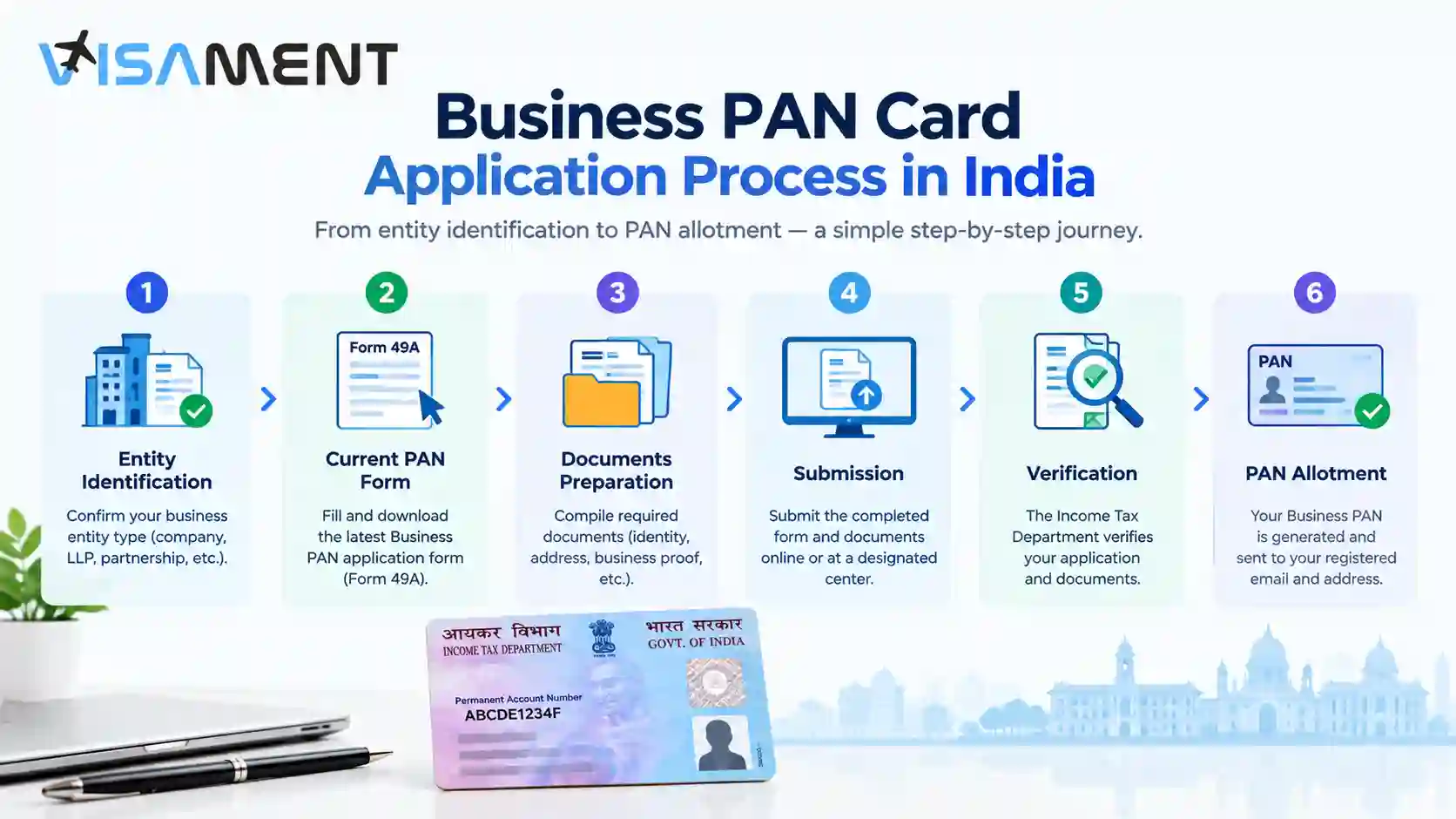
For an existing business entity, the general process is:
1. Identify the correct entity category
First determine whether the applicant is a company, LLP, firm, trust, society, AOP/BOI, foreign company, or another applicable category.
This is important because the PAN application requirements are not identical for every entity.
2. Use the current PAN application framework
Fresh PAN applications submitted on or after 1 April 2026 are governed by the new forms prescribed under the Income-tax Rules, 2026. The Income Tax Department has specifically confirmed that the new PAN forms replaced the previous application framework for fresh applications.
Older articles may still refer to Forms 49A and 49AA. Those references should not automatically be followed for a fresh application under the 2026 framework.
3. Enter the entity's legal information
Provide the business name and other details exactly as they appear in the entity's official records.
Depending on the entity, information may include:
- Legal name
- Date of incorporation or formation
- Registration details
- Communication address
- Contact information
- Authorised person's details
- Other information required by the applicable PAN form
Avoid using a trading name where the form requires the entity's legal name.
4. Prepare the supporting documents
Collect the documents applicable to the entity type before submitting the application.
Check names, dates, and registration numbers across the application and supporting documents. Differences can create avoidable clarification or correction issues.
5. Complete authentication and payment requirements
Follow the current instructions for authentication, signature, or other verification requirements applicable to the application method.
Any applicable PAN application charge should also be checked using the current official application channel rather than an old fee table.
6. Submit and retain the acknowledgement
After submission, retain the acknowledgement or reference information provided by the application system.
Use the current official tracking facility to monitor the application where tracking is available.
7. Receive the PAN
Once the application is processed, the PAN is allotted to the applicant entity. Depending on the selected service, the applicant may receive a physical PAN card, e-PAN card, or both as applicable.
Do not assume a fixed processing period. Processing can depend on the application method, verification requirements, and whether the submitted information and documents are complete.
Business PAN vs Personal PAN
A business entity's PAN and an individual's PAN serve different taxpayers.
| Feature |
Business/entity PAN |
Personal PAN |
| PAN holder |
Eligible business/entity |
Individual |
| Name on PAN record |
Entity's legal name |
Individual's name |
| Example |
ABC Private Limited |
Individual director of ABC Private Limited |
| Purpose |
Entity-level tax identification |
Individual tax identification |
| Separate from owner's/director's PAN? |
Yes, where an entity PAN applies |
Yes |
For example, ABC Private Limited has its own PAN. The company's director also has a personal PAN, but the director's PAN does not become the company's PAN.
This distinction is especially important when completing tax, banking, and regulatory documentation.
PAN During Company Incorporation
A newly incorporated company does not necessarily follow the same standalone process as an already-existing company.
The MCA's SPICe+ incorporation process integrates PAN and TAN allotment. MCA guidance states that after approval of the SPICe+ forms, the Certificate of Incorporation is issued with the PAN allotted by the Income Tax Department, and PAN/TAN information is communicated to the user.
Therefore, someone incorporating a new company should check the current MCA incorporation process rather than automatically submitting a separate old-style PAN application.
The exact incorporation process is outside the scope of this article and should be handled through the current MCA guidance.
Common Business PAN Application Mistakes
Avoid these common problems when preparing an entity PAN application:
- Using the owner's PAN instead of the entity's PAN where a separate entity PAN is required.
- Selecting the wrong entity category.
- Entering a business or trading name when the legal entity name is required.
- Providing incorporation or registration details that do not match official records.
- Submitting documents that do not correspond to the applicant entity.
- Following outdated Form 49A/49AA instructions for a fresh application after 1 April 2026.
- Using an outdated fee or document checklist.
- Providing incomplete or inconsistent authorised-signatory information.
The 2026 transition makes checking the current Income Tax Department guidance particularly important. Existing PAN numbers remain valid; the new forms apply to fresh applications filed from 1 April 2026.
Conclusion
A Business PAN Card is best understood as the PAN associated with an eligible business entity or organisation, rather than as a separate universal type of PAN. The correct treatment depends on the legal structure: companies, LLPs and partnership firms generally have entity-specific PANs, while a sole proprietorship generally uses the proprietor's individual PAN.
Before applying, confirm the entity category, use the current 2026 PAN application framework, and ensure that the legal name and supporting documents match the entity's official records. For newly incorporated companies, check the MCA SPICe+ process because PAN allotment is integrated with company incorporation.


_1741090499.png)