PAN and Aadhaar are two important identification numbers used in India, but they serve different purposes. PAN (Permanent Account Number) is primarily used for income-tax administration and specified financial transactions, while Aadhaar is a 12-digit identity number issued by the Unique Identification Authority of India (UIDAI) and used for identity verification and authentication. They are separate identifiers and should not be treated as interchangeable.
If you are unsure whether you need PAN, Aadhaar, or both, understanding their purpose, eligibility, uses, and relationship can help you provide the correct document when completing tax, banking, KYC, or government-related requirements.
Key Takeaways
- PAN and Aadhaar are different identification systems administered by different authorities.
- PAN primarily supports income-tax administration and specified financial transactions.
- Aadhaar provides a portable proof of identity and supports authentication and e-KYC for applicable services.
- Aadhaar does not establish Indian citizenship or domicile.
- PAN and Aadhaar are not interchangeable simply because both may be accepted as identity documents in some situations.
- PAN-Aadhaar linking connects the two identifiers for applicable taxpayers; it does not make them the same document.
- NRIs should assess PAN and Aadhaar requirements separately because their respective eligibility and compliance rules differ.
What is a PAN Card?
A Permanent Account Number (PAN) is a unique 10-character alphanumeric identifier used in India's income-tax system. PAN allows tax-related information and specified financial transactions to be associated with the relevant taxpayer or other PAN holder.
PAN is particularly important for income-tax compliance and transactions for which quoting PAN is prescribed under applicable rules. It is also commonly requested by banks, financial institutions, employers, investment platforms, property-related transactions, and other organisations where PAN is relevant.
The PAN system is administered through the Income Tax Department. Existing PAN numbers continue under the Income Tax Act, 2025. The Income Tax Department has also introduced new forms for fresh PAN applications made on or after April 1, 2026; these changes do not invalidate existing PAN numbers.
Common uses of PAN
PAN may be relevant for:
- Income-tax compliance and return filing
- Specified financial transactions
- Tax-related records
- Certain banking and investment activities
- Transactions where PAN quotation is prescribed
- Identification of a taxpayer within the income-tax system
The exact requirement depends on the transaction and the applicable rules.
What is an Aadhaar Card?
Aadhaar is a 12-digit random identification number issued by UIDAI after the prescribed enrolment and verification process. UIDAI states that eligible residents can enrol for Aadhaar, and its 2026 handbook also provides for Aadhaar enrolment by eligible NRIs with an Indian passport.
Aadhaar is based on demographic and biometric information. UIDAI describes its features as including uniqueness, portability, authentication, and e-KYC. Aadhaar can therefore be used to establish and verify identity for applicable services.
Importantly, Aadhaar is proof of identity, not proof of citizenship or domicile. Having an Aadhaar number does not by itself confer any right of Indian citizenship or domicile.
Common uses of Aadhaar
Depending on the service and applicable requirements, Aadhaar may be used for:
- Identity verification
- Aadhaar authentication
- e-KYC
- Access to applicable government services and benefits
- Certain financial and service-related verification processes
- Digital identity-related services
Not every service requires Aadhaar, and an organisation's acceptance of Aadhaar for one purpose does not mean Aadhaar replaces every other identification document.
Get Expert Help for Your PAN Card Application!
Have questions? Our experts guide you through every step of the PAN Card Application – no confusion, no delays.
Consult an Expert Today PAN Card vs Aadhaar Card: Key Differences
The easiest way to understand the difference is to compare their primary functions.
| Feature |
PAN |
Aadhaar |
| Full name |
Permanent Account Number |
Aadhaar |
| Issuing authority |
Income Tax Department |
UIDAI |
| Number format |
10-character alphanumeric |
12-digit random number |
| Primary purpose |
Tax and financial identification |
Identity verification and authentication |
| Biometric identifier |
No |
Uses biometric and demographic information |
| Tax administration |
Directly relevant |
May be linked to PAN where applicable |
| Authentication |
Not an Aadhaar-style biometric authentication system |
Supports Aadhaar authentication |
| Citizenship proof |
No |
No |
| Domicile proof |
No |
No |
| Eligibility framework |
Based on PAN rules |
Based on Aadhaar enrolment rules |
| NRI considerations |
PAN may be relevant depending on Indian tax/financial requirements |
Eligible NRIs can enrol subject to applicable UIDAI requirements |
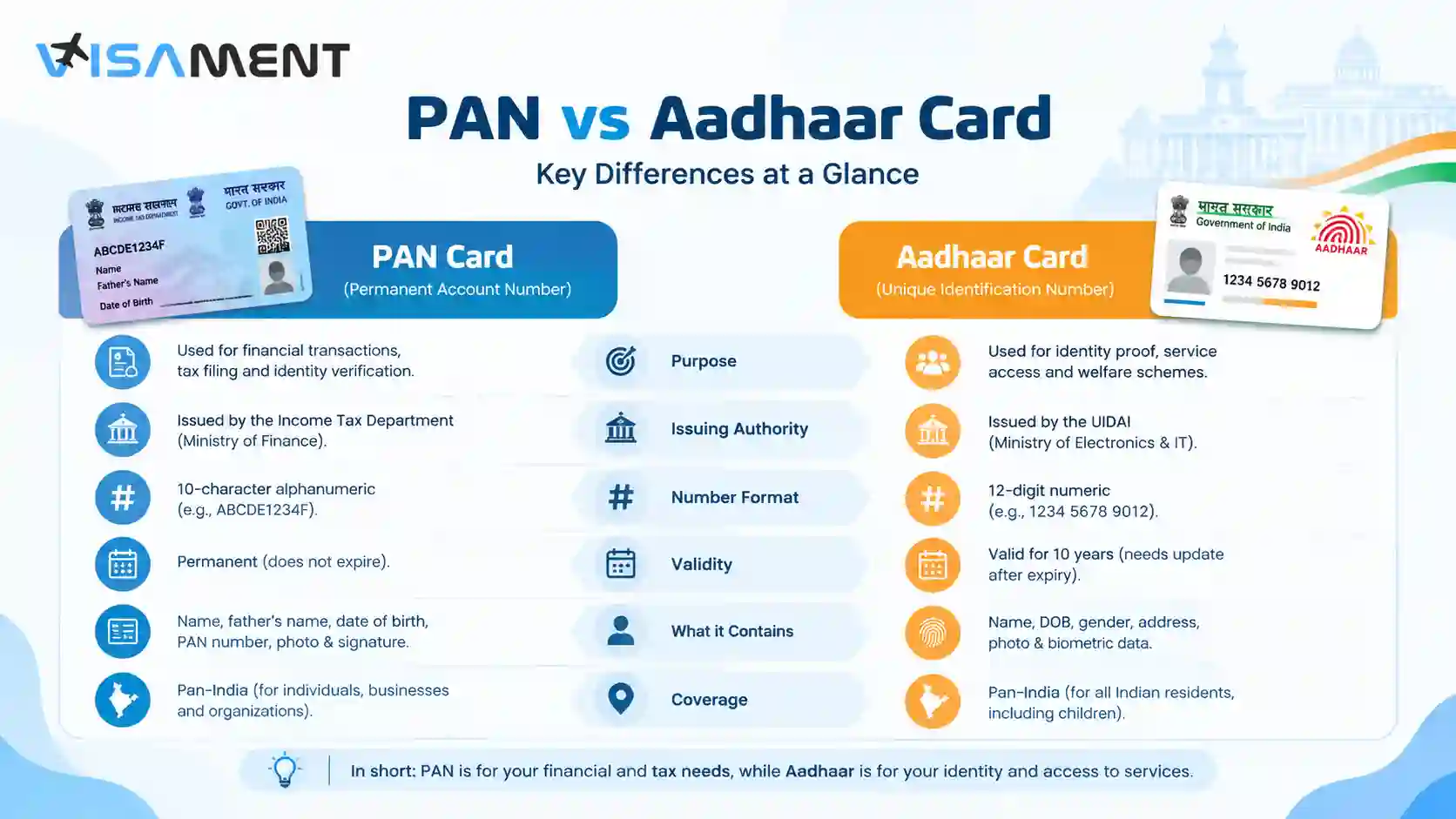
A major distinction is therefore function. PAN identifies a person or entity within the tax and financial reporting framework, while Aadhaar provides an identity platform that can be authenticated for applicable services.
Can Aadhaar Be Used Instead of PAN?
Aadhaar does not generally replace PAN when a transaction or compliance requirement specifically requires PAN.
Although Aadhaar can serve as an identity document and may be accepted for certain verification purposes, PAN has a separate role in the income-tax system. For example, a tax-related transaction may specifically require PAN even if the person also has a valid Aadhaar number.
The two identifiers can therefore appear together in financial or tax processes without having the same purpose.
There is also an important distinction between Aadhaar-based identity verification and tax identification. Aadhaar can help establish identity, while PAN is the identifier associated with the income-tax framework.
Can PAN Be Used Instead of Aadhaar?
PAN is not a general substitute for Aadhaar.
A PAN card may be accepted as one of several identity documents in particular situations, but it cannot perform Aadhaar-specific functions such as Aadhaar authentication.
For example, if a service requires Aadhaar authentication, providing PAN alone does not create an Aadhaar authentication record. The organisation or government service determines which identification method is applicable.
Do You Need Both PAN and Aadhaar?
There is no single answer that applies identically to every person.
Whether you need PAN, Aadhaar, or both depends on factors such as:
- Your residential or tax status
- The transaction or service you are using
- Whether PAN is required under applicable tax rules
- Whether you are eligible for Aadhaar
- Whether a particular service requires Aadhaar authentication
- Whether PAN-Aadhaar linking provisions apply to you
For example, a taxpayer may need PAN for income-tax-related compliance, while another service may request Aadhaar for identity authentication. Having both documents does not mean that they perform the same function.
The Income Tax Department's current guidance also provides exemptions from PAN-Aadhaar linking for specified categories, including certain non-residents and individuals who are not Indian citizens. Applicable exemptions and requirements should be checked against the latest official guidance.
PAN and Aadhaar for NRIs
NRIs often have questions about whether they need both documents. The answer depends on the purpose for which the document is being used.
An NRI may need PAN for Indian income-tax or financial matters where PAN is required. Having NRI status does not by itself mean that PAN is unnecessary.
Aadhaar has a separate eligibility framework. UIDAI's current 2026 handbook states that an NRI can enrol for Aadhaar if the NRI has an Indian passport, and the 182-day residency requirement applicable to resident enrolment does not apply to NRIs. The handbook also states that an Indian passport is mandatory as proof of identity for NRI Aadhaar enrolment.
This means an NRI should not assume either of the following:
- Every NRI must have Aadhaar.
- Every NRI is exempt from having PAN.
The appropriate requirement should be assessed according to the specific tax, banking, identity, or government service involved.
Why are PAN and Aadhaar Linked?
PAN-Aadhaar linking does not mean that PAN and Aadhaar are the same document. It establishes a relationship between two separate identifiers for applicable taxpayers.
The Income Tax Department provides an online PAN-Aadhaar linking facility and states that applicable individuals are required to link the two identifiers. The Department also identifies categories that are exempt from the linking requirement.
For current requirements, it is important to check the latest Income Tax Department guidance rather than relying on older articles or deadlines. Tax rules and terminology changed with the Income Tax Act, 2025 coming into force on April 1, 2026.
If you need the actual linking procedure, it is better to follow a dedicated PAN-Aadhaar linking guide rather than treating this comparison article as a step-by-step tutorial.
Which Document Should You Use?
The appropriate document depends on what the organisation or government service is asking for.
| Situation |
Document generally relevant |
| Income-tax identification |
PAN |
| Specified tax or financial transaction requiring PAN |
PAN |
| Aadhaar authentication |
Aadhaar |
| Aadhaar-based e-KYC |
Aadhaar |
| Identity verification where Aadhaar is accepted |
Aadhaar |
| Tax records associated with PAN |
PAN |
| PAN-Aadhaar compliance where applicable |
Both may be relevant |
This does not mean that every bank, government department, employer, or service provider will have identical documentation requirements. Always follow the requirements applicable to the specific transaction.
For example, a person opening or maintaining a financial relationship may encounter both PAN and Aadhaar during KYC or tax-related procedures. The fact that both documents are requested does not make them duplicates. Each may be serving a different verification or compliance purpose.
Common Mistakes to Avoid
1. Assuming PAN and Aadhaar are the same
They are separate identifiers issued under different systems.
2. Treating Aadhaar as proof of citizenship
UIDAI explicitly states that Aadhaar does not confer citizenship or domicile.
3. Assuming every NRI has the same Aadhaar requirement
Aadhaar eligibility and PAN requirements should be considered separately for NRIs.
4. Assuming PAN can replace Aadhaar authentication
PAN does not provide Aadhaar authentication.
5. Assuming Aadhaar eliminates the need for PAN
Where PAN is specifically required under applicable tax or transaction rules, Aadhaar does not automatically replace it.
6. Relying on outdated PAN information
India's income-tax framework changed from April 1, 2026. The Income Tax Department confirms that existing PAN numbers remain valid while new PAN application forms apply under the new framework.
Conclusion
The difference between PAN card and Aadhaar card is primarily a difference in purpose and function. PAN is designed for identification within the income-tax system and specified financial transactions, whereas Aadhaar is a UIDAI identity number that supports identity verification, authentication and applicable services.
Neither document should automatically be treated as a replacement for the other. Requirements also vary according to the individual, transaction, and service. For NRIs in particular, PAN and Aadhaar should be assessed separately rather than assuming that one document automatically determines the requirement for the other.
If you are unsure which PAN or Aadhaar documentation applies to your NRI or tax-related situation, review the specific requirements for the service before submitting documents.