Related Blogs

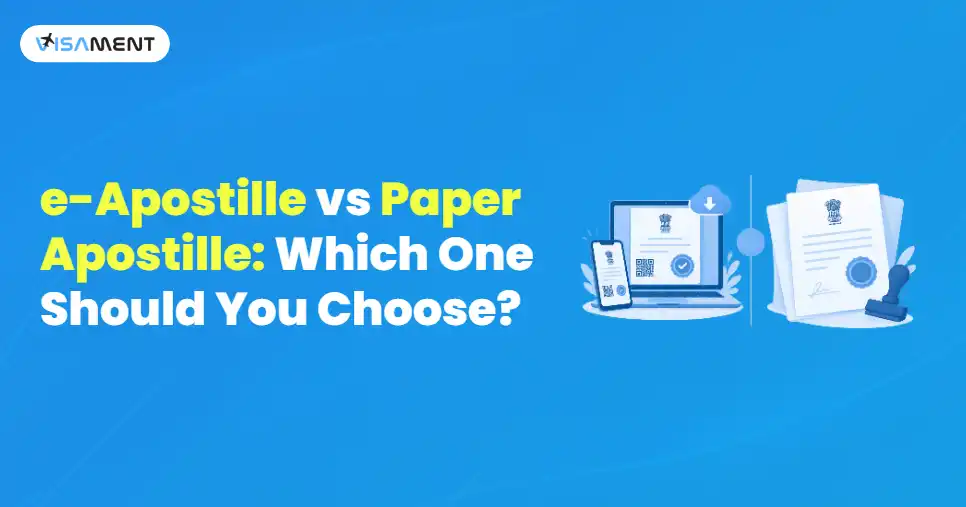
If you are wondering about the difference between an e-Apostille and a paper Apostille, the answer is simple: both serve the same legal purpose under the Hague Apostille Convention. The main difference is that an e-Apostille is issued electronically, while a paper Apostille is issued as a physical certificate attached to the document. Which one you need depends on your document type, the issuing authority, and the requirements of the receiving organization.
Read the blog below to learn more about e-apostille vs paper apostille, their validity, processing, verification, advantages, limitations, and practical use.
e-Apostille, or an electronic apostille, is the digital form of the traditional apostille.
It is the traditional form of an Apostille certificate. It is mostly issued by a competent authority in the country where the public document originates.
The key difference between the two lies in their format and method of handling and verification. However, both have the same function under the Hague Apostille framework.
The table below outlines the difference between e-apostille and paper apostille.
| Feature | e-Apostille | Traditional Paper Apostille |
|---|---|---|
| Format | Electronic | Physical |
| Issuance | Created and electronically signed | Issued as a physical certificate |
| Storage | Digital | Physical |
| Sharing | Can be shared electronically where accepted | Usually requires physical handling |
| Verification | May use an e-Register, digital signature, QR code, reference system | Uses the applicable physical document verification process |
| Physical handling | Usually reduced | Required |
| Hague framework | Same legal effect as a paper apostille | Traditional apostille format |
| Availability | Depends on the authority's e-Apostille implementation | Depends on the authority and document |
| Best suited for | Digital submission where accepted | Physical document submission |
Yes, an e-Apostille is also valid under the Hague Apostille Convention. It also has the same legal effect as the traditional paper apostille.
For instance, an organization might require the following:
Hence, an e-Apostille might be legally valid in general, but it does not guarantee that all organizations accept it in its digital form.
Note: Before choosing an Apostille format, always check the requirements of the organization receiving your document.
An e-Apostille might work more quickly than a paper apostille. However, it depends on the situation: electronic processing may eliminate physical printing, collection, courier delivery, or international shipping.
Keep in mind that an e-Apostille does not have a universal processing time. If you're applying on a tight deadline, understanding the urgent apostille process can help you plan your document legalization more efficiently
Tip: Do not assume a digital apostille will always be issued more quickly than a paper apostille.
The exact operation of an e-Apostille varies by country and relevant authorities. However, the general process includes the following steps.
1. Identify the Document
2. Complete any Required Authentication
3. Submit the Apostille Application
4. Obtain the e-Apostille
5. Verify the Apostille
A paper Apostille usually involves handling the physical document. The exact apostille process depends on the type of document and the receiving country.
It usually involves the following steps.
Note: Applicants must follow the correct instructions provided by the competent authority.
If you plan to use Indian documents overseas, you must first determine whether the destination country accepts an apostille. The document you are submitting must also qualify.
Indian documents might include:
The requirements might vary based on the type of document. Some Indian documents might require authentication or verification by the appropriate authority before Apostille processing.
Note: Never assume all Indian documents follow the same Apostille process.
Stop worrying about delays. Apply now and get your Apostille Certificate on time with our expert service.
The availability of an e-Apostille depends on the Apostille system and applicable rules for the document and jurisdiction. The digital Apostille Program supports e-Apostilles where the relevant authority has the relevant system.
You must also check:
It is necessary for submitting documents for education, employment, immigration, business, or legal purposes.
Technically, an e-Apostille has the same legal effect and functions just like a traditional apostille under the Hague Apostille framework.
Whether it can replace a paper Apostille depends on the applicable authorities and on the receiving organization. Before you opt for an e-Apostille, you must first confirm:
Note: A scanned copy of the paper apostille will not be considered an official e-Apostille.
There are various advantages and limitations of an e-Apostille.
An e-Apostille has several practical benefits such as:
e-Apostilles might not be suitable in all situations for the following reasons.
 Also Want to Know About FBI Criminal Background Check Apostille? Check Now!
The traditional paper apostille has both merits and demerits. These include:
Paper apostilles are needed when:
Paper apostilles usually involve:
You can use the table below to understand which is better for you.
| Situation | Suitable Option |
|---|---|
| Receiving organization accepts digital documents | e-Apostille |
| Receiving organization accepts only physical documents | Paper Apostille |
| Competent authority only offers paper apostille | Paper Apostille |
| Competent authority offers an e-Apostille, and your document qualifies | e-Apostille |
| You require convenient digital storage and sharing | e-Apostille |
| You need to submit a physical document package | Paper Apostille |
| You are unsure what the receiving authority accepts | Check the requirements before applying |
Note: Never choose an apostille format based purely on convenience. Always verify the requirements of the destination country and organization that receives your document.
The key difference between e-apostille and paper apostille is the method by which an Apostille is issued, stored, shared, or verified. An e-Apostille works on the same principle as a paper apostille, i.e., making digital document submission and verification easy wherever electronic systems are supported. On the other hand, a paper apostille remains important when relevant authorities require physical documents, or they do not have the required electronic process for your document.
For Indian documents, the correct option depends on the type of document, authentication requirements, issuing authority, destination country, and receiving organization. Always confirm before applying for an e-Apostille or paper apostille whether it is available for your document and whether the receiving organization accepts it.
You can also contact the experts at Visament if you need help understanding the apostille process for Indian documents, including the required documents and applicable authentication steps.
e-Apostilles are issued digitally, while paper apostilles are issued as physical certificates. Under the Hague Apostille Convention, an e-Apostille has the same validity as a paper apostille.
Yes, they are legally valid. The Hague Apostille Convention states that an e-Apostille is as valid as a paper Apostille and cannot be rejected solely because it is issued digitally.
No, it is different. An e-Apostille is an official electronic document issued through the applicable electronic Apostille system. A scan is just a digital image or copy of a physical document. The HCCH specifically distinguishes electronic documents from scanned ones.
An e-Apostille has the same validity as a paper Apostille under the Hague framework. However, you must confirm the receiving organization's submission requirements and the availability of an electronic process for your document.
You can use the official verification process provided by the competent authority that issued the Apostille. Depending on the jurisdiction, this might involve an electronic register or digital certificate.
The HCCH states that an e-Apostille cannot be refused just because it is digital and must be accepted by Contracting Parties under the Apostille Convention. Practical submission requirements will still vary based on the document and receiving organization.
An e-Apostille offers efficiency benefits, and the HCCH identifies faster processing as one of its potential advantages. However, actual processing times depend on the issuing authority and specific document.
Neither format is better for all situations. An e-Apostille can be more convenient when electronic documents are supported and accepted, while a paper Apostille might be appropriate when physical documentation is needed.
Vipul Jain is the Co-Founder of Visament, a trusted platform dedicated to simplifying Indian immigration, consular, and NRI services for applicants across the globe. With extensive expertise in OCI cards, Indian passport services, visa assistance, apostille and document legalization,... See Full Bio

Talk to our documentation experts for free guidance on your application.
How to Get a Birth or Marriage Certificate Apostilled in India?
What is Apostille? Definition, Meaning, and Importance
e-Apostille in India: Process, Benefits, Documents & Verification
How to Track Your Apostille Application: A Complete Guide
Fast Apostille Service Guide: Process, Documents & Timeline


When you visit a website, it may store data about you using cookies and similar technologies. Cookies can be important for the basic operations of the website and for other purposes. You get the option of deactivating certain types of cookies, even so, doing that may affect your experience on the website.
It is required to permit the basic functionality of the website. You may not disable necessary cookies.
Used to provide advertising that matches you and your interests. May also be used to restrict the number of times you see an advertisement and estimate the effectiveness of an advertising campaign. The advertising networks place them after obtaining the operator's permission.
Permits the website to recognize the choices you make (like your username, language, or the region you are in). Also provides more personalized and enhanced features.
Aid the website operator to determine how the website performs, how visitors interact with the site, and whether there are any technical issues.