Related Blogs

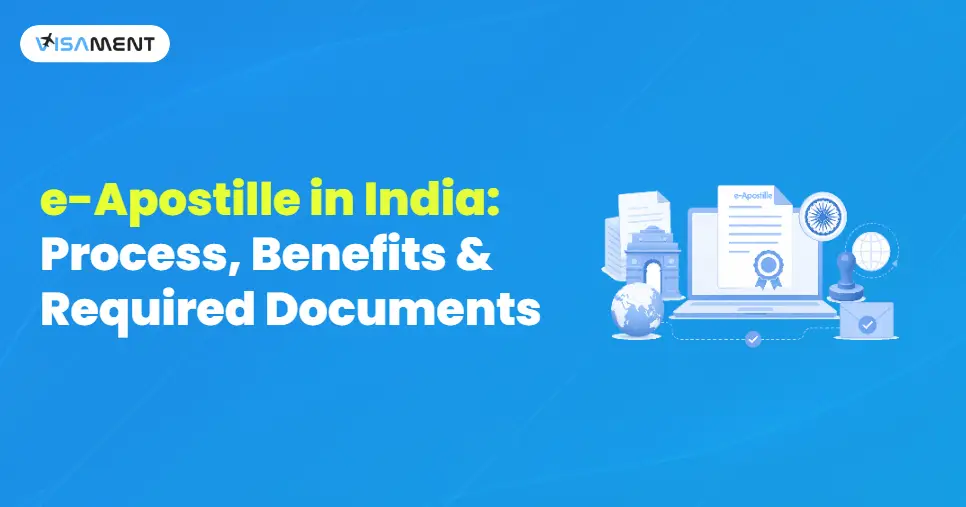
An e-Apostille, also known as an electronic apostille or digital apostille, is the digital version of a traditional apostille certificate that authenticates the origin of a public document for international use. Issued under the Hague Apostille Convention, an e-Apostille is digitally signed by the competent authority and can be securely stored as a PDF on your computer or mobile device for quick access and easy verification.
As more countries adopt digital document authentication, e-Apostilles have become a faster, more secure, and environmentally friendly alternative to paper apostilles. Whether you are planning to study abroad, accept an overseas job, expand your business internationally, or complete legal formalities in another country, you may need to apply for an Apostille to ensure your Indian documents are recognized in Hague Convention member countries with minimal paperwork and faster processing.
In this blog, you'll learn what an e-Apostille is, how it works, eligible documents, benefits, application process, verification method, processing time, and the differences between an e-Apostille and a traditional apostille.
An e-Apostille is a digitally issued apostille certificate that authenticates the origin of a public document for use in Hague Convention member countries. It is made up of secure electronic data and signatures. These are validated and verified by official e-Registers to prevent forgery. An e-Register is where the e-Apostille's identification number can be found and proven.
In India, the e-Apostille process is integrated with the e-Sanad platform, which enables the electronic verification and authentication of eligible public documents before they are issued with a digital apostille.
They are responsible for quick and safe cross-border ratification while also being environmentally friendly since they do not use paper.
An e-Apostille is useful for anyone who needs to submit Indian documents in another Hague Convention country. It is commonly required by:
Here is a list of documents that can be provided with an e-Apostille.
They mostly rely on a digital signature and a secure online database. Here is how they work:
Have questions? Our experts guide you through every step of the Apostille Service– no confusion, no delays.
Consult an Expert TodayThe table below outlines the major differences between a traditional apostille and an e-apostille.
| Feature | Traditional Apostille | e-Apostille |
|---|---|---|
| Format | Physical certificate or stamp affixed to a hard-copy document | Digitally signed and encrypted PDF |
| Delivery Method | Hand-delivered or sent via postal mail or courier | Delivered instantly via email or secure digital download |
| Processing Speed | Slower, usually takes days or weeks due to physical transit | Faster, often issued within hours |
| Security and Verification | Relies on physical stamps, signatures and manual verification | Relies on advanced digital signatures and electronic certificates that are verified online |
|
Document Type |
Best for original physical documents such as diplomas or hard-copy court documents or orders | Best for digitally generated or digital documents such as commercial registers |
| Global Acceptance | Universally accepted by all Hague Apostille Convention member countries |
Widely accepted Some foreign authorities may still demand a physical paper version |
The benefits of an e-Apostille include:
There are 3 major steps to obtain an e-Apostille. These are:
Firstly, the document must be authenticated by the competent authority in the country where the document was issued.
Both the traditional Apostille and e-Apostille have the same function: authenticating documents for use in foreign countries. Choosing between the two can be based on personal choice and what the official authorities prefer.
The e-Apostille has simplified international document authentication by offering a faster, safer, and paperless alternative to traditional apostilles. Whether you are planning to study abroad, work overseas, establish a business, or complete legal formalities in another country, an e-Apostille helps ensure your documents are recognized internationally. Before applying, always confirm the destination country's requirements and ensure your documents are properly authenticated.
If you need professional assistance, the experts at Visament can guide you through the entire e-Apostille process and help you complete your documentation accurately and without unnecessary delays.
Yes, you can print your e-Apostille. However, the printed copy acts only as a reference. The original e-Apostille is a digitally signed PDF. Officials verify its authenticity electronically rather than through a physical signature or stamp.
An e-Apostille itself does not legally expire and remains permanently valid once issued. However, foreign receiving authorities often require the underlying document to be recently issued.
You can verify an e-Apostille by using the unique certificate number on the issuing government's e-registry, scanning the QR code or validating the digital signature within the PDF document.
They are officially recognised by over 120 member countries of the Hague Apostille Convention. While all member nations should legally accept digital documents, specific authorities in countries such as the Netherlands, France, Italy and Spain are the most active and reliable adopters of an e-Apostille.
Vipul Jain is the Co-Founder of Visament, a trusted platform dedicated to simplifying Indian immigration, consular, and NRI services for applicants across the globe. With extensive expertise in OCI cards, Indian passport services, visa assistance, apostille and document legalization,... See Full Bio

Talk to our documentation experts for free guidance on your application.
How to Get a Birth or Marriage Certificate Apostilled in India?
What is Apostille? Definition, Meaning, and Importance
Difference Between Attestation and Apostille: Process, Fees & Documents
Understand What is a Digital Apostille Stamp & Included Details
Dos and Don'ts for the Smooth Apostille Process



When you visit a website, it may store data about you using cookies and similar technologies. Cookies can be important for the basic operations of the website and for other purposes. You get the option of deactivating certain types of cookies, even so, doing that may affect your experience on the website.
It is required to permit the basic functionality of the website. You may not disable necessary cookies.
Used to provide advertising that matches you and your interests. May also be used to restrict the number of times you see an advertisement and estimate the effectiveness of an advertising campaign. The advertising networks place them after obtaining the operator's permission.
Permits the website to recognize the choices you make (like your username, language, or the region you are in). Also provides more personalized and enhanced features.
Aid the website operator to determine how the website performs, how visitors interact with the site, and whether there are any technical issues.