Related Blogs

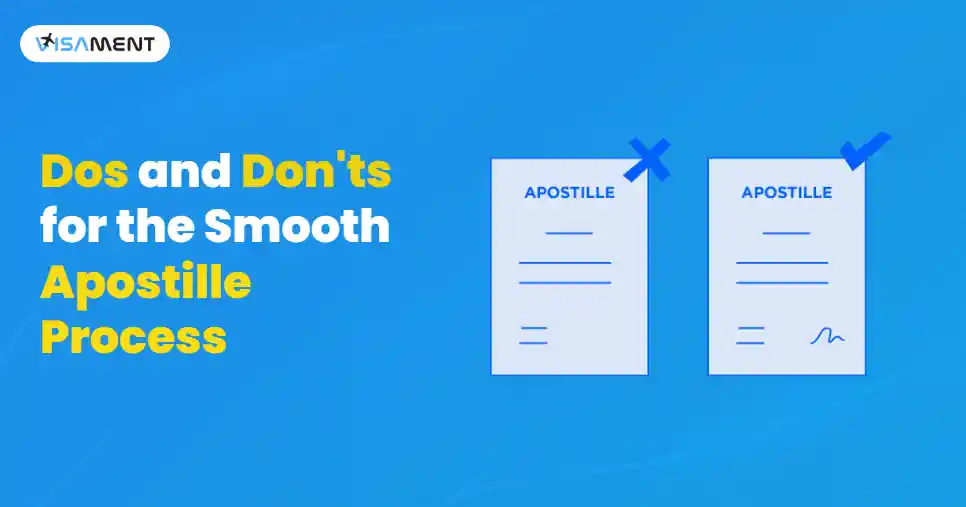
It is very important to obtain an Apostille because it is essential for the documents used in international transactions or personal matters. The process of applying may seem complex for several reasons. With the right approach and a better understanding of dos and don'ts, you can proceed with a smooth and efficient apostille process.
In this blog, we have provided some tips on how to apply for the apostillization of documents and what are the things you should take care of. You can understand the details with the dos and don'ts, and apply for an error-free apostille process on the first go.
Here are some of the things that you should keep in mind before applying for the document apostillization:
You should make sure that the document is authentic and error-free. The apostilles are affixed to the original documents, so you should make sure that all the necessary changes are made before the process starts.
You should understand the specific requirements for the document you want to apostille and research properly before the apostille process starts.
You should know the relevant competent authority that is responsible for issuing the apostilles in your country. Mostly, thisis a government agency, such as the Department of State in the United States.
You should start the process well in advance for apostillization. The processing time for an apostille can eb different, and you don't want to face any delays in the process.
In some of the cases, you have to retain the original document for the records. In these cases, you need to request the certified copies of the original documents and then get these copies apostilled.
If your document requires notarization before apostille, then you should make sure that it is qualified by a notary public and notarized properly.
You should keep the document in its original condition. The document should not be damaged, marked, or altered because the apostilles are generally affixed to a portion of the document.
You should fill out the application forms completely and accurately. Your apostille processing times can be delayed due to incorrect or incomplete forms.
You should be awaare about the Apostille fees before applying. These fees can be different as per the document and its issuing authority. You should make sure that you have enough funds for such costs.
 Also Want to Know About What To Do After Rejection of MEA Apostille Services? Check Now!
Here are some of the things that you should not do to avoid the pitfalls in the apostille process:
You should not leave the apostille process until the last minute because rushing can cause severe mistakes and increase your stress. You must plan and give yourself some buffer time for potential mistakes.
The research is very important, and you should not neglect it. If you skip this step, then it can lead to wasted time, incorrect procedures, and added expenses.
If the destination country has a different official language, then you should not overlook the translation requirements. In some countries, you should submit the documents with their translation into the local language before the apostille.
You should not assume that all the documents ahve similar process. Different documents may have unique requirements for the apostille, so you should always double-check it before initiating the process.
You should always avoid using unauthorized or non-certified service providers for obtaining an apostille. You should choose the government offices or reputable agencies for such crucial tasks.
You should not make any changes to the apostilled documents after they have been issued. If you make any alterations, then it can make your document invalid.
The requirements of the apostille can change depending on the state and the destination country. In some countries, there is a requirement for legalization or translation.
The legal validity is very important in the case of an apostille. If you fail to apostille a specific document, then this can lead to rejection or any serious legal complications in a foreign country.
The apostille process doesn't need to be daunting. You can complete the process very easily by keeping in mind all the dos and don'ts. You can proceed with the process, having full confidence, and make sure that your documents are authenticated properly, and you can use them internationally. If you have any questions or face some challenges during the process, then you can always consult the legal professionals or the relevant government authorities.
At Visament, we have a team of skilled professionals who can help you out with the apostille process. They are available on the platform 24/7 and are very patient with the customers. The prices on our platform are very affordable, and this can save you a lot of time and money. This can save you from many potential headaches while dealing with international transactions or legal matters.
Yes, an apostille can be rejected by the issuing authority or by the destination country's officials for various reasons. These reasons can be incorrect signatures, improper notarization, or a wrong application form.
When a document is apostilled, it receives an apostille certificate in the form of a stamp. It makes the document legalised and authenticated in the other countries that are members of the Hague Apostille Convention.
For most of the documents, it is important to get the notarization first on the document before it gets apostilled for authentication purposes.
Generally, for the apostille stamping, it takes around 2 to 3 working days for personal documents and 4 to 7 working days for other types of documents.
The apostilled document does not have any expiry date itself, but its validity is dependent on the type of documents and the rules of the receiving country.
There is a multistep process involved for the validation of the document. First, it starts with the notarization, and then it will move ahead to the state-level authenticationor regional authorities, and then get the Ministry of External Affairs (MEA) or an equivalent national authority to affix the stamp/sticker for the apostille to confirm its legitimacy in the Hague convention countries.
You can speed up the apostille process by using the professional, state-registered, or MEA-authorized apostille service providers who can offer you the same-day, expedited, or 24-72 hour services according to the type of your document.
If your document gets damaged after an apostille, then it will be considered unusable or invalid by all foreign authorities, especially if the apostille sticker is damaged or if it affects the legibility of the document.
Vipul Jain is the Co-Founder of Visament, a trusted platform dedicated to simplifying Indian immigration, consular, and NRI services for applicants across the globe. With extensive expertise in OCI cards, Indian passport services, visa assistance, apostille and document legalization,... See Full Bio

Talk to our documentation experts for free guidance on your application.



When you visit a website, it may store data about you using cookies and similar technologies. Cookies can be important for the basic operations of the website and for other purposes. You get the option of deactivating certain types of cookies, even so, doing that may affect your experience on the website.
It is required to permit the basic functionality of the website. You may not disable necessary cookies.
Used to provide advertising that matches you and your interests. May also be used to restrict the number of times you see an advertisement and estimate the effectiveness of an advertising campaign. The advertising networks place them after obtaining the operator's permission.
Permits the website to recognize the choices you make (like your username, language, or the region you are in). Also provides more personalized and enhanced features.
Aid the website operator to determine how the website performs, how visitors interact with the site, and whether there are any technical issues.