Related Blogs

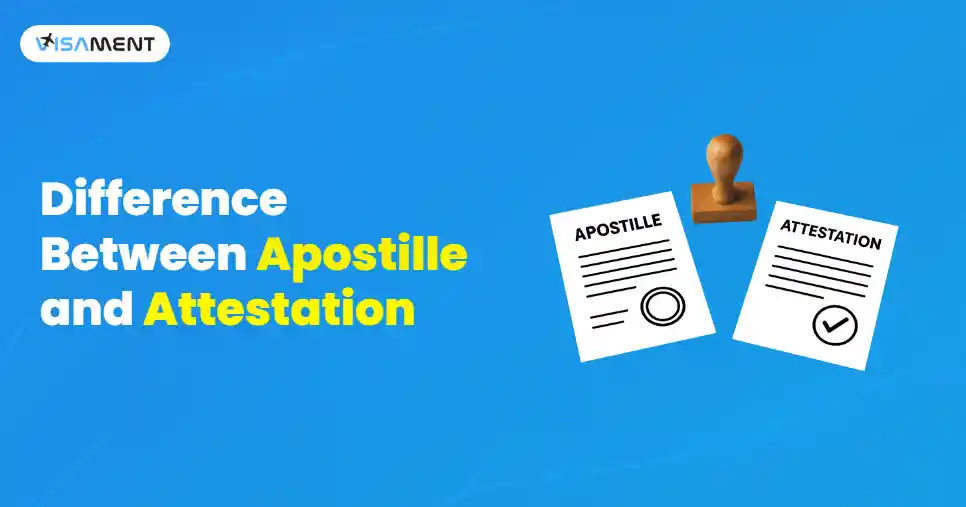
While you prepare the documents to use them internationally, it is very important to understand the processes of attestation and apostille. These procedures are necessary as they validate your public documents and make sure that they are legally recognised in foreign countries. Although both are almost similar processes, they have different functions, and they are applicable in different contexts.
In this blog, you'll learn the key differences between attestation and apostille, and you can learn which legal document is needed for international use and how you can obtain them by ensuring their validity. Both aspects are clarified in this content, and which process is applicable in which country. We have also mentioned the Hague Apostille Convention and how it affects the choice between apostille vs attestation.
Attestation is the process of verifying the authenticity of a document so that it can be legally accepted in another country. It confirms that the document is genuine through verification by the appropriate government authorities.
Unlike an apostille, attestation is a multi-step process that generally includes authentication by the State Government, the Ministry of External Affairs (MEA), and the Embassy or Consulate of the destination country.
Although the terms attestation and apostille are sometimes used interchangeably, they are different procedures. Both authenticate documents for international use, but attestation is required only for countries that are not members of the Hague Apostille Convention, 1961.
An apostille is a process for document legalization that can be used in foreign countries that have signed the Hague Convention for various purposes.
In India, apostilles are issued by the Ministry of External Affairs (MEA) through its authorized service providers. The apostille is issued as a square-shaped sticker containing a unique identification number that verifies the authenticity of the document.
The apostille stamp includes a unique stamp that can only be obtained by members of the country that are included in the Hague Apostille Convention. For a document with an apostille stamp, there is no need for further verification by any government office.
An apostille is required to legalize documents for use in countries that are members of the Hague Apostille Convention.
Common documents that require an apostille include:
Attestation is required when submitting documents to countries that are not members of the Hague Apostille Convention.
It is commonly required for:
Educational certificates, personal documents, medical certificates, and commercial documents often require attestation.
If the destination country requires attestation, submitting unattested documents may delay or lead to the rejection of your visa or application.
|
Attestation
|
Apostille
|
|---|---|
|
Attestation is carried out by state authorities, the Ministry of External Affairs (MEA), and the embassy/consulate of the destination country.
|
An apostille is issued under the Hague-Convention treaty of 1961.
|
|
The attestation is used for the documents and certificates that are submitted to the department and institutions.
|
The apostille verifies the authenticity of documents and certificates.
|
|
For the attestation, you need a consular official to confirm the documents' authenticity.
|
The apostilles are not required for legalization by a consular or any diplomatic authority.
|
|
The attestation seal is used to verify the certificate, and there is no language barrier.
|
Apostilles are recognized by all member countries of the Hague Apostille Convention.
|
 Also Want to Know About Certificate Attestation? Check Now!
Have questions? Our experts guide you through every step of the Apostille Services– no confusion, no delays.
Consult an Expert TodayAttestation is a multi-stage document authentication process.
The process generally follows this order:
 Also Want to Know About How to Track Apostille Application? Check Now!
There are three types of attestation done for the documents:
Also Want to Know About What is an e-Apostille? Check Now!| Type of Service | MEA Fees | Outsourcing Agency Fees | |
|---|---|---|---|
| Service Charge | Scanning charge | ||
| Apostille | INR 50 per apostille sticker | INR 84 for each document | INR 3 for each page |
| Attestation | Free | INR 84 for each document | INR 3 for each page |
| Step or Route | Processing Time | What it Means |
|---|---|---|
| Fast-Track (SDM) | 2 to 5 working days | Best for simple, personal documents handled by local agencies. |
| Official MEA Channel | 5 to 7 working days | The standard processing window used by official government partner hubs. |
| Traditional State HRD Route | 2 to 4 weeks | Required for complex educational degrees that need university verification first. |
No, an apostille and an attestation are not similar. In Attestation, there are many levels for verification, such as notary, state, and embassy stages. It is used for those countries that are not a part of the Hague Convention. While an apostille is a single-step certification for the documents, it is used for the member countries of the Hague Convention, and it is simpler and universally recognized.
The main difference between an apostille and attestation (authentication) is in their application and processes. In attestation, the document is verified by different government bodies, and it is valid for non-Hague countries. On the other hand, an Apostille is a process that certifies the documents to use in any of the Hague-Convention countries.
The apostille is used to certify the authenticity of official documents. It also makes sure that these documents are recognised in the other member countries of the Hague Apostille Convention. The Apostillization process makes the verification of international document bery easy and cross-border administrative and legal processes very efficient.
Normal attestation's purpose is to verify the documents for Non-Hague Convention Countries, which often includes state-level, HRD, or notary verification. Additional attestation works at a higher level; it specializes in stamps from the destination's country embassy and government ministries to make the documents legally valid for international use.
You can apostille many documents, such as public documents (marriage, birth, and death certificates), commercial documents (incorporation certificates, Power of Attorney), and educational certificates (diplomas, degrees, transcripts).
Apostille or Attestation both serve different purposes and are used in different ways. An apostille authenticates the documents to use in the member countries of the Apostille Convention, while an Attestation is done to verify the authenticity of the document to use in any country that is not a member of the Hague Convention.
Vipul Jain is the Co-Founder of Visament, a trusted platform dedicated to simplifying Indian immigration, consular, and NRI services for applicants across the globe. With extensive expertise in OCI cards, Indian passport services, visa assistance, apostille and document legalization,... See Full Bio

Talk to our documentation experts for free guidance on your application.


When you visit a website, it may store data about you using cookies and similar technologies. Cookies can be important for the basic operations of the website and for other purposes. You get the option of deactivating certain types of cookies, even so, doing that may affect your experience on the website.
It is required to permit the basic functionality of the website. You may not disable necessary cookies.
Used to provide advertising that matches you and your interests. May also be used to restrict the number of times you see an advertisement and estimate the effectiveness of an advertising campaign. The advertising networks place them after obtaining the operator's permission.
Permits the website to recognize the choices you make (like your username, language, or the region you are in). Also provides more personalized and enhanced features.
Aid the website operator to determine how the website performs, how visitors interact with the site, and whether there are any technical issues.