Related Blogs

Your Indian tax status as a returning OCI holder depends on how many days you spend in India and how many earlier years you were non-resident. RNOR, short for resident but not ordinarily resident, is the in-between status many people get in their first years back. For a US-based OCI holder moving to India, it decides how India treats your US salary, your US bank interest, and your American investments in the year you return. Getting it wrong means filing as the wrong kind of taxpayer for that year.
A returning OCI holder who has lived in the US for most of the last decade and moves to India for good usually becomes resident in the year they cross the day-count test, and RNOR for that year because of their long time abroad. What changes the answer most is your past: years you already spent living in India in the last decade can take RNOR off the table from your first year back.
RNOR is a tax status under Indian income-tax law, and the tests that decide it count your days in India and your past years. OCI documentation and Indian tax residence are separate questions, and tax residence is worked out from your own dates.
For a returning OCI holder, three statuses matter, and an Indian passport holder or OCI holder can land in any of them:
The year that matters is the tax year, which starts each April. Check your status separately for each tax year, because your days in India and your past years both move on every April.
Many returning OCI holders gave up Indian citizenship years ago, and that Indian passport surrender has no bearing on the tax test either. And if your OCI card itself needs fixing before the move, Visament can help with your OCI card application.
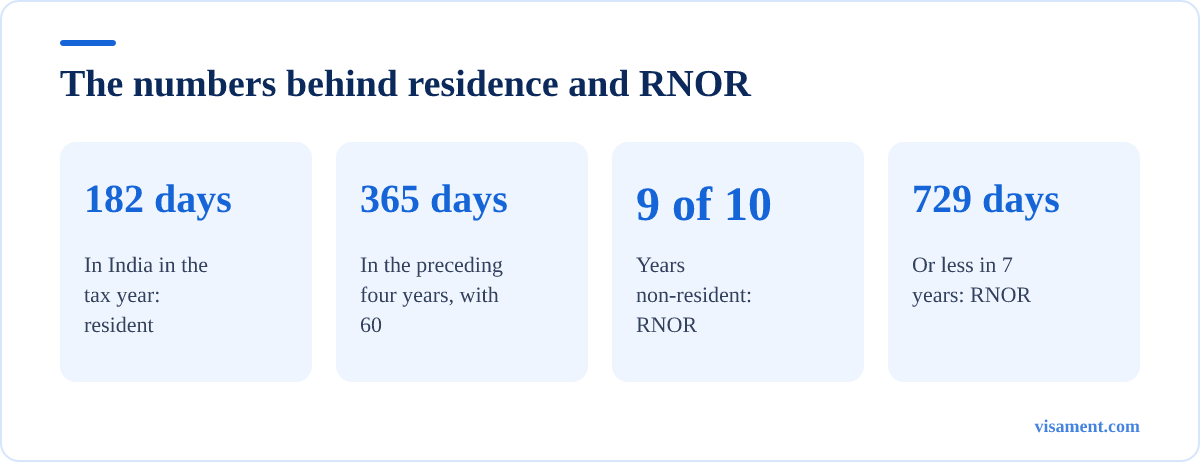
You become resident in India for a tax year if you stay in India for 182 days or more during that year. That rule applies to tax years beginning on or after 1 April 2026. There's a second route too: you're also resident if you stay 60 days or more in the year and 365 days or more during the preceding four years.
That second route changes for some people. For an Indian citizen or person of Indian origin visiting India, the 60-day figure becomes 120 days where total income other than income from foreign sources exceeds ₹15 lakh. Count your days from your passport stamps and travel records, not from memory.
People usually get the year of your move wrong. Arriving halfway through the tax year doesn't mean you're non-resident for it: your earlier visits that year count too.
Example: Meera Iyer is a US citizen with an OCI card who has lived in San Jose since 2008. She spent 20 days in Chennai in June 2026, then moved to Bengaluru for good on 15 October 2026. She assumed that arriving in October kept her an NRI for the 2026-27 tax year. From 15 October 2026 to the end of that tax year, she's in India for 168 days, and with the June visit, that's 188 days. Under the rule that you're resident if you stay 182 days or more in the year, she's resident for 2026-27. Filing as a non-resident would have put her return on the wrong footing for that whole year.
Once you're resident, you're RNOR if you were non-resident in nine out of the ten preceding years, or stayed in India for 729 days or less during the seven preceding years. That's the rule in section 6(13) of the Income Tax Act, 2025, and meeting either condition is enough. Meera, who lived abroad for all ten earlier years, meets both, so she's RNOR for 2026-27.
Check your tax residence and your account status separately, including how India's foreign-exchange rules, FEMA (Foreign Exchange Management Act), treat your accounts.
Have questions? Our experts guide you through every step of the OCI Card Service– no confusion, no delays.
Consult an Expert TodayA non-resident fails the day-count test, an RNOR passes it and meets at least one RNOR condition, and an ordinary resident passes it and meets neither. The tests run in that order: residence first, RNOR second.
| Status | Day-count test for the year | RNOR conditions |
|---|---|---|
| Non-resident | Not met | Not relevant |
| RNOR | Met | At least one met |
| Resident and ordinarily resident | Met | Neither met |
The term NRI is commonly used to describe a person who isn't resident for the tax year. RNOR is still a resident status. An ordinary resident is a resident who has neither of the RNOR conditions.
Your status affects how India looks at both your Indian income and your foreign income. Rent from a flat in Pune, interest on an Indian account, or a salary from an Indian employer still needs to be considered under the rules for your status.
Foreign income is where the status matters. Being RNOR rather than an ordinary resident can change how India treats your US salary, US bank interest, and US investment income. But "foreign income is tax-free while I'm RNOR" is too loose a rule to file on. Income that comes from a business you run from India, or money that lands in India, is treated differently from income earned and paid out in the US, and the line between them is something a tax professional should draw with your actual accounts.
NRE and FCNR deposits should be checked under the rules that apply to each account before you change them.
RNOR ends in the first tax year you're resident and meet neither RNOR condition. In other words, once you've been resident in at least two of the last ten years and spent more than 729 days in India over the last seven, you're no longer RNOR and become an ordinary resident.
That point arrives sooner for people who lived in India before. Each year is tested again, so check both conditions every April rather than assuming your first year's status carries forward.
Example: Sunil Varghese, a US citizen with an OCI card, worked in Hyderabad from 2019 to 2023 before moving to Seattle. He came back to India for good on 1 May 2026 and expected two or three years as RNOR. But he'd spent about 1,400 days in India in the seven years before 2026-27, well over 729, and he'd been resident in four of the ten earlier years, so he wasn't non-resident in nine of ten. Under the RNOR test, he meets neither condition. He's an ordinary resident from his very first year back, and any plan he'd built around a few RNOR years doesn't apply.
Start with a day count. Write down every entry and exit date for the current tax year and the seven before it, and note which of the last ten years you were resident in India. Then put your income into two piles, Indian and foreign, with the account each one is paid into. If your history includes years living in India, as Sunil's did, take that worksheet to an Indian tax professional before you file a return, close a US account, or convert an NRE deposit, because those earlier years decide whether you get any RNOR years at all.
Yes. The residence test applies to any individual, so an OCI holder who stays in India for 182 days or more during a tax year beginning on or after 1 April 2026 is resident for that year. You can also be resident by staying 60 days or more in the year and 365 days or more during the preceding four years.
You must first be resident for the tax year. You're then RNOR if you were non-resident in India in nine out of the ten preceding years, or stayed in India for 729 days or less during the seven preceding years. That's the rule in section 6(13) of the Income Tax Act, 2025, and meeting either condition is enough.
No. RNOR applies only for a tax year in which you're resident and meet at least one RNOR condition: non-resident in nine of the ten preceding years, or 729 days or less in India over the seven preceding years. Someone who already lived in India for several recent years can be an ordinary resident from their first year back.
The 120-day figure applies to an Indian citizen or person of Indian origin visiting India, where total income other than income from foreign sources exceeds Rs. 15 lakh. For that person, the 60-day part of the second residence route becomes 120 days, alongside 365 days or more in India during the preceding four years.
No. RNOR is a status under Indian income-tax law, decided by your days in India and whether you were non-resident in earlier years. Your US tax position is decided under US rules, so you can have a status in India and a separate status in the US for the same period.
Vipul Jain is the Co-Founder of Visament, a trusted platform dedicated to simplifying Indian immigration, consular, and NRI services for applicants across the globe. With extensive expertise in OCI cards, Indian passport services, visa assistance, apostille and document legalization,... See Full Bio

Talk to our documentation experts for free guidance on your application.




When you visit a website, it may store data about you using cookies and similar technologies. Cookies can be important for the basic operations of the website and for other purposes. You get the option of deactivating certain types of cookies, even so, doing that may affect your experience on the website.
It is required to permit the basic functionality of the website. You may not disable necessary cookies.
Used to provide advertising that matches you and your interests. May also be used to restrict the number of times you see an advertisement and estimate the effectiveness of an advertising campaign. The advertising networks place them after obtaining the operator's permission.
Permits the website to recognize the choices you make (like your username, language, or the region you are in). Also provides more personalized and enhanced features.
Aid the website operator to determine how the website performs, how visitors interact with the site, and whether there are any technical issues.