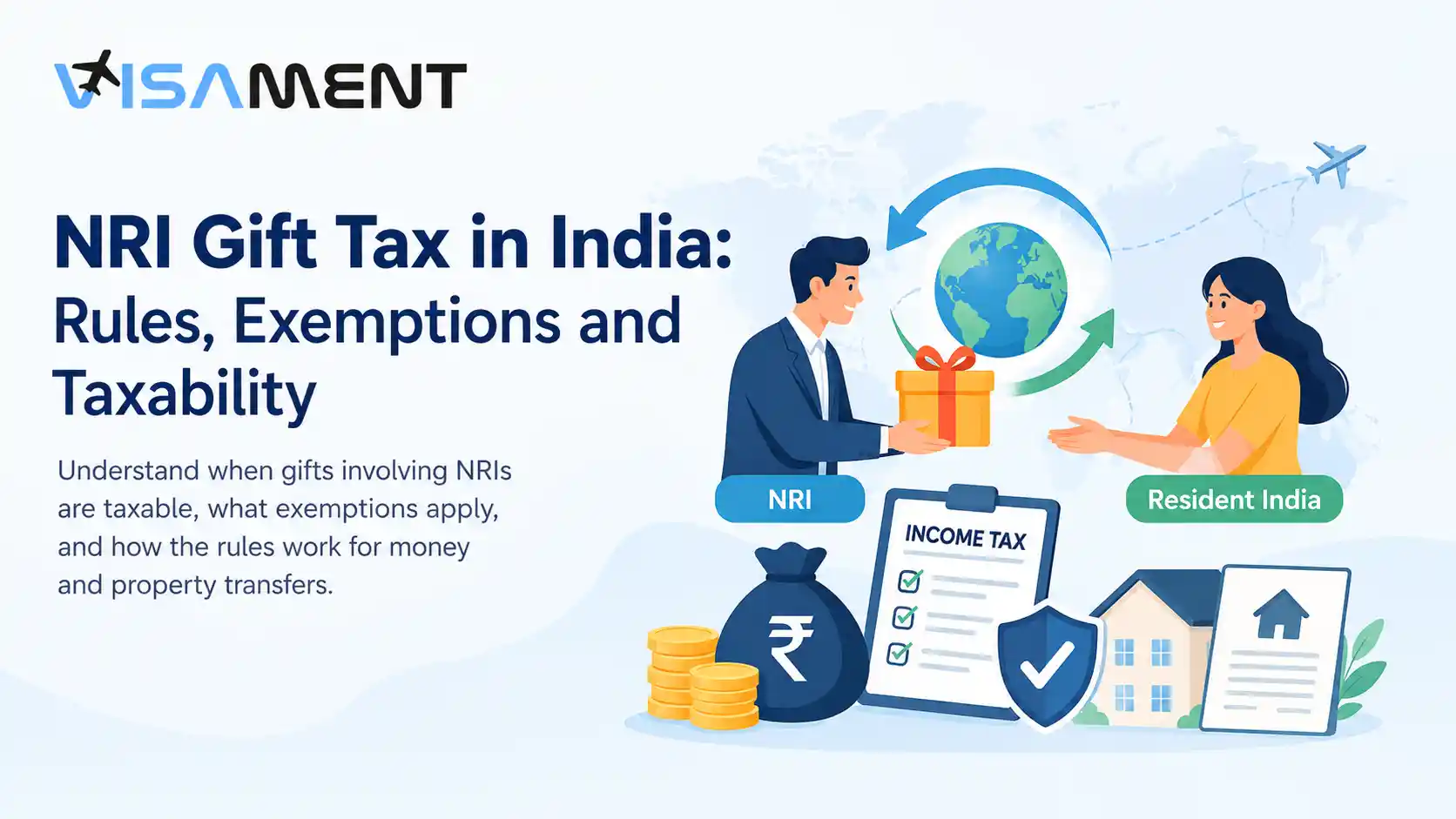
If an NRI sends money to family in India—or an Indian resident gifts money to someone living abroad—does the recipient have to pay tax? NRI gift tax in India depends on the type and value of the gift, the relationship between the giver and recipient, the direction of the transfer, and the applicable tax exemptions.
This guide explains the current Indian income-tax treatment of gifts involving NRIs, including monetary gifts, property, the ₹50,000 threshold, relatives, marriage gifts, and the difference between income-tax and FEMA rules.
Key Takeaways
- NRI status alone does not determine gift taxability. The relationship, direction of the gift, asset involved and applicable exemption also matter.
- For gifts covered by the monetary-gift provision, ₹50,000 is an aggregate threshold, not a separate exemption for every transaction.
- Gifts from specified relatives are generally outside the gift-tax provision, regardless of the amount, subject to the applicable statutory conditions.
- Gifts received on the occasion of an individual's marriage are covered by a specific exemption.
- Gifts received from abroad are not automatically exempt merely because the donor lives outside India.
- A monetary gift from an Indian resident to an NRI can have a different Indian tax treatment under the deeming rules for income arising from payments by residents to non-residents.
- Income-tax rules and FEMA rules are separate. A gift that is not taxable does not automatically mean that every foreign-exchange or remittance requirement has been satisfied.
Is There a Gift Tax for NRIs in India?
India does not currently impose a separate standalone gift tax simply because someone gives a gift. Instead, certain gifts are brought within the income-tax framework and may be taxable in the hands of the recipient as income from other sources.
For the current tax framework, the Income-tax Act, 2025 contains the corresponding gift provision in Section 92(2)(m). The earlier Income-tax Act, 1961 used Section 56(2)(x) for this treatment.
The important point is that the provision is not limited to Indian residents. The Income Tax Department's guidance explains that the gift rules can apply irrespective of the residential status of the donor or recipient.
Therefore, an NRI should not assume that a gift is automatically outside Indian tax rules simply because the money originates outside India.
The tax question should instead be approached by checking:
- Who is giving the gift?
- Who is receiving it?
- Is the donor a specified relative?
- What is being gifted?
- What is its value?
- Does a specific exemption apply?
- Are separate FEMA or banking rules relevant?
When Is a Gift Received by an NRI Taxable?
A gift received by an NRI cannot be classified as taxable or tax-free solely from the recipient's NRI status.
One important situation is a monetary gift from an Indian resident to an NRI or RNOR. Indian tax law contains a specific deeming rule under which certain money paid without consideration by a person resident in India to a non-resident can be treated as income accruing or arising in India. The Income Tax Department explains that this rule was introduced to prevent resident-to-non-resident monetary gifts from escaping Indian taxation merely because the recipient was outside India.
The statutory exceptions still matter. For example, the relationship between the resident donor and NRI recipient can affect whether the gift falls within an exemption.
Example: An Indian resident parent gifts money to a child who is an NRI. The fact that the child lives overseas does not, by itself, determine the Indian tax treatment. The relationship and the applicable exemption must be considered along with the nature and amount of the gift.
For a substantial resident-to-NRI transfer, it is also important to check the applicable FEMA and banking requirements separately from the income-tax analysis.
When Is a Gift From an NRI to an Indian Resident Taxable?
This is one of the most common NRI gift-tax questions.
A monetary gift received by an Indian resident from an NRI can be taxable under the gift provisions if it is received without consideration, exceeds the applicable threshold and does not qualify for an exemption. The fact that the money came from outside India does not by itself make the gift tax-free. The Income Tax Department expressly states that qualifying gifts received from India or abroad can be taxable when the statutory conditions are met.
For qualifying monetary gifts from non-relatives, the ₹50,000 test is based on the aggregate amount received during the relevant tax year. If the aggregate exceeds ₹50,000, the applicable rule can bring the entire qualifying amount into taxation, rather than taxing only the amount above ₹50,000.
|
Situation
|
General tax consideration
|
|
NRI parent → Indian child
|
Relative exemption can apply
|
|
NRI sibling → Indian sibling
|
Relative exemption can apply
|
|
NRI spouse → Indian spouse
|
Relative exemption can apply
|
|
NRI friend → Indian resident
|
₹50,000 aggregate threshold can become relevant
|
|
NRI non-relative → Indian resident
|
Taxability depends on the applicable threshold and exemptions
|
|
Gift received on the recipient's marriage
|
Specific marriage exemption can apply
|
These are general illustrations. The actual result depends on the facts and the law applicable to the transaction.
Gift From an NRI Relative
A gift from an NRI does not become taxable merely because the donor is an NRI.
The statutory definition of relative is important. For an individual, it includes the spouse; brother or sister; brother or sister of the spouse; brother or sister of either parent; lineal ascendants and descendants of the individual or spouse; and spouses of certain persons in these categories.
This means that “family member” should not be used as a loose substitute for the legal definition. A person may be a close family friend, for example, without being a “relative” for this particular tax provision.
Gift From an NRI Friend or Other Non-Relative
A friend is generally not included in the statutory definition of relative.
Therefore, if an Indian resident receives monetary gifts from an NRI friend, the ₹50,000 aggregate threshold and other applicable conditions need to be considered.
For example, suppose an Indian resident receives ₹30,000 from an NRI friend in one transaction and ₹25,000 from another non-relative during the same year. The combined ₹55,000 crosses the ₹50,000 threshold. Under the gift provision, the relevant taxable amount can be the entire ₹55,000, rather than merely the ₹5,000 excess.
Which Relatives Can Give Tax-Free Gifts?
For gifts covered by the relative exemption, the relationship—not the donor's NRI or resident status—is the key factor.
For an individual, the specified relatives include:
- Spouse
- Brother or sister
- Brother or sister of the spouse
- Brother or sister of either parent
- Lineal ascendant or descendant of the individual
- Lineal ascendant or descendant of the spouse
- Spouse of persons covered by the specified categories
The Income Tax Department lists these relationships in its guidance on gifts.
For example, a qualifying gift from an NRI father to an Indian resident child falls within the relative category. The same general principle can apply to qualifying gifts between other relationships specifically covered by the statutory definition.
What About Property Gifts From an NRI?
Gift-tax treatment is not limited to cash.
The provisions can also cover immovable property and specified categories of movable property, such as shares and securities, jewellery, works of art, bullion and virtual digital assets.
The valuation rules differ depending on the asset.
|
Gift type
|
Main point to check
|
|
Money
|
Aggregate qualifying gifts above ₹50,000 can be taxable
|
|
Immovable property received without consideration
|
Stamp duty value above ₹50,000 can trigger taxation
|
|
Specified movable property
|
Aggregate fair market value above ₹50,000 can trigger taxation
|
|
Gift from specified relative
|
Exemption may apply
|
|
Gift received on marriage
|
Specific exemption may apply
|
|
Inheritance/will
|
Separate statutory exclusion applies
|
For an immovable property received as a gift, the stamp duty value can be relevant. For specified movable property, the fair market value is relevant under the applicable provisions.
Because property gifts can also involve registration, valuation, FEMA and other legal considerations, a property transaction should not be treated exactly like a simple bank transfer.
Gift Tax vs FEMA: Why the Two Rules Should Not Be Confused
Income-tax and FEMA answer different questions.
Income-tax rules ask whether the receipt or transfer creates an Indian tax consequence. FEMA and RBI rules deal with foreign-exchange transactions, permitted transfers and the movement of money or assets across borders.
For example, RBI rules have permitted certain resident individuals to make rupee gifts to NRI/PIO close relatives through specified banking channels, subject to the applicable conditions and limits.
That does not mean every gift between a resident and an NRI is automatically permitted under every circumstance.
Before making a significant cross-border gift, check both:
- Income-tax treatment
- FEMA/RBI requirements
- Appropriate banking channel
- Donor and recipient residency status
- Relationship between the parties
- Nature and value of the asset
A tax exemption should therefore not be interpreted as a blanket FEMA exemption.
What Documents Should You Keep for an NRI Gift?
For a substantial gift, maintaining a clear documentary trail can help establish that the transaction was genuinely a gift and explain its source.
Depending on the transaction, useful records may include:
- Bank statements showing the transfer
- Gift deed or written gift declaration, where appropriate
- Donor and recipient identification details
- Evidence of the relationship between donor and recipient
- Documents supporting the source of funds, where relevant
- Property valuation and transfer documents for property gifts
- Relevant correspondence or declarations describing the transaction
A gift should also be distinguishable from a loan, repayment, business payment or consideration for a transaction. The documentation should accurately reflect the actual nature of the transfer.
There is no need to assume that every monetary gift legally requires the same paperwork. Documentation requirements can vary according to the asset, transaction and applicable regulations.
Examples of NRI Gift Tax Treatment
Example 1: NRI Parent Gives ₹5 Lakh to an Indian Child
An NRI parent gives ₹5 lakh to an adult child living in India.
The ₹50,000 threshold should not be viewed in isolation. Because a parent falls within the statutory relative definition, the relative exemption can apply to the qualifying gift.
Example 2: NRI Friend Gives ₹5 Lakh to an Indian Resident
An NRI friend transfers ₹5 lakh to an Indian resident as a personal gift.
A friend is not included in the statutory definition of relative. If no other exemption applies, the ₹50,000 aggregate threshold becomes relevant, and the qualifying amount can be taxable in full once the threshold is exceeded.
Example 3: Indian Resident Parent Gives Money to an NRI Child
An Indian resident parent transfers money to an NRI child.
The transaction needs to be examined under both the gift provisions and the specific rule dealing with money paid by an Indian resident to a non-resident. The relative relationship is particularly important when determining the applicable exemption.
Example 4: NRI Gives Property to an Indian Relative
An NRI transfers qualifying immovable property to an Indian relative.
The transaction should be assessed under the property-gift provisions rather than applying the ₹50,000 cash-gift rule mechanically. The relationship exemption, stamp duty value and applicable FEMA/property-transfer requirements should all be checked.
What Should You Check Before Sending or Receiving an NRI Gift?
Before making a significant cross-border gift, confirm:
- Residency status of both parties.
- Direction of the transfer—NRI to resident or resident to NRI.
- Relationship between donor and recipient.
- Type of gift—money, immovable property or specified movable property.
- Value of the gift and the relevant valuation method.
- Whether a statutory exemption applies.
- Whether FEMA/RBI and banking requirements apply.
- Whether sufficient documentation and transaction records are available.
For complex transactions, especially large gifts or property transfers, obtaining professional tax advice before completing the transaction can help avoid preventable compliance problems.
Chat to Support on Whatsapp
Stop worrying about delays. Apply now and get Indian Counsellor Services.
Chat Now Conclusion
NRI gift tax in India is not determined simply by whether the donor or recipient lives outside India. The correct treatment depends on the direction of the transfer, relationship between the parties, type and value of the gift, applicable exemption and separate FEMA requirements.
For monetary gifts from non-relatives, remember that the ₹50,000 threshold is an aggregate test, while gifts from specified relatives and gifts received on marriage can qualify for statutory exemptions. Cross-border transfers should also be reviewed separately for FEMA and banking compliance.
If you are planning a large monetary or property gift involving an NRI, it is sensible to verify the current tax and foreign-exchange rules before completing the transaction.