Related Blogs

An Overseas Citizen of India (OCI) card does not automatically exempt you from Indian income tax or determine your tax residency. Your obligations depend on your residential status under Indian tax law, the source and nature of your income, and any applicable exemptions or tax treaty relief. This guide explains the key rules, including the changes introduced from 1 April 2026, so you can identify which issues apply to your circumstances.
Yes, an OCI cardholder may have to pay income tax in India. Whether tax is payable depends on the person's residential status, the income involved, and the provisions applicable to that income.
For example, an OCI cardholder living in the United Kingdom may still have Indian tax obligations if they receive rent from a property in India. Conversely, an OCI cardholder who relocates to India does not necessarily become taxable on every item of overseas income immediately; the applicable residency category and statutory rules must first be established.
Indian tax law generally distinguishes between income received or accruing in India and foreign income. The scope of taxable income changes according to residential status and relevant exceptions.
No. An OCI cardholder is a foreign citizen who holds OCI status, while tax residency is determined separately under the applicable tax legislation. The Ministry of External Affairs confirms that OCI cardholders are foreign nationals and are not Indian citizens.
|
Status or concept |
What it determines |
|---|---|
|
OCI status |
Immigration-related status and associated privileges in India |
|
Indian income-tax residency |
How Indian tax law treats the person's income |
|
FEMA residency |
Relevant foreign-exchange and banking treatment |
The term Non-Resident Indian (NRI) can also have different meanings in different legal contexts. Income-tax residency and residency under the Foreign Exchange Management Act (FEMA) should not be treated as interchangeable.
An OCI cardholder may qualify as a non-resident for Indian income-tax purposes, but that conclusion must be based on the applicable tax tests—not the OCI card alone.
Indian tax residency is assessed separately for each relevant tax year. For tax years beginning on or after 1 April 2026, the Income-tax Act, 2025 applies. The basic individual residency tests remain substantially unchanged from the earlier legislation, according to the Income Tax Department.
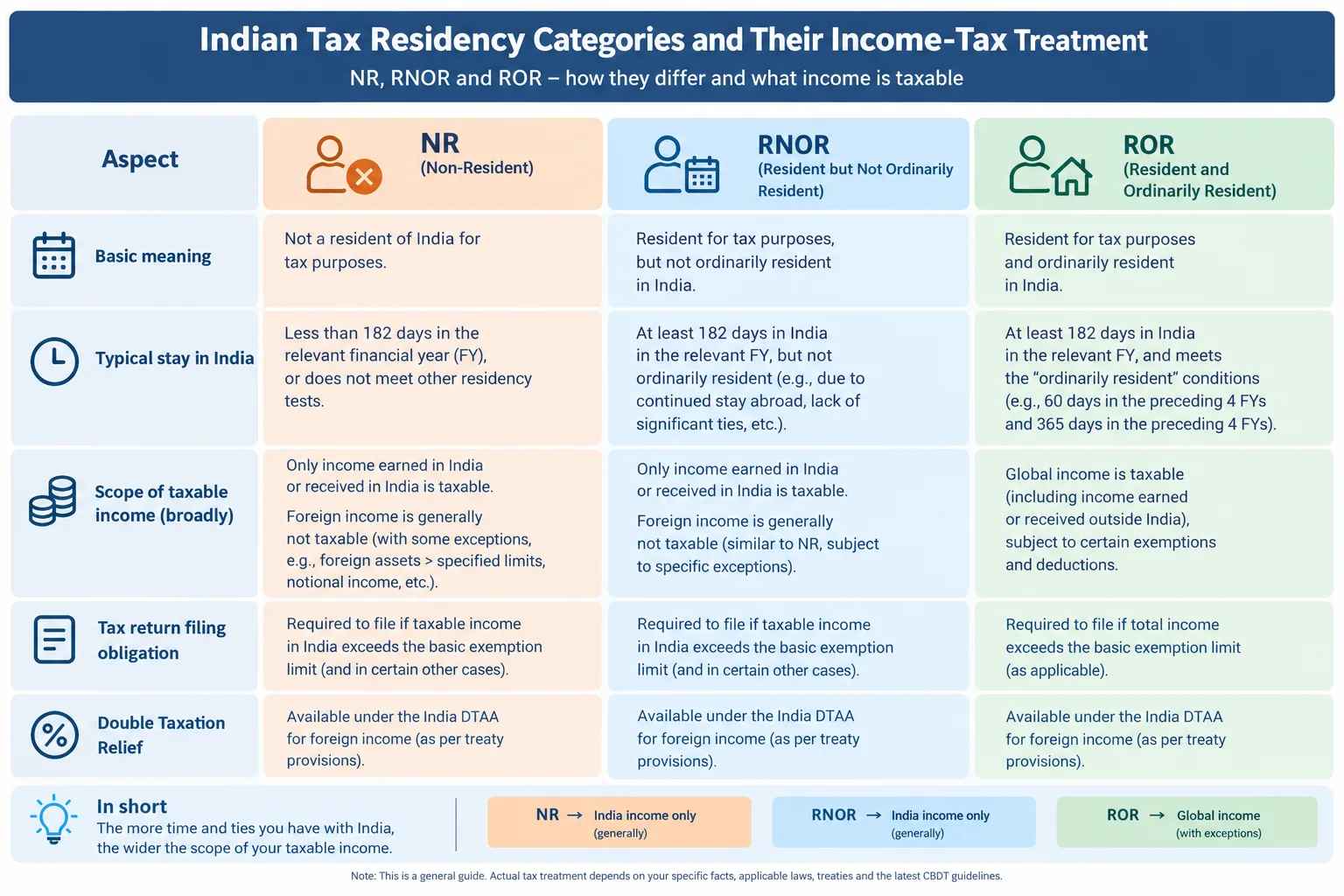
Under the general rules, an individual may be treated as resident in India if either of these conditions is satisfied:
The second test does not apply identically to everyone. Special rules can apply to Indian citizens leaving India for employment or certain ship-related work, and to Indian citizens or persons of Indian origin visiting India.
For a qualifying Indian citizen or person of Indian origin visiting India, the alternative test can use 120 days instead of 60 days when their relevant Indian income exceeds ₹15 lakh and the other statutory conditions are met. The precise outcome depends on the applicable provision and circumstances. Do not use a single day-count threshold as a universal guarantee of non-resident status.
|
Category |
General tax treatment |
|---|---|
|
Non-resident (NR) |
Generally taxed on income received or deemed received in India, or income accruing or deemed to accrue in India, subject to applicable law. |
|
Resident but Not Ordinarily Resident (RNOR) |
Generally taxed on Indian income and certain foreign income connected with a business controlled in India or a profession set up in India. Specific statutory rules apply. |
|
Resident and Ordinarily Resident (ROR) |
Generally within the scope of Indian tax on worldwide income, subject to applicable exemptions, relief and other provisions. |
A resident individual may qualify as RNOR under tests involving their residency history or days spent in India in earlier years. Therefore, becoming resident does not by itself settle how all foreign income will be taxed.
The Income-tax Act, 2025 took effect on 1 April 2026. The new Act applies to tax years beginning on or after that date. Income for FY 2025–26 is dealt with under the Income-tax Act, 1961, even where the return is filed after 1 April 2026.
For FY 2026–27, residential status must be assessed under the 2025 Act. Previous years can still matter when applying tests that look back over earlier periods.
The tax treatment depends on the type and source of income, the individual's residential status, and any applicable exemptions or treaty provisions.
|
Income type |
What OCI cardholders should check |
|---|---|
|
Salary |
Where the employment services are performed and the applicable rules for salary income. Salary relating to services performed in India may be taxable in India, subject to relevant provisions. |
|
Rental income |
Rent from property situated in India may be taxable in India, even if the owner lives overseas. Applicable deductions and property-income rules must be considered. |
|
Bank interest |
The account type, residential status, applicable exemptions and tax deducted at source (TDS) can affect the treatment. |
|
Dividends |
Dividends from Indian companies may be taxable in India, subject to applicable law and treaty relief where available. |
|
Business income |
The business's activities, where income arises, and any relevant rules concerning a business controlled in India or a profession set up in India may matter. |
|
Capital gains |
The location and type of asset, holding period, transaction details and applicable capital-gains provisions affect the tax outcome. |
These categories should not be treated as having one universal tax rate. For instance, selling Indian property and receiving rent from it are different taxable events and may involve different rules.
If you own property in India, use a dedicated property-tax guide or seek professional advice for calculations involving deductions, capital gains, withholding or treaty relief.
Foreign income is not automatically taxable in India simply because you hold an OCI card or visit India for a particular number of days. Its treatment depends on your residential status and the applicable statutory provisions.
A non-resident is generally taxed on income received or deemed received in India, or income accruing or deemed to accrue in India. An Resident but Not Ordinarily Resident (RNOR) is subject to special rules for certain foreign income, including income connected with a business controlled in India or a profession set up in India. An ROR is generally subject to Indian tax on worldwide income, subject to applicable exemptions and relief.
Consider two examples:
Keep records of travel dates, employment arrangements, income receipts and relevant tax documents. These details can be important when determining the correct treatment.
NRE and NRO accounts have different purposes and may receive different tax treatment. An OCI card alone does not guarantee that interest on an NRE account will always be tax-free.
Interest on an eligible NRE account may qualify for an exemption when the applicable statutory and residency conditions are met. Interest on an NRO account is generally taxable in India, with withholding requirements depending on the circumstances.
FEMA and banking rules govern matters such as account eligibility and permitted operation. Income-tax law determines the tax treatment of interest. These are related but separate questions.
If you relocate to India or your residency circumstances change, contact your bank to check whether your account classification needs updating. Do not assume that the tax treatment remains unchanged after a move.
For detailed account eligibility and operation, consult your bank's current guidance and the relevant RBI/FEMA rules.
An OCI cardholder may need to file an Indian income-tax return if the applicable statutory filing conditions are met. Having tax deducted at source does not automatically mean that every filing obligation has been satisfied.
Before deciding whether to file, check:
Tax payable and the obligation to file a return are separate questions. The answer can depend on the applicable law, income categories and individual circumstances.
For the transition year, use the correct framework: returns for FY 2025–26 follow the applicable provisions of the 1961 Act, while tax year 2026–27 follows the 2025 Act. Check the Income Tax Department's return-filing guidance for current requirements and forms.
Potentially. A Double Taxation Avoidance Agreement (DTAA) may provide relief where income is taxed in India and another country, but the outcome depends on the treaty, income type, eligibility conditions and required documentation.
Relief is not automatic for every OCI cardholder or every item of income. Depending on the circumstances, the relevant process may involve treaty documentation or a claim for foreign tax credit under the applicable rules.
The Income Tax Department provides guidance on Form 41 and treaty relief under the Income-tax Act, 2025. Check the rules and forms that apply to your tax year before filing a claim.
Example 1: An OCI holder living abroad and earning rent
A person lives in Canada and receives rent from a flat in India. Their overseas residence does not automatically remove Indian tax obligations on the rental income. They should check Indian property-income rules, any applicable deductions and whether a return is required.
Example 2: An OCI holder making extended visits
A person spends several months in India each year. Their residential status cannot be determined from the current year's stay alone in every case. They must review the applicable day-count test, previous years' presence and any relevant special conditions.
Example 3: An OCI holder relocating to India
A person moves to India while retaining overseas investments and income. They should establish their residential status for each tax year and review the treatment of foreign income, bank accounts, reporting and potential treaty relief.
These are hypothetical examples, not determinations of any individual's tax liability.
 Also Want to Know About NRI Income Tax Rates and Tax Slabs in India? Check Now!
Gather the following information before reaching a conclusion:
If your circumstances involve a relocation, substantial overseas income, business interests or a potential change in residency status, consult a qualified Indian tax professional. A professional can assess your particular facts against the applicable legislation and treaty provisions.
Stop worrying about delays. Apply now and get Indian Counsellor Services.
Chat NowThe most important OCI taxation rule is that OCI status does not determine Indian income-tax residency. Your residential category, the source of your income and the law applicable to the relevant tax year determine how Indian tax rules apply.
Review the relevant residency tests, distinguish Indian-source income from foreign income, and check your filing and banking obligations before making financial decisions. For complex cross-border circumstances, seek advice from a qualified tax professional and verify current requirements through official government guidance.
This article provides general information, not individualized tax or legal advice. Tax rules and filing requirements can change; verify the provisions applicable to your circumstances and tax year before acting.
An OCI cardholder living abroad may need to pay Indian income tax on income received, earned or deemed to arise in India. The tax treatment depends on the person’s residential status, the type and source of income, and any applicable tax treaty.
No. OCI status and income-tax residency are different concepts. An OCI cardholder is a foreign national of Indian origin, while their Indian tax residency is determined separately under the applicable income-tax law for each tax year.
Yes, rental income from property located in India is generally taxable in India, even when the OCI cardholder lives overseas. The taxable amount and deductions depend on the applicable house-property rules and the individual’s circumstances.
Foreign salary is not automatically taxable in India simply because the recipient holds an OCI card. Its tax treatment depends on the person’s residential status, where the employment services are performed, where the income is received and the applicable legal provisions.
Not necessarily. Whether an OCI cardholder must file an Indian income-tax return depends on the applicable filing conditions, income, tax liability and other statutory requirements. Tax deducted at source (TDS) does not automatically remove the obligation to file a return.
Yes, an OCI cardholder may be eligible to claim a refund when the tax deducted exceeds the final tax liability. The person generally needs to meet the applicable return-filing requirements and submit the relevant income-tax return to claim the refund. Copy FAQ
Vipul Jain is the Co-Founder of Visament, a trusted platform dedicated to simplifying Indian immigration, consular, and NRI services for applicants across the globe. With extensive expertise in OCI cards, Indian passport services, visa assistance, apostille and document legalization,... See Full Bio

Talk to our documentation experts for free guidance on your application.



When you visit a website, it may store data about you using cookies and similar technologies. Cookies can be important for the basic operations of the website and for other purposes. You get the option of deactivating certain types of cookies, even so, doing that may affect your experience on the website.
It is required to permit the basic functionality of the website. You may not disable necessary cookies.
Used to provide advertising that matches you and your interests. May also be used to restrict the number of times you see an advertisement and estimate the effectiveness of an advertising campaign. The advertising networks place them after obtaining the operator's permission.
Permits the website to recognize the choices you make (like your username, language, or the region you are in). Also provides more personalized and enhanced features.
Aid the website operator to determine how the website performs, how visitors interact with the site, and whether there are any technical issues.