Related Blogs


If you are an NRI earning taxable income in India, knowing the applicable income-tax slab is the first step toward estimating your tax liability. For AY 2026-27, NRIs can be taxed under the new or old tax regime, subject to the applicable rules. The slab rates are only one part of the calculation because special-rate income, surcharge, cess, and tax credits can also affect the final amount.
The Income Tax Department provides separate slab tables for non-resident individuals under the old and new tax regimes. The following rates apply for AY 2026-27, which relates to income governed by the Income Tax Act, 1961.
| Taxable income | Income-tax rate |
|---|---|
| Up to ₹4 lakh | Nil |
| ₹4,00,001–₹8 lakh | 5% |
| ₹8,00,001–₹12 lakh | 10% |
| ₹12,00,001–₹16 lakh | 15% |
| ₹16,00,001–₹20 lakh | 20% |
| ₹20,00,001–₹24 lakh | 25% |
| Above ₹24 lakh | 30% |
These rates are applied progressively. For example, if taxable income is ₹15 lakh, the entire ₹15 lakh is not taxed at 15%. Different portions of taxable income fall into different slabs.
| Taxable income | Income-tax rate |
|---|---|
| Up to ₹2.5 lakh | Nil |
| ₹2,50,001–₹5 lakh | 5% |
| ₹5,00,001–₹10 lakh | 20% |
| Above ₹10 lakh | 30% |
The Income Tax Department specifically notes that these old-regime rates for non-resident individuals remain the same regardless of the taxpayer's date of birth.
Yes. Eligible NRIs can be taxed under the new tax regime. The Income Tax Department states that the new regime is the default regime for eligible individual taxpayers, while the old regime remains available subject to the applicable conditions for opting out.
For an NRI with no business or professional income, the choice between regimes can generally be exercised through the income-tax return. Taxpayers with eligible business or professional income have additional requirements for opting out of the default regime.
The important point is that NRI status by itself does not mean there is a completely separate set of slab percentages. The applicable regime and the nature of the income determine how the tax is calculated.
Tax slabs work progressively. The rate applicable to one slab does not automatically apply to the taxpayer's entire income.
Suppose an NRI has ₹15 lakh of taxable income and is using the new tax regime for AY 2026-27. Ignoring surcharge, cess, special-rate income and other adjustments for this illustration, the basic tax is calculated across the applicable slabs:
Up to ₹4 lakh: Nil
₹4 lakh to ₹8 lakh: 5% = ₹20,000
₹8 lakh to ₹12 lakh: 10% = ₹40,000
₹12 lakh to ₹15 lakh: 15% = ₹45,000
The basic income tax is therefore ₹1,05,000 before any applicable additions or adjustments.
This example is only an illustration of progressive slab calculation. An actual NRI tax calculation may differ depending on the nature of income, deductions, special tax rates, surcharge, cess, tax already deducted at source and other applicable provisions.
No. Ordinary taxable income can be subject to slab rates, but certain categories of income can have specific tax rates. Capital gains are a key example, so an NRI should not simply add every income figure together and apply the highest slab percentage.
For a detailed calculation involving capital gains, DTAA relief or foreign tax credit, use the relevant dedicated tax guidance rather than treating those subjects as part of a basic slab calculation.
Under the old tax regime, NRI slab rates do not change based on age. The Income Tax Department expressly states that the old-regime rates for non-resident individuals apply irrespective of the taxpayer's date of birth.
This is important for NRIs who are 60 or older because resident senior-citizen rules should not automatically be applied to a non-resident taxpayer. Always determine residential status first and then apply the rules relevant to that status.
 Also Want to Know About NRI/OCI Gift Taxation in India Check Now!
The slab rate is not necessarily the final tax percentage. Surcharge may apply when total income crosses specified thresholds, and health and education cess is also added to income tax and applicable surcharge.
For AY 2026-27, the Income Tax Department lists the following surcharge rates for non-resident individuals:
| Total income | New regime | Old regime |
|---|---|---|
| Up to ₹50 lakh | Nil | Nil |
| ₹50 lakh–₹1 crore | 10% | 10% |
| ₹1 crore–₹2 crore | 15% | 15% |
| ₹2 crore–₹5 crore | 25% | 25% |
| Above ₹5 crore | 25% | 37% |
The rules also provide marginal relief in specified circumstances. In addition, the enhanced 25% and 37% surcharge does not apply to certain specified income, including income covered by sections 111A, 112 and 112A and dividend income, subject to the exceptions stated by the Income Tax Department.
Health and education cess is charged at 4% of income tax plus surcharge, where applicable.
No. An NRI cannot claim the Section 87A rebate.
The Income Tax Department's ITR-2 guidance states that the Section 87A rebate is available only to an individual who is resident in India; non-residents cannot claim the rebate.
This distinction is important because current new-regime information mentions a rebate of up to ₹60,000 for eligible taxpayers with taxable income up to ₹12 lakh for AY 2026-27. That provision should not be interpreted as a ₹60,000 rebate available to NRIs. The official guidance specifically excludes non-residents from Section 87A.
Also Want to Know About Tax Implications for the NRI Moving back to India Check Now!The transition to the Income Tax Act, 2025 makes tax-year terminology especially important in 2026.
| Period | Applicable terminology |
|---|---|
| Income earned during FY 2025-26 | AY 2026-27 under the Income Tax Act, 1961 |
| Income earned from 1 April 2026 to 31 March 2027 | Tax Year 2026-27 under the Income Tax Act, 2025 |
The Income Tax Department explains that the Income Tax Act, 2025 came into force on 1 April 2026 and replaced the Income Tax Act, 1961, subject to transitional provisions. The new Act uses “Tax Year” instead of the earlier “previous year” terminology and discontinues the assessment-year concept for the new framework.
Therefore, an article discussing AY 2026-27 should not be confused with an article discussing income earned during Tax Year 2026-27. The two periods fall under different legislative frameworks.
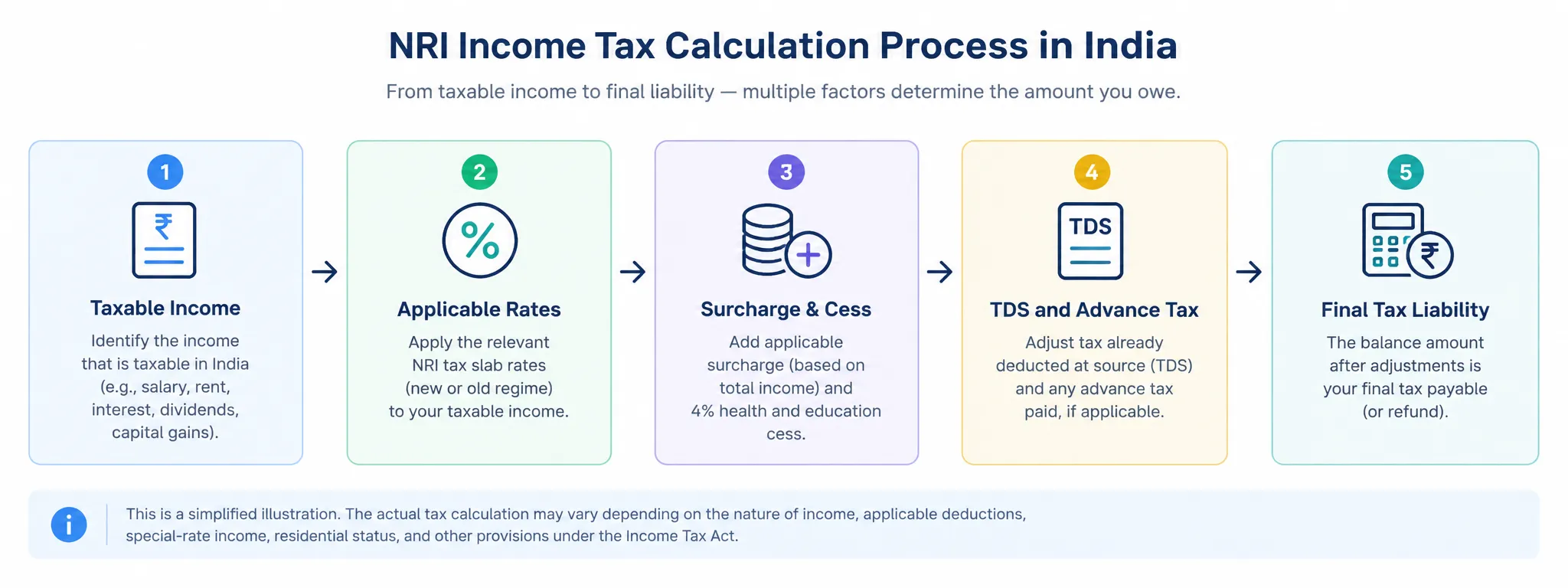
The tax slab is only one part of the calculation. An NRI's final Indian tax liability can depend on:
Residential status — Confirm whether the individual qualifies as an NRI for Indian tax purposes.
Taxable Indian income — Identify the income that is taxable in India under the applicable rules.
Nature of income — Salary, rent, interest, dividends and capital gains may have different tax treatment.
Tax regime — Determine whether the new or old regime applies.
Eligible deductions — The availability of deductions depends on the applicable regime and specific conditions.
Special tax rates — Some income does not follow ordinary slab taxation.
Surcharge — Higher income can trigger additional surcharge.
Health and education cess — The applicable cess is added to NRI income tax and surcharge.
TDS and advance tax — Tax already paid or deducted can affect the balance payable or refundable.
DTAA provisions — Where relevant, a tax treaty may affect the treatment of cross-border income.
TDS should not be confused with the final tax liability. For example, an NRI may have tax deducted from rental income or interest, but the amount ultimately payable or refundable is determined when the overall tax position is calculated.
Stop worrying about delays. Apply now and get Indian Counsellor Services.
Chat NowNRI tax slabs provide the starting point for calculating Indian income tax, but they do not tell the complete story. For AY 2026-27, NRIs should first identify the applicable regime and taxable income, then account for special-rate income, surcharge, cess and taxes already deducted. NRIs should also remember that Section 87A is not available to non-residents.
Because Indian tax rules changed from 1 April 2026 with the introduction of the Income Tax Act, 2025, always verify the applicable tax year and current official guidance before filing.
For AY 2026-27, the new regime starts with nil tax up to ₹4 lakh and reaches 30% above ₹24 lakh. Under the old regime, tax is nil up to ₹2.5 lakh, followed by 5%, 20% and 30% slabs.
Yes. Eligible NRIs can use the new tax regime, which is the default regime for eligible taxpayers, subject to applicable rules for opting out.
Under the old regime, the Income Tax Department states that NRI slab rates remain the same regardless of the taxpayer's date of birth.
Not necessarily. Certain capital gains are subject to specific tax rates rather than ordinary slab rates. The applicable treatment depends on the type of capital gain and the relevant tax provisions.
Tax slabs determine income-tax liability on taxable income under the applicable regime. TDS is tax withheld at source on specified payments. TDS can be credited against the final tax liability but is not necessarily the same as the final tax payable.
Vipul Jain is the Co-Founder of Visament, a trusted platform dedicated to simplifying Indian immigration, consular, and NRI services for applicants across the globe. With extensive expertise in OCI cards, Indian passport services, visa assistance, apostille and document legalization,... See Full Bio

Talk to our documentation experts for free guidance on your application.




When you visit a website, it may store data about you using cookies and similar technologies. Cookies can be important for the basic operations of the website and for other purposes. You get the option of deactivating certain types of cookies, even so, doing that may affect your experience on the website.
It is required to permit the basic functionality of the website. You may not disable necessary cookies.
Used to provide advertising that matches you and your interests. May also be used to restrict the number of times you see an advertisement and estimate the effectiveness of an advertising campaign. The advertising networks place them after obtaining the operator's permission.
Permits the website to recognize the choices you make (like your username, language, or the region you are in). Also provides more personalized and enhanced features.
Aid the website operator to determine how the website performs, how visitors interact with the site, and whether there are any technical issues.