Related Blogs

If you are a foreign national of Indian origin already staying in India, you may be wondering whether you can apply for an OCI Card without leaving the country. The answer depends on both your OCI eligibility and your immigration status in India. An X-1 Entry Visa can be relevant, but holding an X-1 visa by itself does not make someone eligible for OCI registration.
This guide explains how an OCI application from India works, including the X-1 visa, FRRO/FRO requirements, documents, online application process, fees, status tracking, and common mistakes.
Yes, an eligible foreign national can apply for OCI registration in India while holding a qualifying long-duration visa such as an X-1 visa, subject to the applicable OCI requirements. The important point is that the X-1 visa and OCI eligibility are two separate matters.
The current OCI guidance requires a copy of a long-duration visa, other than a Tourist, Missionary, or Mountaineering Visa, with at least three months' validity on the date of application, together with the applicable Residential Permit or Registration Certificate issued by the jurisdictional FRRO/FRO when the application is submitted in India.
The official OCI portal also identifies X-1 as an Entry Visa category for Persons of Indian Origin who do not possess an OCI Card.
Important: An X-1 visa is not itself an OCI eligibility certificate. You must independently satisfy the applicable OCI eligibility criteria.
OCI registration is available only to foreign nationals who fall within the statutory eligibility categories. Depending on the applicant's circumstances, this can include a person who:
The OCI framework also contains restrictions based on specified ancestry, including certain cases involving Pakistan, Bangladesh, or another country notified by the Government of India. Applicants should therefore verify their eligibility before starting the application.
For a complete eligibility assessment, use the dedicated OCI eligibility guide rather than relying only on your visa category.
The X-1 visa is an Indian Entry Visa for eligible Persons of Indian Origin who do not possess an OCI Card. MHA visa guidance identifies X-1 as an Entry Visa category and provides for multiple-entry validity subject to the applicable visa rules.
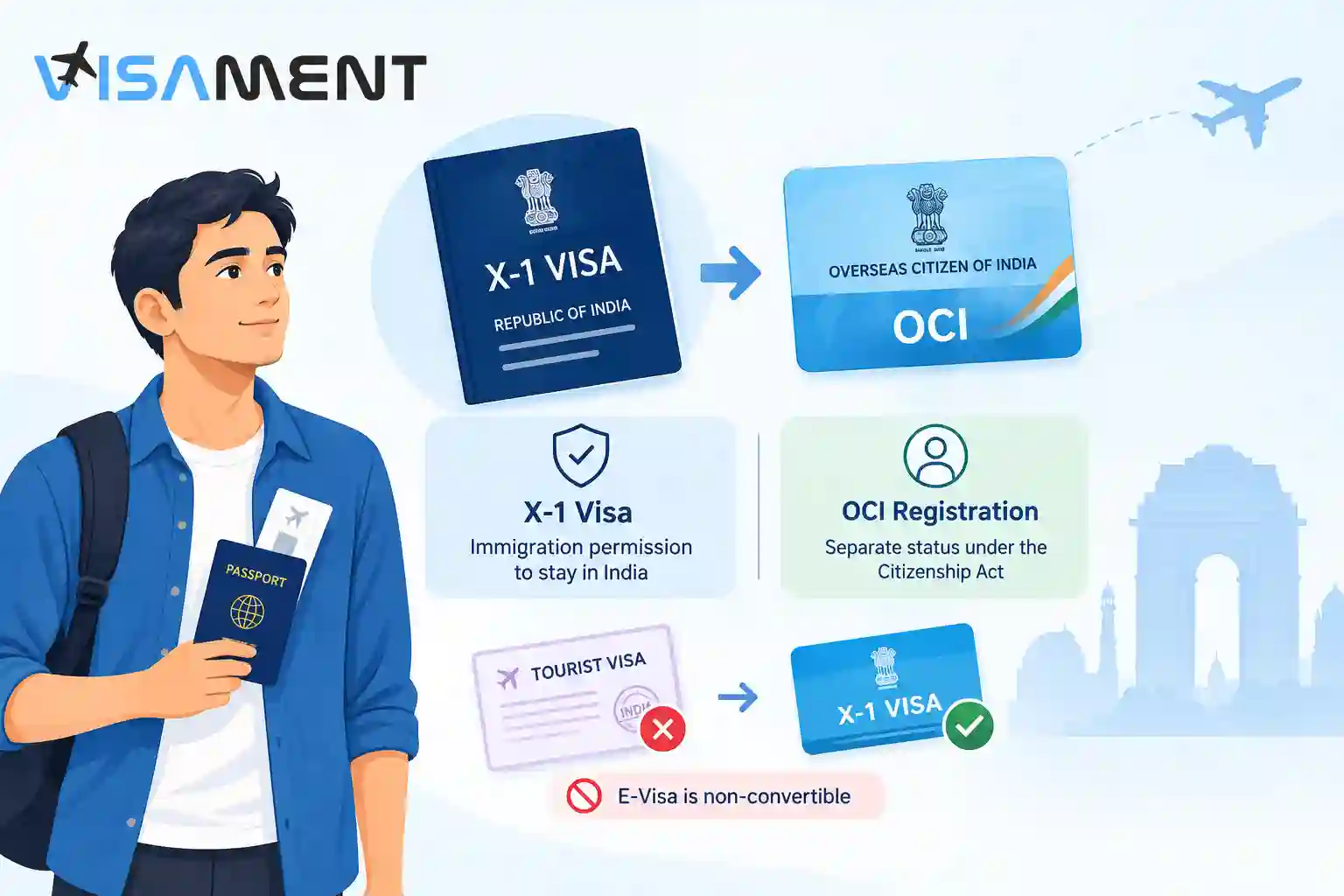
This is why X-1 can be relevant when a person of Indian origin wants to remain in India while pursuing an OCI application. However, the relationship should not be misunderstood:
X-1 visa = immigration permission to stay in India.
OCI registration = separate status available to eligible foreign nationals under the Citizenship Act.
The two processes should therefore be evaluated independently.
Older online articles sometimes describe X-1 as a mandatory preliminary step for every OCI applicant applying from India. That is too broad. The current OCI portal refers more generally to a qualifying long-duration visa and the required FRRO/FRO Residential Permit or Registration Certificate.
MHA guidance has provided for conversion of certain visas held by Persons of Indian Origin who are otherwise entitled to an Entry Visa into an X-1 visa through the concerned FRRO/FRO.
However, applicants should not assume that every Tourist Visa can be converted into an X-1. Eligibility, visa category, documentation, and the applicable FRRO/FRO process must be checked for the individual's circumstances.
Also, an e-Visa is non-convertible under the current official e-Visa guidance, so applicants should not treat an e-Tourist Visa as a guaranteed route to an X-1 visa conversion.
Have questions? Our experts guide you through every step your OCI Card Application Process– no confusion, no delays.
Consult an Expert TodayThe exact documents depend on the OCI eligibility category, but India-based applicants should be prepared to provide documents such as:
| Document | Why it may be required |
|---|---|
| Valid foreign passport | Establishes current nationality and identity |
| Long-duration Indian visa | Establishes the applicant's lawful status in India |
| Residential Permit/Registration Certificate | Required for applicable applications submitted in India |
| Indian passport or other Indian-origin evidence | Establishes the applicant's or ancestor's qualifying Indian connection |
| Citizenship/naturalization documents | May establish how and when foreign nationality was acquired |
| Birth certificates | Used to establish family relationships and Indian ancestry |
| Marriage certificate | Required where OCI eligibility is based on marriage |
| Address/residence documents | May be required for identity, residence, or FRRO processing |
| Photographs and supporting documents | Must meet the applicable OCI specifications |
The official requires the qualifying long-duration visa and the Residential Permit/Registration Certificate issued by the jurisdictional FRRO/FRO for applications submitted in India. It also provides category-specific documentary requirements.
For a complete document-by-document list, refer to the documents required for an OCI application rather than duplicating the entire checklist here.
Before considering your visa status, establish that you fall within one of the OCI eligibility categories. Having Indian ancestry or an X-1 visa does not automatically result in OCI registration.
If you are applying from inside India, check that your current visa is an eligible long-duration visa and has the required validity remaining on the date of application. The official specifies at least three months' validity for the relevant long-duration visa at the time of application.
Applicants residing in India must provide the applicable Residential Permit/Registration Certificate issued by the jurisdictional FRRO/FRO. The jurisdiction depends on where the foreign national is residing.
Start the application through the official OCI Services Portal. Enter your personal information, passport details, family information, and other required particulars carefully.
Your name, date of birth, passport number, nationality, and other identity information should be consistent with your current passport and supporting documents.
Upload the photograph, passport, and supporting documents in the format and specifications prescribed by the OCI portal. The documents required will depend on your eligibility category.
Before submission, check that scans are readable and that names, dates, and family relationships are consistent across documents.
The current registration fee for an application submitted in India is US$275 equivalent in Indian rupees, payable online. Because government fees and payment procedures can change, applicants should verify the amount displayed by the official OCI portal before payment.
When applying from India, original documents are submitted for verification to the concerned FRRO according to the OCI portal's current instructions. The exact procedure and whether the applicant is required to appear should be followed from the instructions issued for the application.
After submission, keep your Application ID and passport number available. The official OCI status enquiry requires both details to check the application status.
If the authorities request additional information, corrections, or documents, respond according to the instructions provided rather than submitting a duplicate application.
FRRO/FRO requirements are important because the OCI card rules specifically require applicable residence documentation for foreign nationals applying in India.
The e-FRRO system provides online services for foreign nationals, including registration and other visa and immigration-related services. Applicants create their own account, submit the relevant application, upload documents, and receive status updates or further instructions electronically.
The exact service you need depends on your immigration circumstances. Do not assume that an OCI application itself replaces a separate immigration or registration requirement.
If an FRRO/FRO authority specifically asks you to appear for an interview or verification, follow that instruction.
Before submitting an OCI application from India, check these points carefully:
If you are unsure which documents apply to your OCI category, you can use an OCI document checklist generator to organize your application requirements before submission.
For additional preparation support, consider having your documents reviewed for common issues such as inconsistent personal details, missing relationship evidence, or incomplete supporting records. Government authorities make the final decision on OCI registration, so no private service provider can guarantee approval.
Applying for an OCI Card from India is possible for eligible foreign nationals, but the process depends on both OCI eligibility and lawful immigration status in India. An X-1 visa can provide an appropriate immigration route for eligible Persons of Indian Origin, but it is not itself a guarantee of OCI eligibility.
Before applying, verify your OCI category, qualifying visa, FRRO/FRO documentation, supporting evidence, and current government requirements. Most importantly, rely on the official OCI Services Portal and current FRRO/MHA guidance rather than older articles or fixed OCI processing-time promises.
Foreign nations who belong to Indian origin or are married to an Indian cannot apply for the OCI card in India while being on missionary, tourist, or mountaineering visa. For this, first, they need to apply for an X1 visa and stay up to 180 days in the country then apply for a card from India.
Yes, with an OCI card, you can stay in India forever. The card grants a lifetime visa to the cardholder with multiple entries in the country for multiple reasons. Also, with the OCI card by your side, you do not register yourself with local authorities for your stay in the country.
Yes, OCI cardholders can apply for an Aadhaar card. However, for this, they need to fulfill the 182-day stay residency requirement in India. In this, within 12 months, they need to live in the country for at least 182 days preceding the Aadhaar card application.
Generally, the OCI application takes 4 to 8 weeks to process. However, this time may vary depending on the available volume of applications and individual circumstances.
Yes, an OCI can become an Indian citizen again. According to section 5(1) (g) of the Citizenship Act, 1955, provision an individual who has been a registered OCI cardholder for 5 years and has been living in India for one year out of the five years, is eligible to apply for citizenship in the country.
Yes, an OCI cardholder can take health insurance in India despite having preexisting health conditions. In case of preexisting medical conditions disclose this thing to the insurer or else there is a chance that at the time of requirement, your claim can be rejected.
No. The official OCI guidance states that foreign nationals holding Tourist, Missionary, or Mountaineering Visas cannot apply for OCI registration in India.
The OCI portal requires the applicable Residential Permit/Registration Certificate issued by the jurisdictional FRRO/FRO for applications submitted in India.
No. X-1 is an Entry Visa category, while OCI registration has its own eligibility requirements under the applicable citizenship framework.
Yes. The official OCI status enquiry allows applicants to check their application using the Application ID and passport number.
Vipul Jain is the Co-Founder of Visament, a trusted platform dedicated to simplifying Indian immigration, consular, and NRI services for applicants across the globe. With extensive expertise in OCI cards, Indian passport services, visa assistance, apostille and document legalization,... See Full Bio

Talk to our documentation experts for free guidance on your application.


When you visit a website, it may store data about you using cookies and similar technologies. Cookies can be important for the basic operations of the website and for other purposes. You get the option of deactivating certain types of cookies, even so, doing that may affect your experience on the website.
It is required to permit the basic functionality of the website. You may not disable necessary cookies.
Used to provide advertising that matches you and your interests. May also be used to restrict the number of times you see an advertisement and estimate the effectiveness of an advertising campaign. The advertising networks place them after obtaining the operator's permission.
Permits the website to recognize the choices you make (like your username, language, or the region you are in). Also provides more personalized and enhanced features.
Aid the website operator to determine how the website performs, how visitors interact with the site, and whether there are any technical issues.