Related Blogs

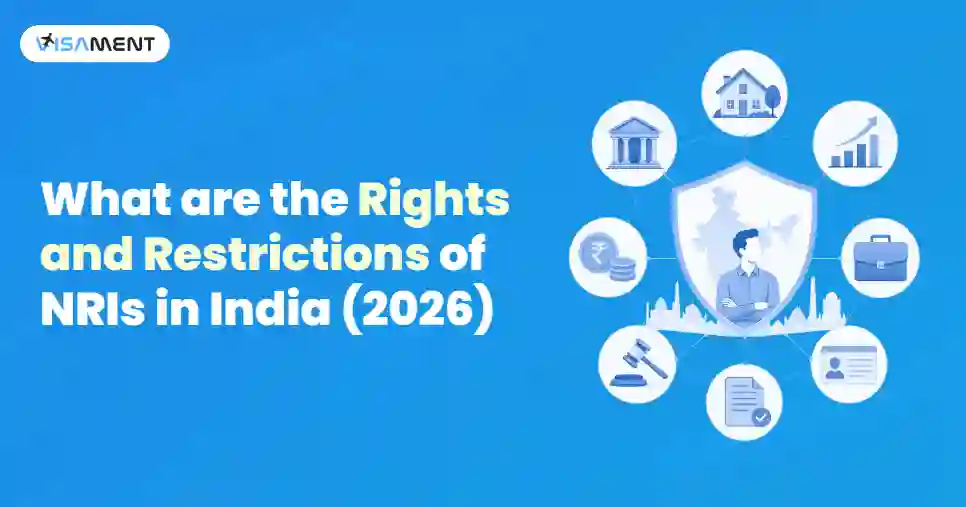
Many non-resident Indians play a major role in the Indian economy and contribute through investments, business activities, and property ownership. However, in this, most of the NRIs are still holding their citizenship and live outside India, which means that some of the financial, legal, and regulatory burdens are different from the as those applicable to Indian residents.
The major question for most of the NRIs is:
The answer to these questions depends on the various Indian laws, which include the Foreign Exchange Management Act (FEMA), the Indian Income Tax Act, 1961, Reserve Bank of India (RBI) regulations, the Representation of the People Act, 1950, and various applicable rules.
Through this guide, we will see the major rights and restrictions of NRIs in India and help you to stay compliant with financial and legal decisions.
Here are some of the rights of NRIs in India mentioned below.
It is one of the most crucial rights for NRIs in India, which allows them to enter or stay in India.
As most of the NRIs are Indian citizens, they are not required to apply for an Indian visa, a residence permit, or any visa extension for the duration of their visit to India. However, staying for a long time in India may affect their residential status, which can directly impact their tax and FEMA purposes.
If you are an NRI, then you can easily purchase or own immovable property in India. You are eligible to buy the permitted property in India mentioned below.
NRIs are alos get their property from their ancestors or any relatives, following all the rules and regulations of Indian succession laws.
However, FEMA is imposing strict restrictions on the purchase of agricultural and plantation properties in India by NRIs. An NRI cannoit but such types of properties, but some property can be acquired through inheritance or gift from relatives in accordance with Indian laws.
NRIs are allowed to open a bank account in India, such as:
NRE (Non-Resident External) Account:
An NRE account is used to deposit foreign earnings into Indian rupees. Funds in the NRE account are generally free and repatriable, which are subject to applicable regulations.
NRO (Non-Resident Ordinary) Account:
The NRO account is designed to manage the income that is earned in India, such as rents, dividends, pension, interest, and repatriation, subject to the RBI guidelines.
FCNR (Foreign Currency Non-Resident) Account:
For preserving deposits in foreign currencies and to help reduce the exchange rate risk.
NRIs can invest in various financial instruments in India, including:
By following all the FEMA and RBI regulations. However, some investments may need appropriate banking or sector-specific rules.
NRIs have the legal right to inherit both movable and immovable property in India, including:
However, the inheritance is governed by the applicable personal and succession laws and also depends on the individual circumstances.
NRIs can start or invest in businesses within permitted sectors, which may include:
Some of the sectors need valid permission or approval from the government.
NRIs can apply for a Permanent Account Number (PAN), essential for various financial activities in India such as:
Applying for an Aadhaar card for NRIs depends on the applicable residency requirement under the Aadhaar Act.
NRIs who retain Indian citizenship may register to vote as overseas electors, subject to eligibility criteria established by Indian election laws. Voting in India is subject to the process and requirements provided by the Election Commission of India.
Most of the NRIs enjoy many rights and privileges in India. However, there are some of the restrictions for NRIs under Indian laws, such as:
NRIs cannot purchase the following properties:
NRIs are not allowed to purchase these properties under FEMA, although inheritance of such properties is allowed under the applicable laws.
Financial transactions governed by FEMA must be compliant, including
Not following the FEMA rules can lead to regulatory complications.
NRIs are taxed differently from resident Indians. Income sourced or accruing in India, such as:
This income can be taxable in India. However, the tax liability will depend on residential status and existing tax treaties under the provisions of the Double Taxation Avoidance Agreement (DTAA).
NRIs must maintain correct bank account categories and update their residential status with financial institutions, particularly if returning to India permanently. Then they need to redesignate their NRE or FCNR accounts in accordance with the RBI regulations.
Restrictions in Specific Sectors
Some sectors may have investment limits or require government approval, depending on the approval of the Indian government or following the RBI and FEMA regulations.
NRIs can unintentionally violate laws due to a lack of awareness. Common errors include:
Here are some of the tips that will help the NRIs to manage efficient management of financial and residential matters in India efficiently.
NRIs enjoy significant rights in India as citizens, including the ability to enter and stay in the country, own property, inherit assets, and invest in various sectors such as commercial or residential properties. open bank accounts, inherit properties from ancestors, invest in financial markets, or participate in economic activities.
However, an NRI also follows the necessary regulations concerning foreign exchange, taxation, and property ownership.
Understanding all the rights and restrictions of NRIs in India can make financial, legal, and investment decisions more correct. Through updated information about the latest laws and documentation, and by following the FEMA, RBI, and tax regulations, NRIs can smoothly manage their interest in India and avoid making any legal or financial errors or mistakes.
Yes, an NRI can purchase a residential or commercial property in India. However, they are not allowed to purchase any agricultural land or plantation property in India under the FEMA rules and regulations.
Yes, an NRI can stay in India and does not need a valid visa to remain in India.
Yes, if an NRI's income is earned within India, then they need to pay tax in India. The tax liability depends on the nature of income, residential status, and the applicable tax laws of the Government of India.
No, an NRI cannot invest in agriculture or plantation property in India. It is not advised under the FEMA rules and regulations.
Yes, an NRI can easily invest in the Indian stock market, but invest in mutual funds, government securities, or any other eligible financial instruments that are subject to the FEMA, RBI, and SEBI rules and regulations.
Yes, an eligible NRI can vote in India if they are registered as an elector in compliance with the Indian election laws.
Vipul Jain is the Co-Founder of Visament, a trusted platform dedicated to simplifying Indian immigration, consular, and NRI services for applicants across the globe. With extensive expertise in OCI cards, Indian passport services, visa assistance, apostille and document legalization,... See Full Bio

Talk to our documentation experts for free guidance on your application.

When you visit a website, it may store data about you using cookies and similar technologies. Cookies can be important for the basic operations of the website and for other purposes. You get the option of deactivating certain types of cookies, even so, doing that may affect your experience on the website.
It is required to permit the basic functionality of the website. You may not disable necessary cookies.
Used to provide advertising that matches you and your interests. May also be used to restrict the number of times you see an advertisement and estimate the effectiveness of an advertising campaign. The advertising networks place them after obtaining the operator's permission.
Permits the website to recognize the choices you make (like your username, language, or the region you are in). Also provides more personalized and enhanced features.
Aid the website operator to determine how the website performs, how visitors interact with the site, and whether there are any technical issues.