Related Blogs

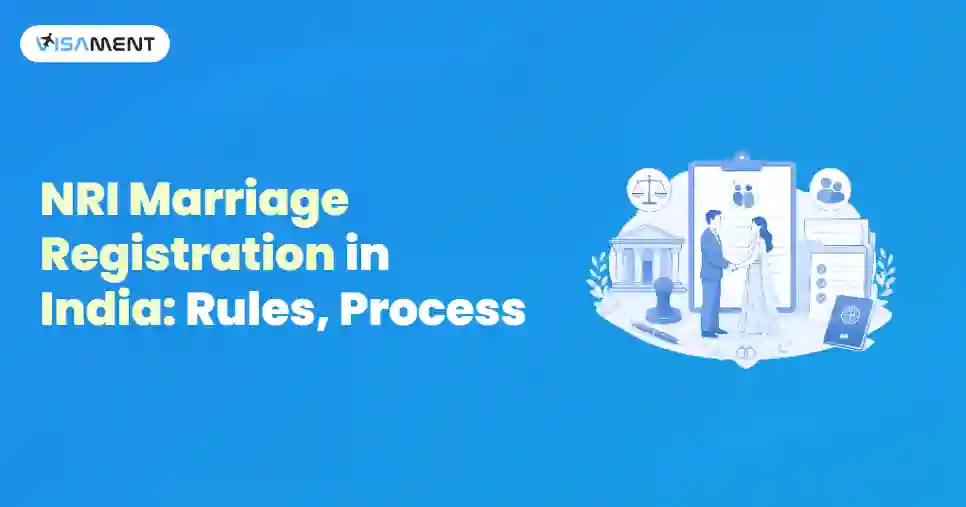
Marriage registration is a crucial legal procedure for all couples, especially for those involving Non-Resident Indians (NRIs). A marriage certificate is an important legal document required for various purposes, including immigration, visa applications, OCI card applications, passport updates, spouse sponsorship, bank accounts, property inheritance, and other legal matters in India and abroad.
Whether an NRI is marrying an Indian citizen, another NRI, or a foreign national, following Indian legal rules for registration is important to provide legal proof of the marriage and make future administrative processes easier. However, the process of registering can differ based on the couple's religious background, nationality, and the laws you follow.
Most of the couples find themselves confused regarding eligibility criteria, applicable laws, documents required, government fees, and the timeline for NRI marriage registration. Providing incomplete or inaccurate documentation can lead to delays or multiple visits to the Marriage Registrar's office.
In this guide, we will provide you with details about NRI marriage registration in India, including the legal framework, eligibility, process, documentation, fees, and common mistakes to avoid.
NRI marriage registration refers to the formal process of documenting a marriage with the relevant government authority in India and obtaining an official marriage certificate.
This certificate acts as legal verification that the marriage has been solemnized and recorded according to Indian law. It is issued by the Registrar of Marriages, verifying the couple's eligibility and their submitted documents.
NRI marriages may be required if:
Once the marriage is registered, the certificate is recognized for various legal, immigration, financial, and administrative purposes.
Though many marriages take place following religious or traditional customs, registering the marriage confers official legal recognition, which is particularly vital for NRIs who may need the certificate for various applications across different jurisdictions.
A registered marriage certificate is typically required for:
Without a registered marriage certificate, many of these processes can become cumbersome and lengthy.
Have questions? Our experts guide you through every step of the OCI Card Application Services – no confusion, no delays.
Consult an Expert TodayA marriage certificate in India can be registered by the following individuals who follow all the legal requirements in accordance with the applicable marriage laws.
The registration law will depend on factors like the couple's religion, the location of the marriage, and their individual circumstances. The three primary laws governing NRI marriages in India are:
Applicable when both partners are Hindus, Buddhists, Jains, or Sikhs, and the marriage is conducted following customary religious practices.
Under the Hindu Marriage Act of 1955:
It is one of the most commonly laws that is used for marriage registration for NRIs of the Hindu faith.
This law provides a civil framework for marriage that is independent of religion.
It is applicable when:
A notice of intended marriage must be submitted before the marriage is completed, along with following all the legal procedures mentioned in the Act.
It is mostly used for marriages celebrated outside India where at least one party is an Indian citizen.
If an NRI or Indian citizen marries in a foreign country in front of an authorized Marriage Officer at an Indian Embassy, this Act helps the marriage.
However, marriages conducted within India typically fall under either the Hindu Marriage Act or the Special Marriage Act according to the circumstances.
Before submitting a marriage registration application, both parties must meet the legally meet the eligibility criteria according to Indian laws.
Generally, the essential requirements are:
Minimum Age:
Groom: 21 years or older.
Bride: 18 years or older.
Here is the full detailed process that can help ypou to complete the NRI marriage registration process in India.
Step 1: Examine the Applicable Marriage Law
You need to see whether the marriage is registered under the Hindu Marriage Act, the Special Marriage Act, or any other applicable law.
According to the applicable act, your documentation, process, and notice period will be determined.
Step 2: Collect all the Required documents
You need to collect all the essential documents for the NRI marriage registration, such as:
If you submit any foreign-issued documents, then you may need to provide apostilled or attested documents.
Step 3: Submit the Marriage Registration application
You need to submit the Marriage Registration application form with all the documents to the jurisdictional marriage registrar.
In some of the states, you will need to book an online appointment for the document verification.
Step 4: Verification of Documentation
Your documents will be verified by the marriage registrar:
You also need to check the regular notification, as the registrar may ask for some additional documents.
Step 5: Impression before the Registrar
Both of the spouses, with their witnesses, need to appear before the marriage registrar on the scheduled date.
The registrar will confirm the information provided in the application and records of statements of the parties where required.
Step 6: Issuance of Marriage Certificate
Once the application process and the documents are verified, the marriage registrar will issue the marriage certificate to the NRIs.
This certificate will help you as proof of marriage, and you can also use it for a visa application, OCI application, immigration, or any legal purposes.
The documents for NRI marriage registration can depend on the applicable law, marriage state, or the nationality of the spouse. Here are some of the documents that are essential for NRI marriage registration in India.
The time for NRI marriage registration depends on the verification of documents and the number of applications received by the Marriage Registrar in India.
Here is the table below that will help you easily to see the Processing time for NRI marriage registration in India.
| Registration Certificate | Estimated Processing Time |
|---|---|
| Hindu Marriage Act Registration | It would generally take 7-30 days |
| Special Marriage Act Registration | It will take about 30-60 days |
| Issue of Marriage Certificate | Process on the same day or within a few days after verification. |
The processing time may depend on the state, local authority, and individual circumstances.
Here are some of the common mistakes that can help you to get the NRI marriage registration easily without facing any mistakes or errors.
NRI marriage registration in India is an important legal step that provides official recognition of your marriage and allows future immigration, visa, OCI applications, passport updates, banking arrangements, property transfers, and other legal matters. Whether under the Hindu Marriage Act or the Special Marriage Act, knowing the relevant rules, having the required documents ready, and following the legal process can help you with an error-free registration experience.
Before starting with your application, verify that all documents are complete, correct, and matched. Ensure that foreign documents are apostilled or legalised as required. Preparing documents can reduce delays and make the registration process easier for both spouses.
For those who are still confused about applicable laws, document requirements, or the registration process, seek guidance from an experienced professional like Visament. We can help you complete the process smoothly without facing a single error or mistake and avoid complications.
Yes, an NRI can register a marriage in India, provided the couple meets the eligibility criteria under the relevant marriage law and submits the required documentation.
NRI marriages are primarily registered under the Hindu Marriage Act, 1955, or the Special Marriage Act, 1954, depending on the parties' religion and the type of marriage.
Here are the documents required for NRI marriage registration in India, such as passports, visa or OCI card (if applicable), address proof, age proof, photographs, wedding photographs, marriage application form, affidavits, and witness identification.
Yes, an NRI can legally marry an Indian citizen in India, provided both partners fulfill the legal requirements defined by the applicable marriage law.
Yes, two NRIs can register their marriage in India if they meet the eligibility criteria and submit the required documentation.
Yes, both spouses generally need to be present at the Marriage Registrar's office in person, along with required witnesses, for verification and registration.
Generally, three adult witnesses with valid identification and address proof are required for marriage registration in India.
The Processing time for NRI marriage registration depends on the state and the applicable laws. Generally, marriages under the Hindu Marriage Act are registered within weeks, while those under the Special Marriage Act may take longer due to a notice requirement.
Registration fees depend on the state and marriage law. Additional costs may apply for affidavits, document notarization, apostille services, or certified translations.
No, an OCI card is not mandatory for marriage registration. However, if the NRI spouse holds one, it may be submitted as supporting identification or residency documentation.
Yes, depending on the issuing country and the registrar's requirements, foreign documents may need to be apostilled or attested before they are accepted in India.
Some states allow online application submissions or appointment scheduling. However, both spouses and required witnesses generally need to personally appear before the Marriage Registrar to finalize the registration.
Vipul Jain is the Co-Founder of Visament, a trusted platform dedicated to simplifying Indian immigration, consular, and NRI services for applicants across the globe. With extensive expertise in OCI cards, Indian passport services, visa assistance, apostille and document legalization,... See Full Bio

Talk to our documentation experts for free guidance on your application.

When you visit a website, it may store data about you using cookies and similar technologies. Cookies can be important for the basic operations of the website and for other purposes. You get the option of deactivating certain types of cookies, even so, doing that may affect your experience on the website.
It is required to permit the basic functionality of the website. You may not disable necessary cookies.
Used to provide advertising that matches you and your interests. May also be used to restrict the number of times you see an advertisement and estimate the effectiveness of an advertising campaign. The advertising networks place them after obtaining the operator's permission.
Permits the website to recognize the choices you make (like your username, language, or the region you are in). Also provides more personalized and enhanced features.
Aid the website operator to determine how the website performs, how visitors interact with the site, and whether there are any technical issues.