Related Blogs

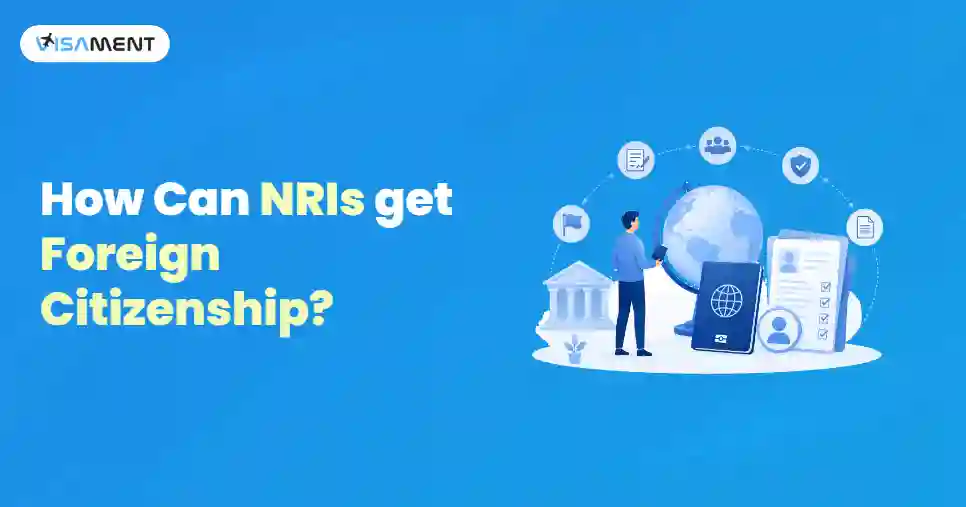
Every year, many Non-Resident Indians (NRIs) pursue foreign citizenship in the countries they reside in, motivated by varied goals such as enhanced career prospects, the right to vote, simplified international travel, or ensuring long-term family stability. Converting to foreign citizenship often involves a commitment to a new life abroad.
However, this process entails more than just obtaining a new passport. It involves meeting strict residency and legal requirements, undergoing naturalization, and understanding the implications of changing your citizenship status, especially when India does not recognize dual citizenship.
Acquiring citizenship in another country requires mandatory legal obligations, such as surrendering your Indian passport and potentially applying for an Overseas Citizen of India (OCI) Card if eligible.
In this guide, we provide you with the full process of how NRIs can get foreign citizenship, along with eligibility, process, and the documents you need after naturalization.
The choice to obtain foreign citizenship is generally influenced by overarching personal, professional, and financial aspirations. While permanent residency offers the advantage of living and working abroad, citizenship enhances rights and protections significantly.
Common motivations include:
The foreign citizenship eligibility criteria are:
Have questions? Our experts guide you through every step of the OCI card– no confusion, no delays.
Consult an Expert TodayHere is the detailed application process for how an NRI gets foreign citizenship.
Step 1: Secure Permanent Residency
Start by applying for permanent residency through various ways such as:
While permanent residency allows for indefinite residency in the country, it does not automatically grant citizenship.
Step 2: Fulfill Residency Requirements
After getting permanent residence, it is essential to meet the specified residency duration and to follow all the immigration authorities' rules, such as:
Maintaining continuous residency is crucial, as long extended absences can affect your eligibility.
Step 3: Compile Necessary Documents
Before applying, gather all required supporting documents that are requested by the immigration authority, such as:
Ensure that all documents are correct and up to date to avoid any delays in the processing of your application.
Step 4: Submit the Citizenship Application
Carefully fill out the application's official form and submit it along with the necessary documents and required government fees.
Many countries now have online application systems, while others might need physical submissions to immigration offices. Before submitting the application, you need to check every detail of the application for each part, and make sure it matches the supporting documents to avoid any errors or mistakes.
Step 5: Complete Biometric Requirements
Applicants need to provide biometric data, such as fingerprints and photographs, and signatures for identity verification purposes and background checks.
Biometric appointments are generally scheduled once your application has been approved.
Step 6: Attend Interview and Citizenship Test
Applicants may be required to attend an interview with an immigration officer to complete a citizenship or civics test.
The interview will verify the following information:
The citizenship test typically covers the nation's history, government structure, legal system, and civic responsibilities.
Step 7: Get Citizenship Approval
After all eligibility criteria, the immigration authority will finalize a decision regarding your application. If approved, instructions will be provided to attend the citizenship ceremony or take an oath of allegiance.
Step 8: Participate in the Citizenship Ceremony
The citizenship ceremony is the final step of your process of becoming a foreign citizen.
Applicants need to take a formal oath, pledging loyalty to their new country, and receive a Citizenship or Naturalization Certificate.
This certificate is important for future use, such as passport applications and other official or legal purposes.
Step 9: Apply for a Foreign Passport
Once citizenship is granted, applicants can apply for their new country's passport.
This passport will act as the primary travel document, replacing the Indian Passport, and will be required for future travel and consular services. and visa applications.
NRIs who are residing in foreign countries can obtain citizenship through the Naturalization process for Indians. It means that you have become a legal citizen after residing in the country for a specified time limit with meting the eligibility requirements.
Here are some of the common countries for Indian origin applicants to get foreign citizenship as an NRI.
| Country | Common Pathway | General Requirement |
|---|---|---|
| United States | Naturalization | Permanent residency with continuous residence. |
| Canada | Naturalization | Permanent residency and physical requirement |
| United Kingdom | Naturalization | Qualifying residence and permanent residency. |
| Australia | Citizenship by conferral | Permanent residence and residency requirements |
| New Zealand | Citizenship Grants | Character and residence requirements |
| Germany | Naturalization | Integration requirement and Lawful residence |
| Ireland | Naturalization | Residency and eligibility requirements |
| Singapore | Citizenship by approval | Permanent residency and government approval |
| Netherlands | Naturalization | Large residency and integration requirements |
The eligibility requirements can also depend on the country and the individual criteria. Applicants should see the latest eligibility criteria from the official Immigration authority for the country where they are applying for foreign citizenship.
For every NRI who is applying for foreign citizenship, this is the most important part.
India does not allow dual citizenship, meaning that if you voluntarily acquire another country’s citizenship, your Indian citizenship will terminate automatically as per the Citizenship Act of 1955.
Failure to follow these post-naturalization requirements could lead to complications or penalties when interacting with Indian authorities or financial institutions.
Once you acquire foreign citizenship, it's vital to manage your documentation effectively to facilitate dealings with Indian consulates, banks, taxation entities, and legal systems. The checklist below includes essential documents for various processes, such as passport surrender, OCI Card application, immigration-related matters, and financial updates:
| Documents | Purpose | Required For |
|---|---|---|
| Foreign Passport | It acts as proof of primary identity and travel document after naturalization. | You will need it for an OCI card, an Indian visa, PAN card, banking, Passport surrender, and other consular services. |
| Citizenship or Naturalization certificate | It confirms the country and date of your new citizenship. | Passport surrender, OCI Visa application. |
| Indian Passport | It is required to surrender your Indian passport | Passport surrender |
| Surrender certificate | It is the official proof of Indian passport surrender. | OCI card, consular services. |
| OCI Card (if issued) | Proof of your OCI status, travel, and Other services. | Banking, property, KYC, travel |
| Indian visa | Required for traveling to India | Travel to India |
| Passport photos | Photos should be according to the specifications | Passport surrender, OCI, visa |
| Proof of current address | It is used to confirm the foreign residential address. | OCI PAN Banking or Visa |
| Birth certificate | For the verification of date of birth and identity | OCI Family applications |
| Legal Name change | For confirmation of any name change due to marriage or legal process. | All Consular Services |
| PAN Card | Required for tax compliance and financial transactions | Income tax, banking, or investment |
| Bank KYC Documents | Update your citizenship and residential status | NRE account or NRO account investments |
| Marriage certificate | Help in spouse-based applications | OCI visa or name change |
| Property documents | Needed for buying or selling property | Property transactions |
| Tax documents | Help in tax filing, TDS, or other financial requirements | For income tax and repatriation |
Tip: Carefully verify that your name, date of birth, passport number, and address are uniform across all documents since they are a leading cause of application delays and verification issues.
Getting foreign citizenship shows an important step towards global mobility, high professional thinking, and long-term residency rights. However, for individuals going from Indian citizenship, includes legal and regulatory responsibilities that must be taken seriously.
Following naturalization, you must stop the use of your Indian passport, after surrender your Indian passport, and obtain a Surrender Certificate. If eligible, you can also apply for an OCI Card. Additionally, updating your PAN records, bank accounts, investments, and other financial documents is essential to comply with Indian law and ensure error-free interactions for your affairs in India.
By keeping your documentation ready, you can make the process easier with Indian authorities, Indian consulates, or financial institutions. Whether for travel, investment, property management, or maintaining family connections. Proper documentation helps you in a smooth transition to your new status and helps you to get to your new adopted country.
Yes, NRIs can obtain foreign citizenship if they meet the requirements set by the country in which they reside. Most countries provide citizenship via naturalization after a required period of residency and compliance with legal requirements.
No, India does not recognize dual citizenship. If you adopt the citizenship of another nation, your Indian citizenship will be cancelled automatically under the Citizenship Act, 1955.
The time for obtaining foreign citizenship can vary depending on the country and specific factors like permanent residency duration, language skills, and completion of the naturalization process.
Common choices for NRIs citizenship include the United States, Canada, the United Kingdom, Australia, New Zealand, Germany, Ireland, and Singapore, subject to each nation’s immigration policies.
Here are the common documents needed: a valid passport, permanent resident card, proof of residency, birth certificate, marriage certificate (where relevant), tax records, employment verification, and any additional documents needed by the eligibility authority.
Once you gain foreign citizenship, your Indian passport will be invalid for international travel, and you must surrender it to the appropriate authorities to proceed further.
Yes, surrendering your Indian passport and obtaining a Surrender Certificate is generally required for former Indian citizens after acquiring foreign nationality.
Yes, if you meet the eligibility criteria, you can apply for an OCI Card after acquiring foreign citizenship and completing the passport surrender procedures.
Yes, you may travel to India using your foreign passport with a valid Indian visa or an OCI Card if you have received one.
If there have been any changes in your citizenship status, residency, or personal details, it is advisable to update your PAN records with the relevant authorities.
Yes, you should inform your bank and complete the necessary KYC processes to update your citizenship and residency information.
Yes, foreign citizens of Indian origin, including OCI cardholders, are permitted to own certain types of property in India, in accordance with legal regulations.
Common errors include using their Indian passport continuously, delaying the surrender process, submitting incomplete OCI applications, neglecting to update KYC or PAN information, and providing mismatched personal details.
After acquiring foreign citizenship, you should apply for your new passport, discontinue using your Indian passport, complete the surrender process, obtain a Surrender Certificate, apply for an OCI Card (if applicable), and ensure your PAN, bank accounts, and financial details are updated accordingly.
Vipul Jain is the Co-Founder of Visament, a trusted platform dedicated to simplifying Indian immigration, consular, and NRI services for applicants across the globe. With extensive expertise in OCI cards, Indian passport services, visa assistance, apostille and document legalization,... See Full Bio

Talk to our documentation experts for free guidance on your application.

When you visit a website, it may store data about you using cookies and similar technologies. Cookies can be important for the basic operations of the website and for other purposes. You get the option of deactivating certain types of cookies, even so, doing that may affect your experience on the website.
It is required to permit the basic functionality of the website. You may not disable necessary cookies.
Used to provide advertising that matches you and your interests. May also be used to restrict the number of times you see an advertisement and estimate the effectiveness of an advertising campaign. The advertising networks place them after obtaining the operator's permission.
Permits the website to recognize the choices you make (like your username, language, or the region you are in). Also provides more personalized and enhanced features.
Aid the website operator to determine how the website performs, how visitors interact with the site, and whether there are any technical issues.