Related Blogs


If you are an NRI returning to India with gold, understanding the customs rules can help you avoid unexpected duty and delays at the airport. NRIs can bring gold into India subject to the applicable eligibility conditions, baggage rules and customs requirements. However, the duty-free allowance for jewellery is different from the rules for importing gold bars or coins on payment of customs duty.
This guide explains the applicable limits, eligibility requirements and declaration process under India's 2026 customs framework.
There is no single quantity that can be described as universally duty-free for every NRI. The applicable allowance depends on whether the gold qualifies as jewellery under the baggage rules or is imported under a separate gold-specific provision.
Eligible returning residents or tourists of Indian origin who have resided abroad for more than one year may qualify for the following duty-free jewellery allowance under the Baggage Rules, 2026:
These limits concern qualifying jewellery and apply subject to the conditions in the rules. They should not be interpreted as a general exemption for gold bars, coins or every gold item carried by a passenger.
Gold bars and coins must be assessed under the applicable gold import provisions rather than automatically treated as personal jewellery.
The relevant gold import notification specifies a maximum of one kilogram of gold per eligible passenger under the covered provision. Eligibility and other requirements apply, including the relevant stay-abroad conditions and customs declaration and payment procedures.
Before travelling with bullion or coins, check the exact forms of gold covered by the current notification. Do not assume that the jewellery allowance applies to them.
The amount payable depends on the applicable legal provision, the gold being imported and the current customs assessment rules. Rates and valuation requirements can change, so travellers should confirm the current position before departure.
For an accurate assessment, consult the official CBIC traveller guidance and the applicable customs notification. A purchase invoice can help establish purchase details, but it does not automatically make gold duty-free.
NRIs and other eligible international passengers can bring gold into India, but the applicable customs treatment depends on the type of gold, the passenger's circumstances and the provision being used.
Before travelling, consider these factors:
For the separate concessional-duty gold import provision, the relevant CBIC notification defines an eligible passenger by reference to Indian origin or a valid Indian passport and a stay abroad of at least six months. Limited short visits may be disregarded if the notification's conditions are met.
The jewellery allowance under the Baggage Rules, 2026 has a different condition: the passenger must be a resident or tourist of Indian origin returning after residing abroad for more than one year.
These requirements should be checked separately rather than assuming that eligibility under one provision establishes eligibility under the other.
 Also Want to Know About Tax Implications on Receiving Inheritances in India for NRIs/OCIs? Check Now!
The most important distinction is that a duty-free jewellery allowance is not the same as permission to import gold under a separate customs-duty provision.
Under the Baggage Rules, 2026, eligible returning residents or tourists of Indian origin who have resided abroad for more than one year may qualify for duty-free clearance of jewellery up to the specified weight limits. A separate provision governs eligible passengers importing gold on payment of applicable customs duty.
|
Rule |
Duty-free jewellery allowance |
Separate gold import provision |
|---|---|---|
|
Main purpose |
Allows eligible passengers to bring qualifying jewellery without duty |
Allows eligible passengers to import specified gold subject to conditions and duty |
|
Eligibility |
Resident or tourist of Indian origin returning after residing abroad for more than one year |
Eligibility defined by the applicable gold import notification |
|
Quantity |
Up to 40 g for female passengers and 20 g for other passengers, subject to conditions |
Maximum one kilogram per eligible passenger under the relevant provision |
|
Duty |
No duty on qualifying jewellery within the applicable allowance |
Applicable customs duty must be paid |
|
Gold forms |
Jewellery meeting the rule's definition |
Gold forms specified in the relevant notification |
The jewellery allowance is subject to the prescribed passenger category and other conditions. It should not be treated as an unrestricted exemption for all gold owned by an NRI.
Likewise, the one-kilogram limit is a quantity ceiling under the relevant gold import provision, not permission to carry one kilogram of gold duty-free. The traveller must satisfy the applicable eligibility, declaration and payment requirements.
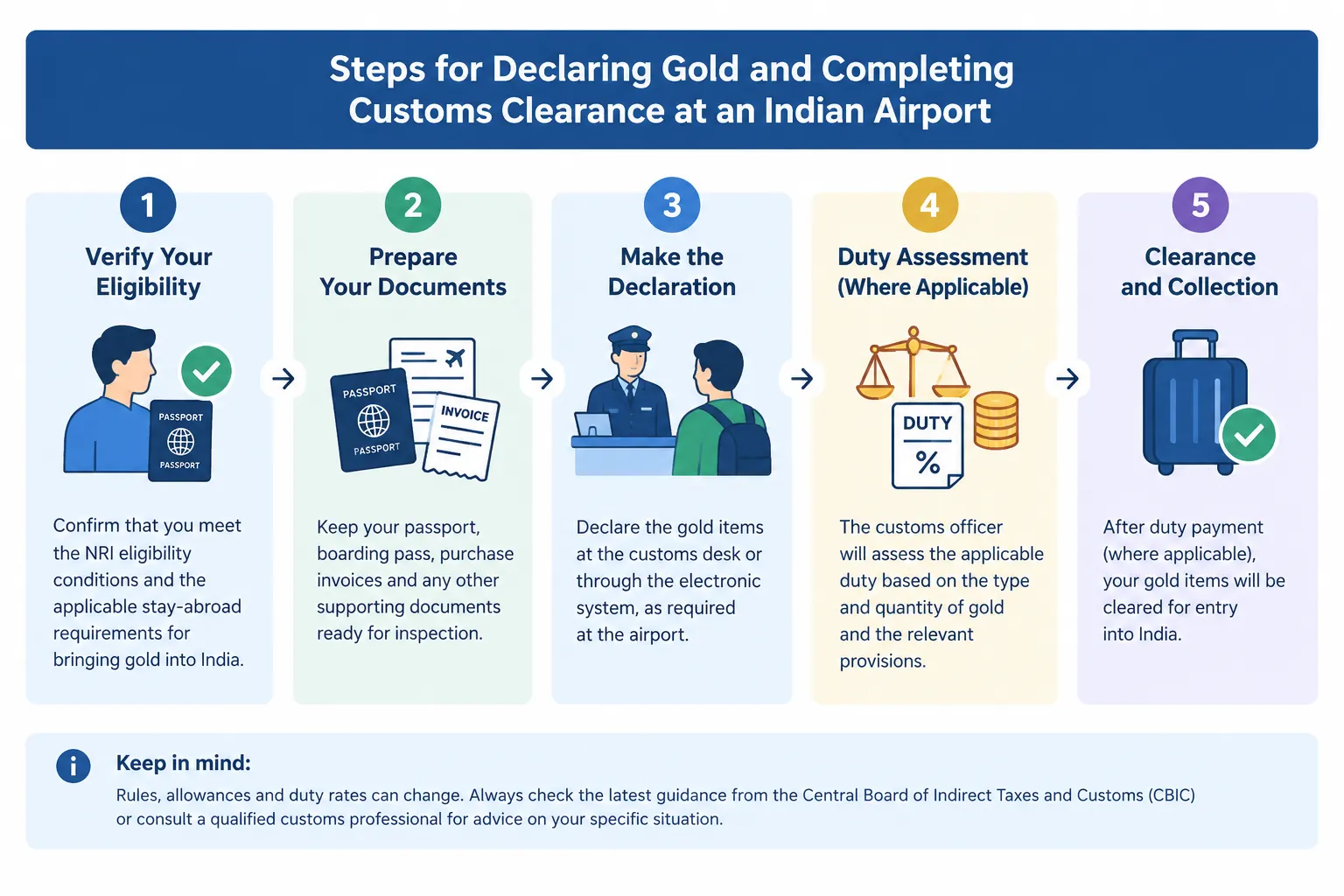
If your gold requires declaration or customs assessment, follow the applicable procedure rather than assuming that carrying it in personal baggage makes it exempt.
Determine whether you qualify for the jewellery allowance or the separate gold import provision. Check your stay abroad, passenger category, quantity and type of gold.
Keep your passport, travel records, purchase invoices and any other documents relevant to your circumstances. These may assist customs assessment, although the documents required depend on the applicable procedure.
Follow the current customs declaration process for your goods. If you are carrying dutiable gold or gold requiring a specific declaration, use the prescribed channel or procedure and do not rely on the green channel as a substitute for declaration.
Cooperate with customs officials, provide the requested information and pay the applicable duty before clearance where required. Retain the relevant declaration and payment records.
The CBIC's International Travellers portal provides official baggage guidance and information about the ATITHI customs application, which supports passenger declarations and related services. The exact procedure available to you should be verified before travel.
Even when gold is being carried for personal use, misunderstandings about customs rules can cause problems.
If you are returning to India permanently, check whether the transfer-of-residence provisions are relevant to your circumstances. These provisions have separate conditions and should not be assumed to exempt every gold item.
Also Want to Know About Custom Rules for NRIs Bringing Goods to India? Check Now!Failure to comply with Indian customs requirements can result in additional duty, detention or confiscation of goods, penalties, or other legal action, depending on the circumstances and applicable law. These consequences are not automatic in every case; the outcome depends on the facts and the relevant legal provisions.
If you are unsure whether your gold needs to be declared, check with Indian Customs before travelling. Where declaration is required, disclose the goods through the applicable procedure and follow the instructions given by customs officials.
Stop worrying about delays. Apply now and get Indian Counsellor Services.
Chat NowNRIs can bring gold to India, but the permitted quantity and customs duty depend on the type of gold, passenger eligibility and applicable customs provisions. The key distinction is between the duty-free jewellery allowance under the Baggage Rules, 2026 and the separate provision for eligible passengers importing gold on payment of duty.
Before travelling, verify the latest rules through the official CBIC International Travellers portal and keep the relevant supporting documents ready. If you are carrying gold bars, coins, or jewellery beyond the applicable allowance, confirm the declaration and duty requirements before your journey.
Not automatically. Previous ownership alone does not establish a customs exemption. The applicable rules, passenger circumstances, and evidence available may affect the treatment of the jewellery.
Certain gold forms may be permitted under specific gold import provisions, subject to eligibility, quantity restrictions, and applicable customs duty. The jewellery allowance should not be assumed to cover coins or bars.
It may. Eligible returning residents may need to consider the transfer-of-residence provisions under the Baggage Rules, 2026. The applicable conditions and exclusions must be checked separately.
A female can carry up to 40 grams of gold with them in any form with a value limit of Rs 1,00,000 as a part of her personal baggage.
Yes, the NRIs can bring the gold in multiple trips to India as long as they follow the specific weight limit and conditions.
Certain forms of gold that are restricted or prohibited depend on the national laws, international regulations, and the purpose of transport (commercial or personal). Some of the general restricted forms (duty-free) are gold biscuits, bars, or ingots, gold scrap or dust, commercial quantities of gold, etc.
Vipul Jain is the Co-Founder of Visament, a trusted platform dedicated to simplifying Indian immigration, consular, and NRI services for applicants across the globe. With extensive expertise in OCI cards, Indian passport services, visa assistance, apostille and document legalization,... See Full Bio

Talk to our documentation experts for free guidance on your application.




When you visit a website, it may store data about you using cookies and similar technologies. Cookies can be important for the basic operations of the website and for other purposes. You get the option of deactivating certain types of cookies, even so, doing that may affect your experience on the website.
It is required to permit the basic functionality of the website. You may not disable necessary cookies.
Used to provide advertising that matches you and your interests. May also be used to restrict the number of times you see an advertisement and estimate the effectiveness of an advertising campaign. The advertising networks place them after obtaining the operator's permission.
Permits the website to recognize the choices you make (like your username, language, or the region you are in). Also provides more personalized and enhanced features.
Aid the website operator to determine how the website performs, how visitors interact with the site, and whether there are any technical issues.