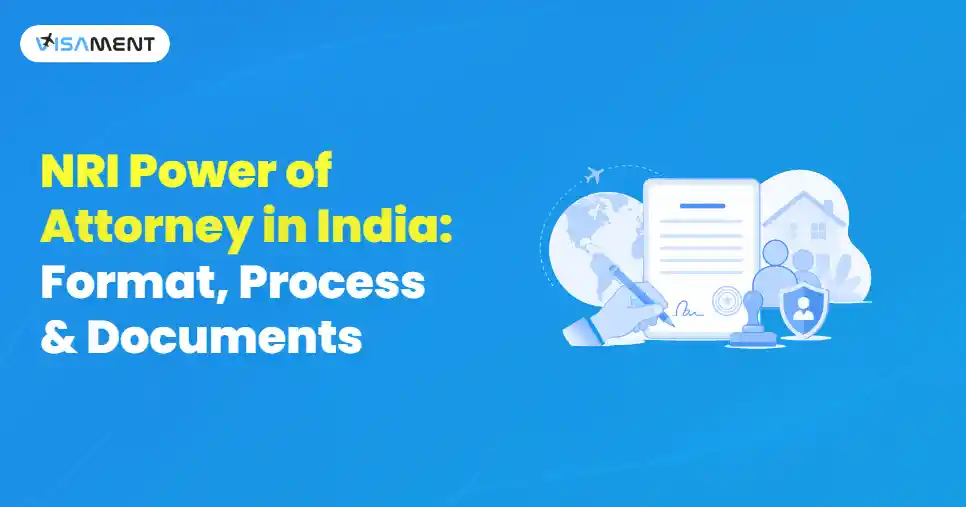
If you're living abroad and need someone to manage your property, banking, legal, or financial matters in India, a Power of Attorney (POA) is one of the easiest legal solutions. An NRI Power of Attorney allows you to authorize a trusted person in India to act on your behalf without travelling back.
Read the blog below to learn more about the NRI Power of Attorney, when you need one, the correct format for use in India and how to make it usable from abroad.
Key Takeaways
- A Power of Attorney enables NRIs to allow someone in India to handle their legal, financial or property matters on their behalf.
- Choose the correct POA: General POA for broad powers or Special POA for a specific task.
- POA signed abroad must be notarised or attested and may need registration in India.
- You must clearly define the powers granted and appoint a trusted individual.
- A POA can be revoked if it is no longer required or if the task is finished.
What is a Power of Attorney for NRIs?
A POA is a legal document that allows another person (an agent or attorney) to act on your behalf in specific matters. The individual who gives the power is known as the principal.
To understand this more simply, it means you are permitting someone else to perform certain tasks in your name. This can range from signing documents and managing bank accounts to selling property or attending to tax affairs.
Why Do NRIs Need a Power of Attorney (POA)?
Since India has a vast diaspora, numerous NRIs maintain strong ties to the country using property, bank accounts, investments or family responsibilities. These are the situations that call for a Power of Attorney for NRIs. They include:
Property Management and Sales
- If you own property in India and plan to rent, maintain, or sell it, you can allow a POA to handle the entire process.
- For instance, an NRI in the United Kingdom can authorise a relative to negotiate and sign a sale deed without making multiple trips to India.
Banking and Investments
- The POA you appoint can operate bank accounts, deposit or withdraw funds, pay bills and manage investments on your behalf.
- This is an ideal option for day-to-day or urgent financial matters.
Tax and Legal Matters
- This allows your agent to liaise with tax authorities, sign returns and represent you in court for matters such as inheritance disputes.
- This allows you to meet the stipulated deadlines while being overseas.
Business Operations
- In your absence, you can also let a manager or partner sign contracts, fill out regulatory paperwork and make operational decisions to keep your business running.
Personal and Family Affairs
- Elderly parents in India can grant POA to their children living overseas to manage pensions, insurance claims or government paperwork.
- An NRI can also grant a POA to a family member in India to handle personal, legal or administrative matters.
Emergencies and Health Care
- A medical Power of Attorney allows a trusted person to make healthcare decisions on your behalf if you become incapacitated.
- This forms part of a durable POA for contingency planning.
Types of Power of Attorney for NRIs in India
When appointing a Power of Attorney for NRIs in India, you must choose the type that completely suits your needs. There are several options for a Power of Attorney, and each comes with different scopes and purposes.
1. General Power of Attorney (GPA)
- This allows your chosen individual to manage a wide range of matters for you while you are living overseas.
- For instance, you can give a GPA to your spouse or a sibling to manage your property, handle finances and act in your place.
- A GPA generally remains valid until it is revoked, the purpose is fulfilled, or the principal passes away. If continuity during incapacity is intended, the document should be drafted accordingly after obtaining appropriate legal advice.
2. Special Power of Attorney (SPA)
- This restricts your chosen individual's access to a specific task or transaction.
- It includes tasks such as selling a single property, representing you in a single court case or managing a defined financial matter.
- These are one-time transactions where you are limiting your POA's powers.
- For instance, allowing a cousin to sell only a specific plot of land with no authority beyond that task.
- SPA's are time-bound and expire once the task is finished.
3. Durable Power of Attorney (DPA)
- This form of POA stays valid even if you lose your mental and physical capacity.
- It applies to either a general or special POA if drafted with the correct wording.
- This type of POA is helpful for long-term planning if you want uninterrupted authority, even when incapacitated.
- For instance, you can appoint a sibling to manage medical and financial matters if a health condition progresses.
- Since a durable POA is not a separate legal document, it is created using specific durable-effect language in the POA and ends upon your death.
4. Other variations include:
- Financial Power of Attorney
- This is only for financial matters such as banking, investments and tax filings.
- Property Power of Attorney
- This is used to buy, sell, lease or manage real estate.
- Medical Power of Attorney
- This allows someone else to make healthcare decisions on your behalf.
- Springing Power of Attorney
- This becomes valid only for a specific event such as a doctor certifying incapacity.
- It requires clear conditions and is less common for NRIs
| Type |
Best For |
Validity |
| General POA |
Multiple matters |
Until Revoked |
| Special POA |
One transaction |
Ends after Completion |
| Durable POA |
Incapacity planning |
Continues after incapacity |
| Medical POA |
Healthcare decisions |
As specified |
When Do NRIs Need a Power of Attorney?
It is necessary to know when you need a Power of Attorney for NRIs and which one to choose. Common situations where a POA is necessary include:
- For long-term travel or relocation
- Property transactions for NRIs
- Banking and investment requirements
- Family situations and emergencies
- Ease of doing business or transactions
After you have decided to acquire a Power of Attorney in India, you must make sure to prepare it correctly. There is no fixed template, and every POA must include certain core elements to make it accepted by Indian authorities.
It must include:
1. Clear Title and Introduction
- Make sure you give your document the title of "Power of Attorney" and state whether it is general or specific.
- It must contain a clear declaration of your intent.
- There must be clarity in granting authority.
- Traditional phrasing is optional
2. Names and Identifying Details
- Make sure you include your full name, address and identifying information (father's name, passport or Aadhaar number).
- You must do the same for your chosen attorney.
- These details will help in identifying the identities of both parties.
3. Effective Dates and Duration
- You must state when the POA becomes effective and how long it will last.
- If it is a durable power of attorney, you must specify that it will remain valid after you are incapacitated.
4. Scope of Powers Granted
- This part functions as the core of the document.
- You must list out the powers you are granting to an individual.
- To avoid ambiguity, be precise since your attorney can only act within what's stated.
5. Restrictions or Conditions Granted
- You must include limits if you want them.
- Conditions allow control, but once it is signed, your attorney's authorised acts will be legally binding.
6. Signature and Date
- You must sign and date the original document. Your signature will make the document legally valid.
- State the place of execution and initial on every page.
7. Witnesses
- You must have two adult witnesses sign with their full details.
- For POAs executed abroad, witnesses often sign before the notary or the Indian Consulate.
8. Notarisation or Acknowledgement
- If you are signing outside of India, you will need a notarisation.
- This will confirm your identity and signature.
- In India, notarisation is not always legally required. However, it adds credibility in cases of property and court matters.
9. Stamp Paper and Registration Details
- If it is signed in India, you must prepare it using the non-judicial stamp paper, as per state rules.
- If it is executed overseas, you must pay stamp duty when the POA is presented in India for adjudication.
Get Expert Help for Power of Attorney India from USA!
Have questions? Our experts guide you through every step of the Power of Attorney India from the USA– no confusion, no delays.
Consult an Expert Today How to Get a NRI & Power of Attorney From Outside India?
Indian authorities can determine that a POA is made overseas if it is executed before an authorised official and then legalised. There are 2 ways to do this:
1. Via the Indian Embassy or Consulate
- It is usually called an Indian Embassy Power of Attorney.
- This involves booking an appointment, taking the drafted document along with ID and signing it in the presence of a consular officer.
- The official will then verify your identity and attest the POA with the embassy's seal and signature.
- Consular attestation is accepted directly in India without further legalisation.
- Make sure you check the mission's requirements before visiting.
- In some cases, the POA needs to be notarised locally first, or the witness's signature needs to be notarised or signed in person at the consulate.
- After attestation, the original document must be sent to your representative in India for use.
If you are applying for a Power of Attorney India from UK, make sure you follow the attestation or apostille requirements applicable in the UK before sending the document to India for stamping or registration.
2. Signing the POA before a local notary public and obtaining an apostille
- Since India is a member of the Hague Apostille Convention, documents apostilled in another member country are generally accepted in India without further consular legalisation, subject to applicable Indian laws and procedures.
- For instance, in the UK, the Foreign, Commonwealth and Development Office issues apostilles for notarised documents.
- If your country is not a member or prefers not to use the apostille process, you can have the notarised document certified by the Indian embassy or consulate.
- Both apostille and consular attestation work; however, countless NRIs find the apostille route quicker, while consular attestation may sound familiar to certain Indian officials.
- You must appear in person before the notary or consular officer since remote or online notarisation is not allowed in India.
Documents Required for an NRI Power of Attorney
Before applying for or executing a Power of Attorney, keep the following documents ready:
- Valid Indian passport
- Visa or residence permit (where applicable)
- Overseas address proof
- Passport-size photographs
- Draft Power of Attorney document
- Identity proof of the attorney holder in India
- Property documents (for property-related POAs)
- PAN card, if required for the transaction
- Any additional documents requested by the Indian Embassy, Consulate or local authorities
Registration and Stamp Duty Requirements For an NRI Power of Attorney
Getting your POA notarised and legalised abroad is the first step. To make it fully effective in India, you might need to pay stamp duty and register it formally.
Stamp Duty
- It must be paid on most legal documents, including powers of attorney.
- If you have executed the document on plain paper abroad, it must be presented to the local District Registrar or Sub-Registrar in India within 90 days of arrival for adjudication.
- The officials will then calculate the applicable duty, which is often around Rs. 100 for general purposes.
- It is higher for property transactions or when given to non-family members. Make sure to endorse the document once it is paid.
- Missing this deadline can result in penalties. Unstamped documents cannot be used in court for registration.
Registration
- Registration is generally required when the Power of Attorney authorises the sale, purchase or transfer of immovable property. Registration requirements may vary depending on the nature of the transaction and the applicable state laws in India.
- This officially records the POA at the Sub-Registrar's office and gives it public notice.
- Even if it is not required, registration is advised in many states for important POAs to strengthen their legal standing.
- In matters of property, the authorised agent usually completes the registration on your behalf in India by presenting the adjudicated document and ID.
- Without a registration, your agent will be unable to sign a sale deed or complete a property transfer in your name.
Common Mistakes to Avoid When Creating a Power of Attorney
To avoid delays or legal complications, keep these points in mind:
- Appoint only a trusted individual as your attorney.
- Clearly define the powers being granted.
- Ensure all names and identification details are accurate.
- Follow the attestation or apostille requirements applicable in your country.
- Complete stamping and registration requirements in India wherever applicable.
- Revoke the Power of Attorney once it is no longer required.
Can a Power of Attorney Be Revoked?
Yes. A Power of Attorney can generally be revoked by the principal at any time, provided it is revocable and the principal is legally competent. A revocation deed should be prepared, and the attorney holder should be notified. If the original POA was registered, the revocation should also be registered with the appropriate authority in India. It is also advisable to notify banks, government departments or any other institutions where the POA has been used.
Conclusion
A Power of Attorney is a practical and reliable solution for NRIs who need to manage their legal, financial or property matters in India without being physically present. By choosing the right type of POA, clearly defining the powers granted and following the required legal formalities, NRIs can ensure their affairs are handled efficiently and securely. Consulting a legal professional before drafting a POA can further help prevent unwanted complications.
If you are unsure about the documentation, attestation, apostille or registration process and need assistance with a Power of Attorney India from the USA, Visament can help you avoid unnecessary delays. We offer end-to-end support for NRI documentation services, including guidance on Power of Attorney documentation, attestation and related procedures. Visament helps you make the entire process simpler and more convenient.