Related Blogs


If you earn income connected with India and another country, the same income may potentially be subject to tax in both jurisdictions. DTAA India rules are designed to address this type of double taxation by allocating taxing rights and providing applicable forms of tax relief under the relevant treaty.
This guide explains what DTAA means, how an India tax treaty works, who may qualify for treaty benefits, what documentation can matter, and why DTAA does not automatically mean that income is tax-free in India.
DTAA means Double Taxation Avoidance Agreement. It is an agreement between India and another country or specified territory that establishes rules for dealing with taxation of cross-border income and avoiding or relieving double taxation.
Under Section 90 of the Income-tax Act, the Central Government can enter into agreements with foreign countries or specified territories for purposes including relief from double taxation, avoidance of double taxation, exchange of information and recovery of tax.
A DTAA therefore should not be viewed simply as a tax-saving arrangement. It is a bilateral tax framework that determines how particular categories of income may be taxed when more than one country has a potential taxing claim.
The exact treatment depends on the relevant treaty, the type of income, the taxpayer's tax residence and other applicable conditions.
Double taxation can arise when an individual or business has a connection with more than one country.
For example, suppose an individual is tax resident in Country A but earns interest from an Indian source. India may have a right to tax the Indian-source income, while Country A may also tax the individual's worldwide income under its domestic law.
Without appropriate relief, the same income could effectively face taxation in both jurisdictions.
A DTAA helps establish rules for these situations. Depending on the treaty, it may:
Section 90 also expressly covers exchange of information and recovery of income tax as purposes for which agreements may be entered into.
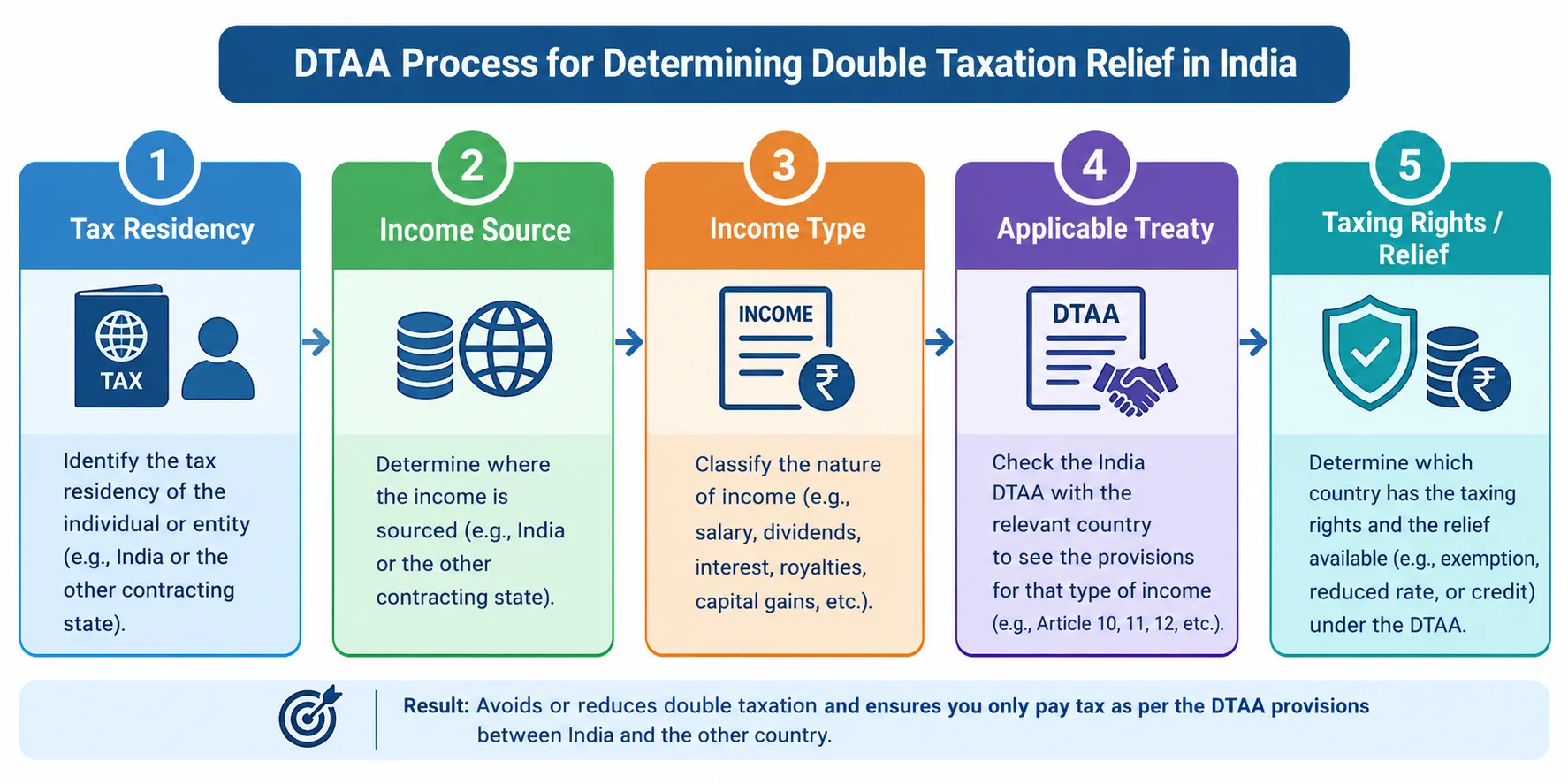
The basic DTAA process can be understood through four questions:
For example, if an Indian tax resident earns qualifying income from another country, the foreign country may impose tax under its domestic rules. India may also tax the income under Indian law. Where an applicable DTAA exists, the treaty and Indian tax rules determine how the double-taxation issue is addressed.
The Income Tax Department explains that where a DTAA applies, relief for taxes paid in the treaty country is governed by the relevant agreement and the applicable Indian provisions.
DTAA benefits are not automatically available to every person who earns foreign income or is an NRI.
Eligibility depends on the relevant India-country tax treaty and the taxpayer's circumstances. Important factors can include:
For certain non-resident taxpayers seeking relief under a DTAA, Section 90(4) requires a certificate of residence from the relevant foreign government, while Section 90(5) requires prescribed additional documents and information.
This is why being an NRI alone does not establish entitlement to every DTAA benefit. The specific treaty and the taxpayer's facts must be considered.
The exact provisions differ from treaty to treaty, but Indian tax treaties commonly contain articles dealing with different categories of income.
|
Income category |
What to check under the treaty |
|---|---|
|
Interest |
Whether both countries can tax it and whether a treaty rate applies |
|
Dividends |
Source-country taxation and applicable treaty limitations |
|
Royalties |
Definition, source rules and treaty rate or taxing rights |
|
Business profits |
Whether a Permanent Establishment (PE) exists and how profits are allocated |
|
Employment income |
Residence, place of employment and treaty conditions |
|
Capital gains |
Which country has taxing rights over the particular asset or gain |
|
Immovable property income |
Rules generally connected with the location of the property |
|
Other income |
The specific treaty article and residual rules |
The Income Tax Department's international-tax guidance identifies common treaty articles covering areas such as residence, Permanent Establishment, immovable property, business profits, dividends and interest.
The important point is that there is no single DTAA rate that applies to all income or all countries. The applicable treaty must be examined before relying on a particular rate or exemption.
No. DTAA does not automatically make income tax-free in India.
A tax treaty may give India the right to tax certain income, limit India's taxing rights, allocate the taxing right to the other country, or provide a mechanism for relieving double taxation.
For example, a treaty may provide a maximum rate for certain types of income earned by a resident of the other contracting state. That does not mean every type of income earned by that person is exempt from Indian tax.
The outcome depends on factors such as:
Section 90(2) provides that, where a relevant agreement applies, the provisions of the Income-tax Act apply to the extent they are more beneficial to the taxpayer, subject to the statutory framework and applicable anti-abuse provisions.
The exact procedure depends on the taxpayer, income and treaty. At a high level, the process involves the following:
Determine which country considers you a tax resident for the relevant period under its domestic rules and, where necessary, under the applicable treaty.
Do not rely on a general statement about DTAA. Check the actual agreement between India and the country concerned.
Determine whether the income relates to interest, dividends, royalties, salary, business profits, capital gains or another category covered by the treaty.
The relevant article determines how the income can be taxed and whether a treaty limitation or relief mechanism applies.
A Tax Residency Certificate (TRC) can be important for claiming treaty benefits. Depending on the circumstances, prescribed forms and supporting information may also be required. The Income Tax Department currently provides dedicated forms and guidance for treaty-related documentation, including Form 10F/Form 41.
Treaty relief does not remove the need to comply with applicable Indian tax-return, withholding and disclosure requirements.
Because documentation and filing requirements can change, taxpayers should verify the current requirements applicable to their situation before claiming treaty relief.
DTAA and Foreign Tax Credit (FTC) are related but different concepts.
|
DTAA |
Foreign Tax Credit |
|---|---|
|
A tax treaty between jurisdictions |
A mechanism for relief from qualifying foreign taxes |
|
Establishes rules for allocating or limiting taxing rights |
Generally provides credit for eligible foreign tax against applicable domestic tax |
|
Depends on the applicable treaty |
Depends on applicable domestic rules and, where relevant, treaty provisions |
|
Contains articles covering different types of income |
Addresses the tax already paid or deducted in another jurisdiction |
For example, an applicable DTAA may determine how income can be taxed between India and another country. Where foreign tax has been paid, the taxpayer may then need to consider the applicable foreign-tax-credit rules for obtaining relief.
The Income Tax Department distinguishes treaty-based relief under Sections 90 and 90A from unilateral relief under Section 91 where no applicable DTAA exists.
Before relying on an India tax treaty, check these points:
The safest approach is to treat DTAA India as a treaty-specific exercise rather than a universal tax exemption. A result that applies to one country or type of income may not apply to another.
Stop worrying about delays. Apply now and get Indian Counsellor Services.
Chat NowDTAA in India provides a framework for dealing with taxation when income has a connection with India and another jurisdiction. It can help allocate taxing rights and provide relief from double taxation, but it is not a blanket exemption from Indian tax.
If you are relying on treaty relief, check your tax residency, the specific India-country DTAA, the relevant income category, applicable treaty article and required documentation. For complex cross-border situations, professional review can help ensure that the treaty position and Indian tax reporting are evaluated together.
The DTAA provides the benefits to those individuals and companieswho are earning an income outside of their country of residence. DTAA prevents them from getting taxed twice on the same income and saves them from paying more tax than necessary.
An NRI may be able to claim benefits under an applicable India-country DTAA, but NRI status by itself does not guarantee every treaty benefit. Eligibility depends on the relevant treaty, tax residency, income type and applicable conditions.
There are three methods used to avoid double taxation: Exemption: You can claim tax relief by using this method in either of the two countries. Tax Credit: You can claim tax relief by using this method in your country of residence. Deduction: The taxes paid to foreign governments can be claimed by taxpayers in their country of residence.
No. DTAA does not automatically exempt income from Indian tax. The applicable treaty article determines India's taxing rights and the relief, if any, available to the taxpayer.
A taxpayer generally needs to establish treaty eligibility, identify the applicable treaty provision, satisfy relevant residency and documentation requirements, report the income correctly and claim the applicable relief under the current rules.
No. DTAA is the treaty framework, while foreign tax credit is a mechanism for obtaining relief for qualifying foreign taxes under applicable rules.
The Income Tax Department publishes India's tax-treaty information. Start with the official DTAA resources and then check the specific treaty applicable to the country and type of income involved.
Vipul Jain is the Co-Founder of Visament, a trusted platform dedicated to simplifying Indian immigration, consular, and NRI services for applicants across the globe. With extensive expertise in OCI cards, Indian passport services, visa assistance, apostille and document legalization,... See Full Bio

Talk to our documentation experts for free guidance on your application.



When you visit a website, it may store data about you using cookies and similar technologies. Cookies can be important for the basic operations of the website and for other purposes. You get the option of deactivating certain types of cookies, even so, doing that may affect your experience on the website.
It is required to permit the basic functionality of the website. You may not disable necessary cookies.
Used to provide advertising that matches you and your interests. May also be used to restrict the number of times you see an advertisement and estimate the effectiveness of an advertising campaign. The advertising networks place them after obtaining the operator's permission.
Permits the website to recognize the choices you make (like your username, language, or the region you are in). Also provides more personalized and enhanced features.
Aid the website operator to determine how the website performs, how visitors interact with the site, and whether there are any technical issues.