If you have lived outside India for several years and are now spending more time in India, your tax status may not simply be “Resident” or “NRI.” You may qualify as RNOR (Resident but Not Ordinarily Resident), a separate residential-status category under Indian income-tax law. Understanding RNOR status can help you determine how India treats your income for tax purposes and avoid mistakes caused by applying the wrong residency classification.
Key Takeaways
- RNOR means Resident but Not Ordinarily Resident, a residential-status category under Indian income-tax law.
- RNOR status is relevant only after an individual qualifies as a Resident under the applicable residential-status rules.
- The current RNOR criteria include being non-resident in 9 out of the preceding 10 years or staying in India for 729 days or less during the preceding 7 years.
- Residential status is determined separately for each relevant tax year, so RNOR status can change as your residence and India-stay history change.
- For tax years beginning before 1 April 2026, residential status continues to be determined under the Income Tax Act, 1961. For tax years beginning on or after that date, the Income Tax Act, 2025 applies.
- RNOR status can affect the scope of Indian taxation of foreign-source income, but foreign income should not be assumed to be automatically tax-free merely because you are RNOR.
What Is RNOR Status in India?
RNOR stands for Resident but Not Ordinarily Resident. It is a residential-status classification used under Indian income-tax law for an individual who is treated as resident in India but meets the applicable conditions for being considered “not ordinarily resident.”
This distinction matters because Indian tax rules do not treat every resident in exactly the same way. Your residential status can influence the scope of income that is considered for Indian taxation.
RNOR is therefore different from both Non-Resident (NRI) and an ordinary Resident.
The Income Tax Department confirms that the RNOR/NOR criteria under the Income Tax Act, 2025 remain substantively unchanged from the corresponding rules under the Income Tax Act, 1961.
Who Can Qualify for RNOR Status?
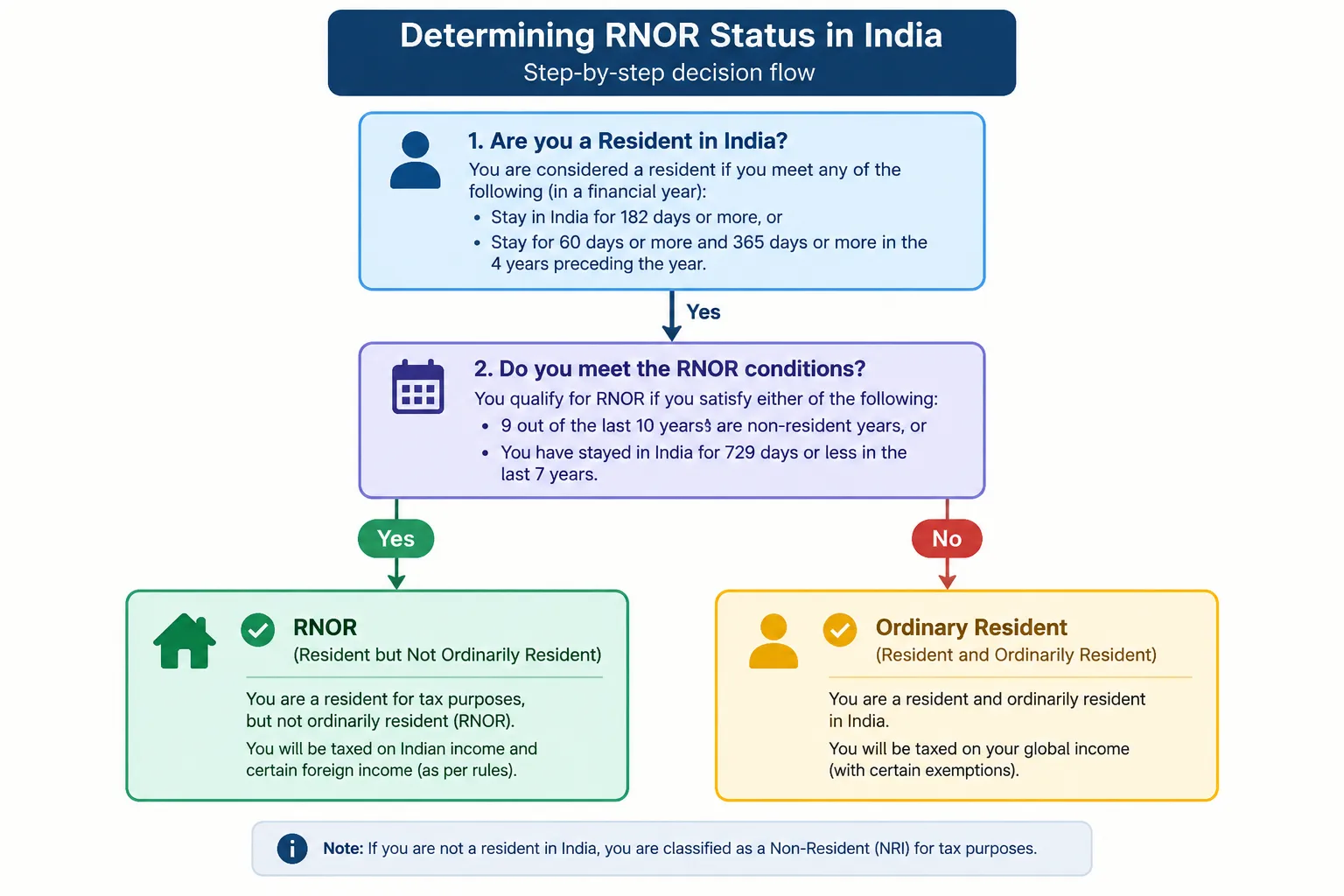
RNOR status is not determined simply because someone has returned to India after living abroad. There are two stages to consider:
- Determine whether the individual is Resident or Non-Resident for the relevant tax year.
- If the individual is Resident, check whether the RNOR conditions are satisfied.
The basic individual residency tests continue under the Income Tax Act, 2025. In general, an individual may become resident based on the number of days spent in India during the relevant tax year, subject to the special rules and exceptions applicable to particular categories of individuals.
Once a person falls into the Resident category, the RNOR conditions determine whether that person is ordinarily resident or not ordinarily resident.
This distinction is particularly important for people returning to India after spending many years abroad.
What Are the RNOR Conditions?
The current Income Tax Department guidance identifies two principal conditions for determining whether an individual is not ordinarily resident:
1. Non-Resident in 9 of the Previous 10 Years
An individual can qualify as RNOR if they were non-resident in India in 9 out of the 10 preceding years.
This is a historical test. It does not look only at the person's current year of residence. Instead, the individual's residential status over the preceding 10 years is considered.
Example:
Suppose an individual lived outside India and was treated as a non-resident for 9 of the 10 years preceding the relevant tax year. If that individual becomes resident in India during the relevant year, the 9-out-of-10-year condition may support RNOR status.
The actual determination should be made using the residential status for each relevant preceding year rather than simply counting years spent abroad.
2. Stayed in India for 729 Days or Less During the Previous 7 Years
An individual can also qualify as RNOR if they were physically present in India for 729 days or less during the 7 preceding years.
This is a cumulative stay test.
Example:
Suppose a returning Indian spent relatively little time in India during the seven years before becoming resident. If the total stay across those seven preceding years is 729 days or less, this condition may support RNOR status.
The important point is that the calculation covers the preceding seven years collectively, not just the current tax year.
Special Rules for Certain Indian Citizens and Persons of Indian Origin
The residential-status rules also contain special provisions for certain Indian citizens and persons of Indian origin (PIOs) who visit India, as well as specific rules concerning Indian citizens who may not be liable to tax in another country.
For example, the current statutory material contains specific residency provisions for an Indian citizen or PIO visiting India where the relevant stay and income conditions are met. The official notified material should be checked for the applicable tax year and circumstances before applying these provisions.
This is one reason why a person should not determine RNOR status from the number of days spent in India alone. Citizenship, purpose of travel, income and historical residential status can also matter.
How Does RNOR Status Affect Tax in India?
The main reason RNOR status matters is that residential status affects the scope of income that may be subject to Indian taxation.
For an RNOR, Indian-source income remains relevant for Indian tax purposes. The treatment of foreign-source income can be different from the treatment applicable to an ordinary Resident, but the answer depends on the nature and source of the income and the applicable provisions.
Therefore, it is inaccurate to say simply that “foreign income is tax-free for RNORs.”
For example, someone returning to India may have:
- Salary or business income connected with India
- Interest or investment income in India
- A foreign salary
- Foreign bank interest
- Investments or other income outside India
The tax treatment of each item should be considered under the rules applicable to the relevant tax year. Double-taxation relief or treaty provisions may also become relevant in appropriate circumstances.
If you need detailed assistance with NRI income-tax filing, that should be handled through the relevant dedicated tax-filing resource rather than turning this RNOR explainer into a complete tax-return guide.
RNOR vs NRI vs Resident
RNOR, NRI and Resident are not interchangeable terms.
|
Status
|
Basic Meaning
|
Main Point
|
|
Non-Resident / NRI
|
Individual does not qualify as resident under the applicable Indian residency rules
|
Indian residential status is non-resident
|
|
RNOR
|
Individual qualifies as Resident but satisfies the applicable “not ordinarily resident” conditions
|
A resident with a specific historical-residency classification
|
|
Resident
|
Individual qualifies as resident and does not fall within the RNOR category
|
Generally treated as ordinarily resident, subject to the applicable rules
|
The most important distinction is that RNOR is a category within the Resident classification. It is not simply another word for NRI.
For example, an NRI who returns to India and becomes resident may potentially qualify as RNOR if the applicable historical conditions are satisfied. Returning to India does not automatically mean that the person becomes an ordinary Resident for tax purposes.
Does RNOR Status Apply Forever?
No. Residential status is determined for each relevant tax year.
Your status can change as your stay in India and your historical residential record change. The fact that you qualified as RNOR in one year does not by itself guarantee RNOR status in every subsequent year.
This is particularly important for people who have permanently returned to India. Their status may evolve as the historical look-back periods change.
For that reason, keep accurate records of your travel and residence history rather than relying on the status you used in a previous tax return.
How to Determine Your RNOR Status
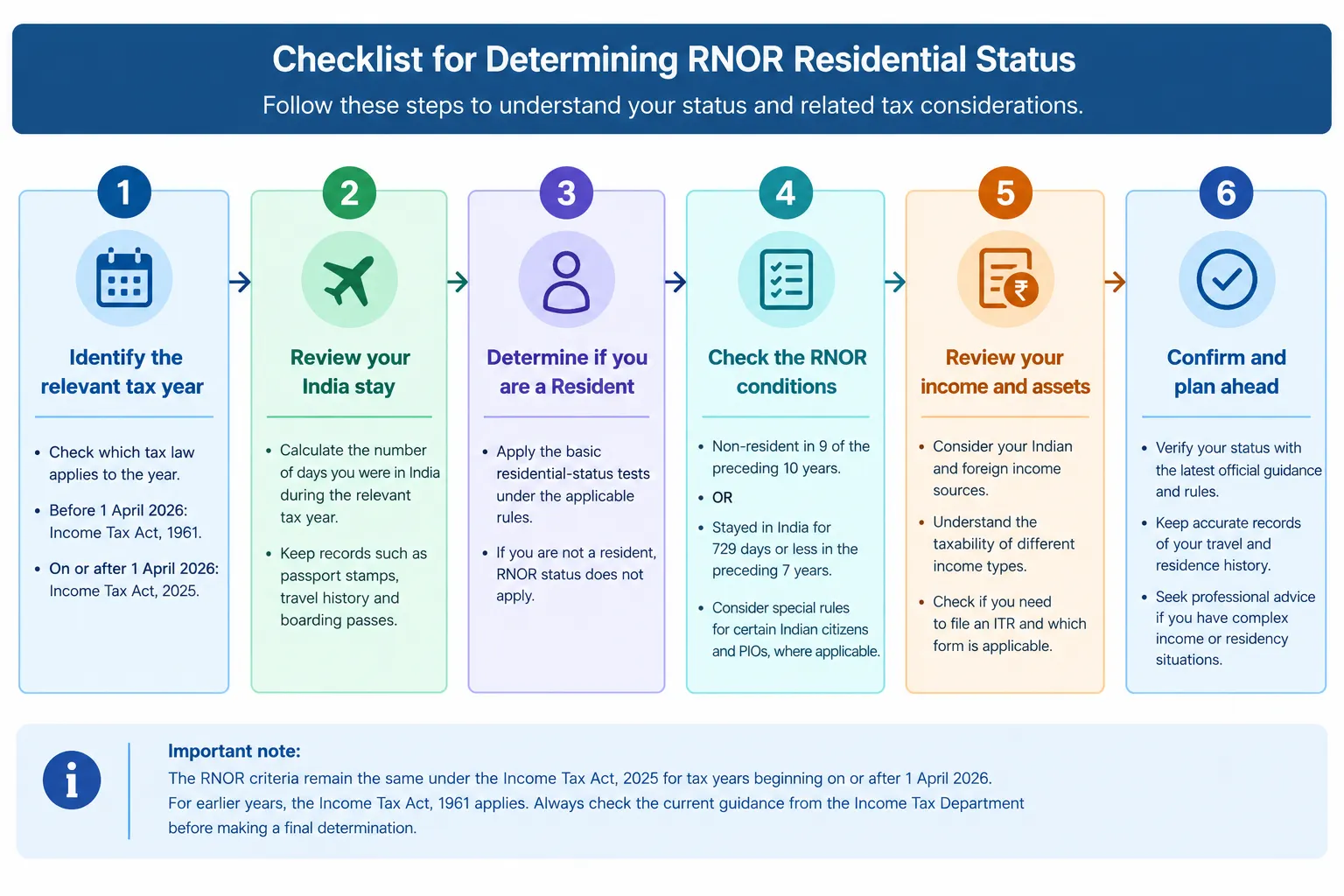
A practical approach is to work through these steps:
- Identify the relevant tax year.
Confirm which tax law applies to that year. Tax years beginning before 1 April 2026 continue to be governed by the Income Tax Act, 1961, while tax years beginning on or after 1 April 2026 fall under the Income Tax Act, 2025.
- Calculate your stay in India during that tax year.
Apply the relevant residential-status rules rather than assuming that living abroad automatically makes you an NRI.
- Determine whether you are Resident or Non-Resident.
The current basic residency tests continue to use the applicable India-stay thresholds, subject to specific provisions and exceptions.
- If you are Resident, check the RNOR conditions.
Review your residential status during the preceding 10 years and your cumulative stay in India during the preceding seven years.
- Review your income and circumstances separately.
If you have foreign income, foreign assets, multiple-country tax residency or other complex circumstances, do not determine taxability solely from the RNOR label.
- Verify the applicable ITR requirements.
Current Income Tax Department guidance states that an RNOR cannot use ITR-1 or ITR-4. The appropriate return depends on the individual's income and other circumstances.
A Practical Example for a Returning NRI
Consider an Indian citizen who has lived outside India for several years and returns to India.
During the year of return, the individual may satisfy the applicable conditions for becoming a Resident. That does not automatically mean the person is an ordinary Resident.
The next question is whether the person meets either of the relevant RNOR conditions based on their historical residential status and India stay. If the person was non-resident for at least 9 of the preceding 10 years, or stayed in India for no more than 729 days during the preceding seven years, the RNOR classification may apply.
This example is illustrative only. An individual's actual status depends on the complete facts for the relevant tax year.
Why the Tax Year Matters
A common mistake is to apply today's rules retrospectively to an earlier tax year.
The Income Tax Department states that residential status for a tax year beginning before 1 April 2026 continues to be determined under the Income Tax Act, 1961, even if the assessment or reassessment happens after the Income Tax Act, 2025 comes into force. For tax years beginning on or after 1 April 2026, the new Act applies.
The Department also states that the RNOR criteria themselves were not modified under the new Act.
Therefore, always identify the relevant tax year before applying residential-status rules.
What About ITR Filing for an RNOR?
RNOR status can affect which income-tax return form is available.
For example, the Income Tax Department's current guidance states that ITR-1 cannot be filed by an RNOR, while ITR-4 is also unavailable to an RNOR.
That does not mean every RNOR taxpayer automatically uses one particular alternative form. The appropriate ITR depends on the person's income sources and other circumstances.
If your situation involves salary, investments, foreign income, capital gains, business income or foreign assets, check the current return-form requirements for the applicable tax year before filing.
When Should You Seek Professional Tax Advice?
RNOR status can usually be understood through the statutory tests, but some situations are more complicated than simply counting days.
Professional tax advice can be useful when you:
- Have recently returned to India after many years abroad.
- Have income from multiple countries.
- Maintain foreign bank or investment accounts.
- Are uncertain about your residential status for a previous year.
- Need to determine the Indian tax treatment of foreign income.
- Have questions involving a tax treaty or double-taxation relief.
- Are unsure which ITR is appropriate.
The key is to establish your residential status first and then analyze the tax treatment of your specific income and assets.
If you need professional assistance with NRI tax matters, NRI income-tax services can be considered after determining that you need support beyond the general guidance in this article.
Chat to Support on Whatsapp
Stop worrying about delays. Apply now and get Indian Counsellor Services.
Chat Now Conclusion
RNOR status is particularly important for people who have lived abroad and are becoming Indian tax residents. RNOR means Resident but Not Ordinarily Resident, and the classification depends on the applicable residential-status rules and historical residence or stay in India.
The two principal RNOR tests currently focus on whether the individual was non-resident in 9 of the preceding 10 years or stayed in India for 729 days or less during the preceding 7 years.
Because residential status is determined for each tax year, keep accurate travel records and verify the rules applicable to the specific year. If you have foreign income, foreign assets or a complex residency history, obtain appropriate tax advice before filing.


 Also Want to Know About