If you are an NRI who missed the deadline for filing your Indian income tax return, you may still be able to file a belated ITR. However, late filing can result in a delayed-filing fee and, depending on your tax position, interest or other consequences.
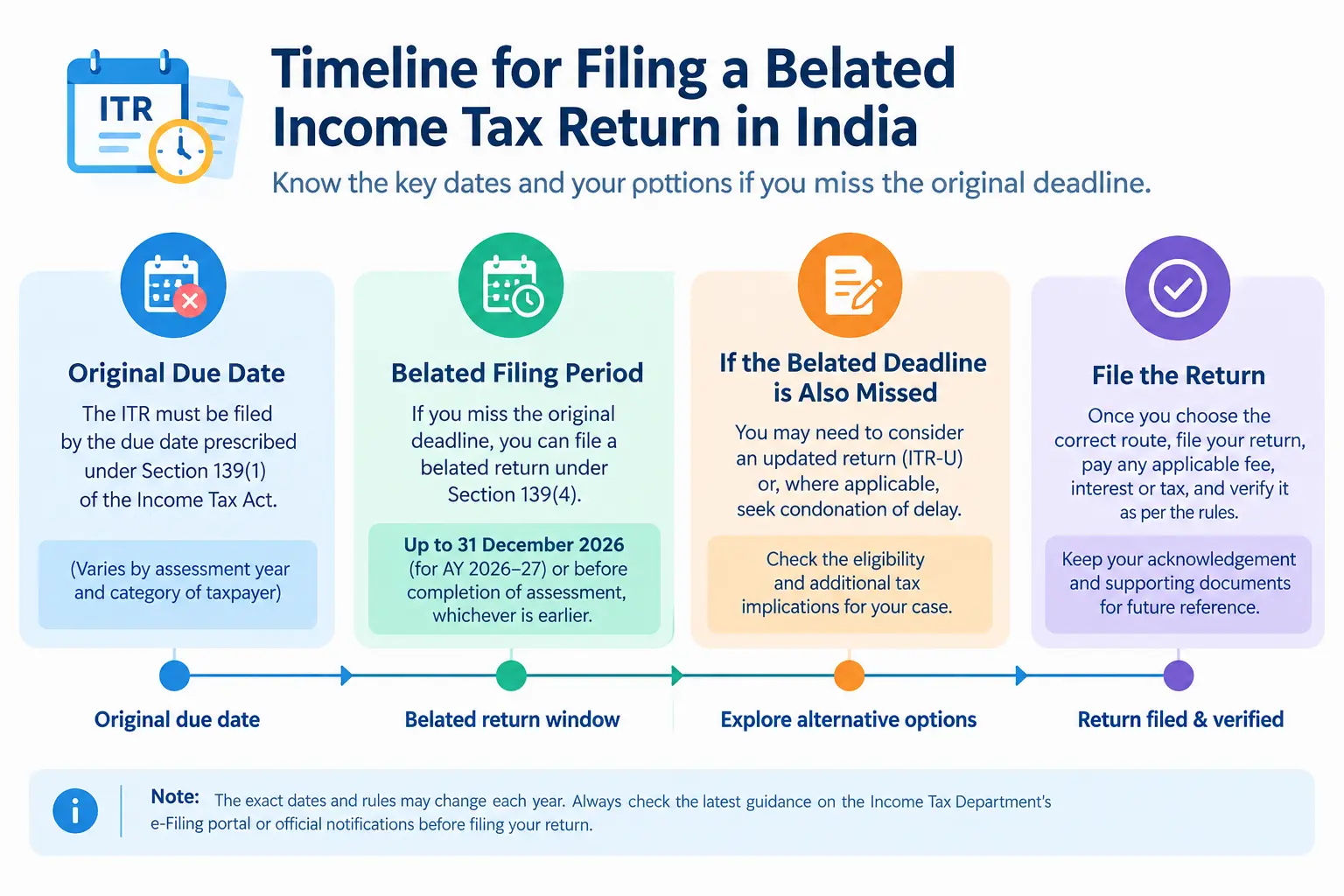
For AY 2026–27, the Income Tax Department states that a belated return can generally be filed under Section 139(4) up to 31 December 2026 or before completion of assessment, whichever is earlier. The delayed-filing fee is ₹1,000 if total income does not exceed ₹5 lakh and ₹5,000 in other cases.
Key Takeaways
- A belated ITR is a return filed after the applicable original filing deadline but within the permitted belated-return period.
- For AY 2026–27, the delayed-filing fee is ₹1,000 for total income up to ₹5 lakh and ₹5,000 where total income exceeds ₹5 lakh.
- The late-filing fee is separate from any tax or interest that may be payable.
- For AY 2026–27, the current belated-return deadline is 31 December 2026, or completion of assessment, whichever is earlier.
- Being an NRI does not by itself remove the consequences of late filing. Your Indian filing obligation depends on your income and applicable tax rules.
- A belated ITR and an ITR-U (updated return) are different filing mechanisms.
- If you have foreign income or assets, check the applicable disclosure and reporting requirements carefully before filing.
What Is a Belated ITR for an NRI?
A belated ITR is an income tax return filed after the original due date prescribed under Section 139(1), but within the period allowed for a belated return.
For an NRI, the first question is not simply whether they live outside India. You should determine your Indian tax residential status and Indian tax filing obligation for the relevant year before deciding whether a return is required. The Income Tax Department separately identifies ITR forms applicable to non-resident individuals; for AY 2026–27, ITR-2 and ITR-3 are among the applicable forms depending on the taxpayer's income sources.
For example, an NRI with Indian rental income, capital gains from Indian investments, or other taxable Indian income may have an Indian ITR filing obligation even while living abroad.
What Is the Belated ITR Penalty or Late Filing Fee for NRIs?
The belated ITR penalty commonly referred to as the late filing fee is generally based on total income, rather than on whether the taxpayer is an NRI.
For AY 2026–27 under the Income Tax Act, 1961, the Income Tax Department states the following delayed-filing fee:
|
Total income
|
Late-filing fee
|
|
Up to ₹5 lakh
|
₹1,000
|
|
Above ₹5 lakh
|
₹5,000
|
The ₹5 lakh threshold refers to total income, not the amount of tax ultimately payable.
For example, suppose an NRI has ₹8 lakh of taxable total income from Indian sources but TDS has already covered the tax liability. A zero or low balance tax payable does not automatically change the applicable late-filing fee. The fee is determined under the relevant delayed-filing provision.
The applicable assessment year should always be checked because tax rules and filing provisions can change.
Is the Belated ITR Late Fee the Same as Tax or Interest?
No. Late-filing fee, income tax and interest are separate liabilities.
|
Amount
|
What it relates to
|
|
Late-filing fee
|
Consequence of filing the return after the applicable due date
|
|
Income tax
|
Tax payable on taxable income after considering applicable credits and provisions
|
|
Interest
|
May arise because of delayed payment or specified tax-payment defaults
|
An NRI who files late may therefore have more than one amount to pay. For example, if Indian tax remains unpaid after accounting for TDS, the taxpayer may have a tax liability as well as applicable interest. The exact interest depends on the circumstances and the relevant assessment year.
The Income Tax Department also confirms that taxpayers who miss the prescribed filing date may have to pay a late-filing fee and interest on tax liability, where applicable.
This distinction is important because paying the tax due does not, by itself, mean that the return was filed on time.
What Is the Last Date to File a Belated ITR?
For AY 2026–27, a belated return under Section 139(4) of the Income Tax Act, 1961 may be furnished on or before 31 December 2026 or before completion of assessment, whichever is earlier.
The relevant deadline depends on the assessment year and applicable filing provisions. Therefore, an NRI should not assume that the same calendar date applies to every year's return.
For AY 2026–27, income earned during FY 2025–26 is reported in the return for AY 2026–27 and continues to be governed by the Income Tax Act, 1961. The Income Tax Department specifically confirms that AY 2026–27 returns remain governed by the old Act despite the commencement of the Income Tax Act, 2025.
What Happens If an NRI Files the ITR Late?
Filing a belated return can have several consequences depending on the taxpayer's circumstances.
1. You may have to pay a late-filing fee
For AY 2026–27, the applicable fee is ₹1,000 or ₹5,000 depending on total income.
2. Interest may apply
Late filing can coincide with unpaid tax. Where applicable, interest may be charged separately from the delayed-filing fee.
The amount cannot be stated as a single figure for every NRI because it depends on factors such as tax liability, TDS, advance tax and the relevant statutory provisions.
3. Certain losses may not be carried forward
Late filing can affect the ability to carry forward certain losses. Under the Income Tax Act, 1961, loss-return provisions generally require compliance with the prescribed filing deadline for specified losses. The Income Tax Department confirms that a loss return filed belatedly for an earlier assessment year may fail to qualify for carry-forward under the applicable provisions.
This can be particularly important for NRIs reporting capital losses from Indian investments or eligible business losses.
4. A refund does not automatically make late filing irrelevant
An NRI may have excess TDS deducted from Indian salary, bank interest, rent or other income and may therefore expect a refund. Filing late does not mean the tax computation can simply be ignored.
The taxpayer should determine whether a return is required and whether the refund can be claimed through the applicable filing route.
5. Foreign income and asset reporting requires care
NRIs should not assume that their return only requires information about Indian income. The correct disclosure requirements depend on residential status and the applicable return form and tax provisions.
For AY 2026–27, the Income Tax Department identifies specific return forms for non-resident individuals and provides separate reporting requirements within the applicable forms.
Can an NRI File a Belated ITR If No Tax Is Payable?
Yes, a taxpayer may still need to file a return even when the final tax payable is nil, depending on the applicable filing obligation.
For example, an NRI may have Indian income on which sufficient TDS has already been deducted. The fact that the final tax calculation results in no additional tax payable does not automatically mean that there was no filing obligation.
The correct approach is to check the filing requirement for the relevant assessment year, calculate the income and tax correctly, claim eligible TDS credit, and then determine whether a belated return can and should be filed.
Do not assume that “no tax payable” means “no ITR required.”
What If an NRI Misses the Belated ITR Deadline Too?
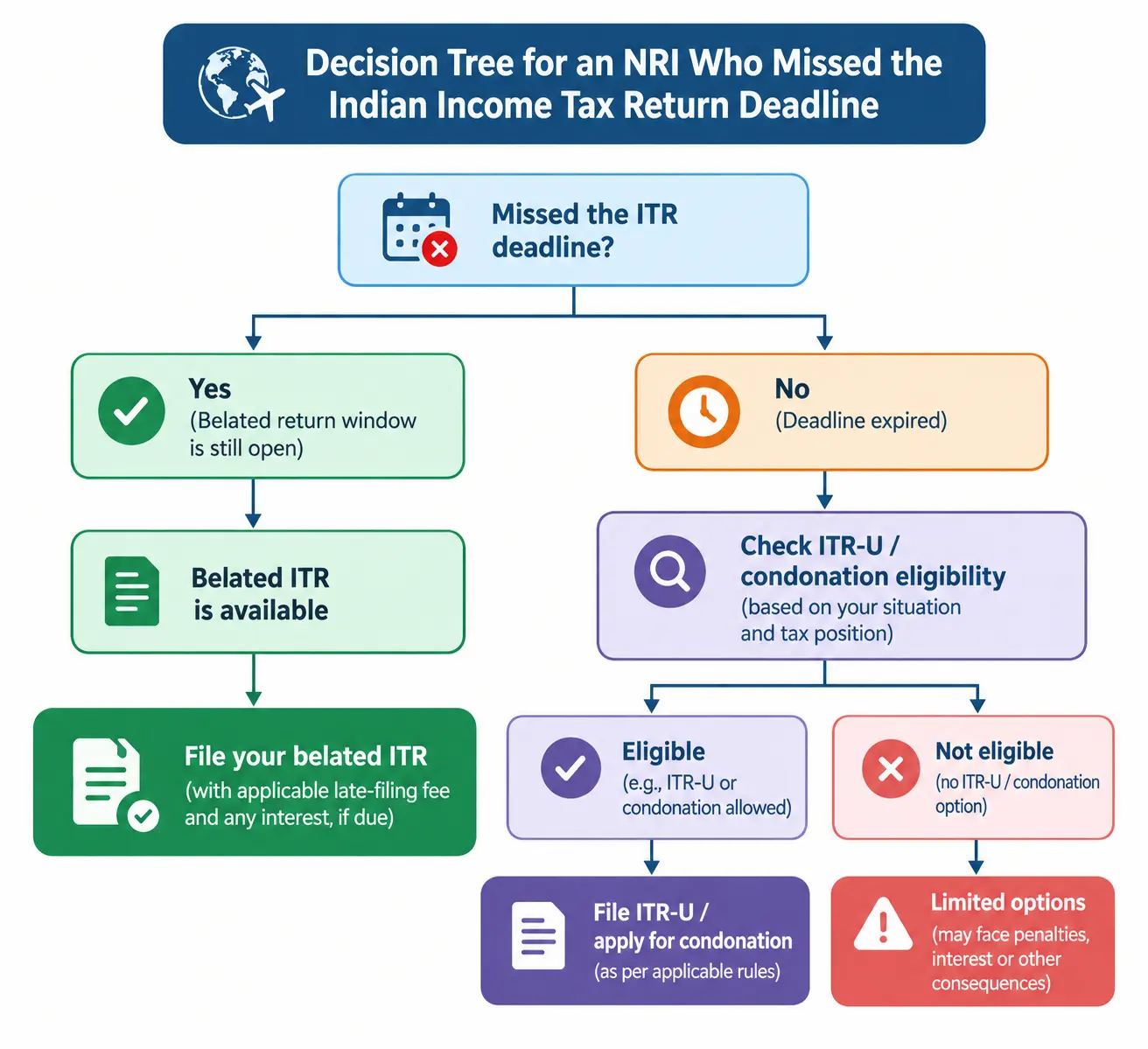
Once the ordinary belated-return window has expired, an NRI should not simply assume that a normal belated return can still be filed.
Depending on the circumstances, the taxpayer may need to examine an ITR-U (updated return) or seek condonation of delay where the statutory requirements are met.
The Income Tax Department's guidance identifies ITR-U and condonation of delay under Section 119(2)(b) as possible routes in appropriate situations.
These mechanisms are not interchangeable. An updated return has its own eligibility conditions and additional tax implications, while condonation is a separate relief mechanism that requires the relevant conditions and approval.
Therefore, an NRI who has missed both the original and belated deadlines should determine the correct statutory route before submitting a return.
Belated ITR vs ITR-U: What Is the Difference?
A belated ITR and an ITR-U serve different purposes.
|
Belated ITR
|
ITR-U
|
|
Filed after the original due date within the permitted belated-return period
|
Used to update income-tax information subject to statutory conditions
|
|
Governed by the applicable belated-return provision
|
Governed by the updated-return provisions
|
|
Delayed-filing fee may apply
|
Additional tax may apply depending on the circumstances
|
|
Used for a late regular return
|
Has separate eligibility restrictions and conditions
|
For AY 2026–27, the Income Tax Department confirms that an updated return can continue to be filed under Section 139(8A) of the old Act after the new Act comes into force, subject to the applicable rules.
Do not use ITR-U simply because it sounds like another name for a belated ITR. The two filing routes have different legal consequences.
What Should an NRI Do After Missing the ITR Deadline?
If you have missed your Indian ITR deadline, follow this sequence:
- Identify the assessment year. Make sure you are working with the correct financial year and assessment year.
- Confirm your residential status. Your NRI status for tax purposes should be determined under the applicable rules for that year.
- Check your Indian income. Review salary, rent, interest, dividends, capital gains and other Indian-source income.
- Reconcile TDS and tax payments. Check your Form 26AS and Annual Information Statement (AIS) before preparing the return.
- Check whether the belated-return window is still open.
- Calculate tax, applicable interest and late-filing fee. These are separate components.
- Use the correct ITR form. Non-resident individuals may need ITR-2 or ITR-3 depending on their income and circumstances.
- File and verify the return. Keep the acknowledgement and supporting records.
- If the belated deadline has expired, check ITR-U or condonation options instead of filing through an incorrect route.
Common Mistakes NRIs Should Avoid When Filing a Belated ITR
NRIs should be particularly careful about the following:
- Assuming that living outside India means an Indian ITR is never required.
- Using a resident-only ITR form when the taxpayer is non-resident.
- Confusing financial year, assessment year and tax year.
- Reporting Indian income but overlooking relevant TDS information.
- Treating the late-filing fee as the only amount that may be payable.
- Assuming that an ITR-U is simply a late ITR.
- Filing a loss return late without checking whether the loss remains eligible for carry-forward.
- Using outdated filing deadlines from a previous assessment year.
- Ignoring foreign-asset or foreign-income reporting requirements where applicable.
For AY 2026–27, the Income Tax Department specifically states that ITR-1 and ITR-4 are not available to non-resident individuals, while ITR-2 and ITR-3 are among the applicable forms depending on the taxpayer's income profile.
Chat to Support on Whatsapp
Stop worrying about delays. Apply now and get Indian Counsellor Services.
Chat Now Conclusion
Missing your ITR due date does not necessarily mean you can no longer file a return. For AY 2026–27, taxpayers can generally use the belated-return route up to 31 December 2026 or completion of assessment, whichever is earlier, with a delayed-filing fee of ₹1,000 or ₹5,000 depending on total income.
The important point is to distinguish the belated ITR late fee from tax and interest, and to check whether late filing affects issues such as loss carry-forward or a refund. If the belated-return deadline has already passed, check whether ITR-U or another applicable statutory route is available rather than assuming a normal belated return can still be filed.