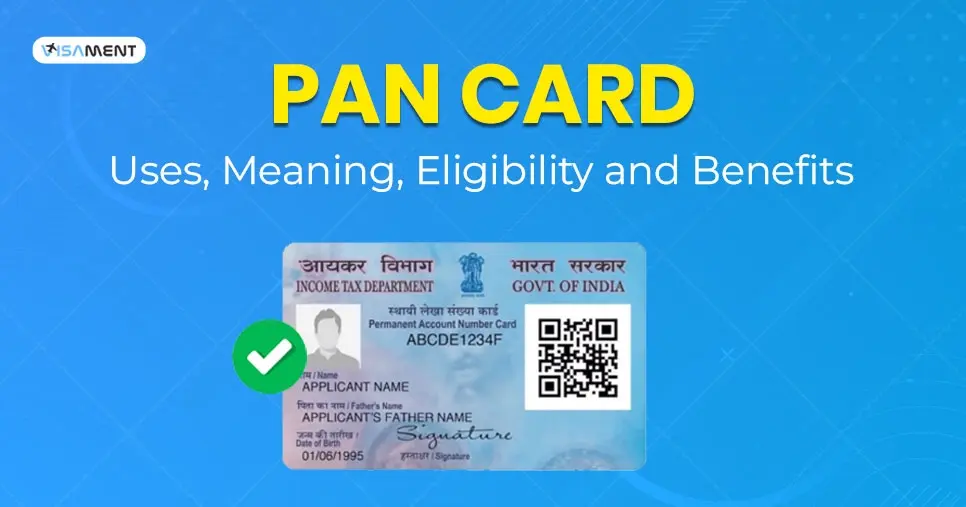
A PAN (Permanent Account Number) is a unique alphanumeric identifier that is issued to each taxpayer by the Income Tax Department and overseen by the Central Board of Direct Taxes. It can also be used for identification verification.
A PAN card is required for financial activities, such as selling or buying assets above specific limits, earning taxable pay or professional fees, buying mutual funds, etc.
The main aim of PAN is to establish a global identifying key to track monetary transactions that may contain taxable components to avoid tax evasion. The PAN number does not change with the change of location throughout India.
In this blog, you can explore the uses of a PAN card. We have also highlighted its role in income tax purposes, business activities, financial transactions, and international dealings.
Major Financial and Legal Uses of PAN Card
- Serves as a valid proof of identity.
- Can be used as address proof in eligible cases.
- Required for filing Income Tax Returns (ITR).
- Needed for business or company registration.
- Required to open NRE and NRO bank accounts.
- Used for obtaining phone and gas connections.
- Mandatory for investing in mutual funds, shares, and bonds above prescribed limits.
- Required for cash deposits exceeding ₹50,000 in a bank account.
- Needed for purchasing motor vehicles (other than most two-wheelers).
- Required for certain high-value international travel bookings.
- Necessary for specified high-value banking and financial transactions.
- Required for remitting funds outside India, where applicable.
- Used for high-value payments and purchases as per Income Tax regulations.
- May be required for hotel or restaurant bills exceeding the prescribed threshold.
PAN Card Benefits
A PAN card provides many benefits, especially in making financial transactions. Here are some of the benefits of using a PAN card:
- Easy Loan Approval: Helps lenders verify your financial history, making loan processing smoother.
- Simplified Tax Filing: Makes filing Income Tax Returns (ITR) easier by linking your financial transactions.
- Tracks Investments: Helps monitor investments and ensures accurate tax reporting on gains.
- Lower TDS Rates: Providing your PAN helps avoid higher Tax Deducted at Source (TDS) rates.
- Identity Proof for Minors: A Minor PAN Card serves as identity proof and enables minors to be nominees for financial assets and investments.
Have questions? Our experts guide you through every step of the PAN Card Application– no confusion, no delays.
Consult an Expert TodayUses of PAN Card in Financial Transactions
A PAN Card is mandatory whether you are opening a bank account, buying property, or investing in stocks. Here are some of the PAN card uses in financial transactions:
PAN Card in Banking
When you open a bank account, one of the important documents is a PAN card. PAN cards are used by banks to track financial transactions and ensure that they comply with tax regulations. Here are the important points about the PAN card's role in banking:
- Cash Transactions: Required for specified high-value cash deposits and withdrawals.
- Bank Account Opening: Needed to open savings, current, or fixed deposit (FD) accounts.
- Interest & Tax Tracking: Helps track interest income and ensures the correct TDS is applied.
- Loans & Credit Cards: Used by banks to verify your financial history when processing loan or credit card applications.
PAN Card in Investments
A PAN card is important for different investment activities. It helps the government to track investments and make sure that the taxes on gains are paid. Here are the uses of a PAN card in various investments:
- Mutual Funds: A PAN card is required for mutual fund investments above ₹50,000 and helps track your investments and capital gains.
- Gold Purchases: A PAN is mandatory for gold purchases exceeding ₹2 lakh, helping ensure transparency in high-value transactions.
- Stock Market: A PAN is required to open a Demat account and to buy or sell shares in the stock market.
- Bonds & Debentures: A PAN is needed for investing in bonds and debentures, helping track interest income and ensure correct tax deductions.
PAN Card in Property Transactions
There are significant financial transactions in the process of buying or selling a property. The PAN card always has an important role in ensuring transparency and saving from tax evasion in real estate dealings. Here are some PAN card uses:
- Property Sale: While selling your property, it is important to quote the PAN in the sale deed. This helps in tracking the capital gains from sales and ensures that the correct amount of taxes is paid.
- Property Purchase: If you purchase property for an amount of Rs 10 lakhs or more, then a PAN is required. This rule applies to both residential and commercial properties.
- Rent Agreements: If the actual rent is more than Rs. 1 lakh, then both the tenant and landlord have to provide their PAN cards for the rent agreement.
- Home Loans: When you apply for a home loan, the banks need your PAN card to get your financial background and credit score.
How to File Income Tax Returns with a PAN Card?
Filing income tax returns is important for taxpayers annually. Here are the steps on how to file ITRs using a PAN card:
- Collect Documents: Keep your PAN card, Form 16, bank statements, investment proofs, and income details ready.
- Register on the Income Tax Portal: Log in to the Income Tax e-filing portal using your PAN.
- Choose the Right Form: Select the appropriate ITR form based on your income. For example, ITR-1 is for salaried individuals, while ITR-4 is for business income.
- Fill in the Details: Enter your personal, income, and deduction details accurately. Make sure that the information is the same as on your PAN card and other documents.
- Go for Tax Calculation: The portal helps individuals to calculate their tax liability. If you have paid more tax, you can claim a tax refund. If you have paid less tax, then you have to pay the balance.
- Verify and Submit: Verify all the details and submit the Income tax return. You can verify it electronically by using the Aadhaar OTP, net banking, or by sending a signed physical copy of the acknowledgment to the Centralised Processing Center (CPC).
Uses of PAN Card for Business and Professional Activities
Having a PAN card is necessary for businesses for so many reasons. Here are some PAN card uses:
- Tax Filing: A PAN card is required to file income tax returns. It ensures that the businesses' tax records are correctly maintained.
- Compliance: The businesses comply with different tax regulations and avoid penalties with the PAN card.
- Financial Transactions: The banks and financial institutions need a PAN card for opening bank accounts and making large transactions.
- Verification: It is used as proof of identity for various businesses. It helps with legal formalities and many verifications.
GST Registration and PAN Card
GST is an indirect tax that is imposed by the government on the manufacture, sale, and consumption of various goods and services. If the businesses exceed a certain turnover threshold, then GST registration is essential. A PAN card can be considered a prerequisite for GST registration.
Process for GST Registration Using PAN Card
- Make sure that your business has a valid PAN card.
- Visit the official GST portal.
- Fill out the GST registration application form and provide the PAN details.
- Upload the required documents, including the proof of business registration, PAN card, and identity and address proof of the business owner.
- The GST portal will verify your details, and after approval, a GSTIN (GST Identification Number) will be issued.
GST Compliance and PAN Card
After the GST registration, maintaining compliance is very necessary. The PAN card plays an important role in this process:
Key Parts of GST Compliance
- Annual Returns: You must file an annual return by summarising all the transactions of the year and including PAN details, which is a crucial part of the documentation process.
- Input Tax Credit: The businesses can claim the input tax credit on their purchases. The PAN card helps in tracking and verifying these claims.
- Tax Payments: All the GST payments are linked to the PAN card. It ensures that tax payments are credited correctly.
- Monthly and Quarterly Returns: Businesses have to file GST returns monthly or quarterly, depending on their turnover. The PAN card is required for this process.
- E-Way Bills: For transporting goods valued at more than a certain amount, it is mandatory to generate an e-way bill. The details of PAN are needed.
Benefits of GST Compliance
You can gain so many benefits by staying compliant with the GST regulations:
- Improved Credibility: GST-compliant businesses are trusted more by customers and suppliers, and they have better credibility.
- Avoid Penalties: You should file regular and accurate returns to avoid hefty penalties.
- Business Growth: For smoother operations and business growth, it is necessary to be compliant with GST rules.
- Input Tax Credit: Proper compliance makes sure that you claim input tax credit seamlessly, which eventually reduces the overall tax burden.
Uses of PAN Card For International Transactions
Foreign Remittances refer to transferring money from one country to another. There can be many reasons for this transfer, such as education, family support, or investments. A PAN card is required for all Indian residents sending or receiving money internationally.
PAN Card Needed in Foreign
- Tax Deductions: With the help of a PAN card, the identity of the individual or entity is proved. It ensures that proper tax is deducted at the source if it is applicable.
- Bank Procedures: The banks and financial institutions ask for a PAN card to process international money transfers. It is used to verify the identity of a person and make sure that the transaction complies with legal standards.
- Regulatory Compliance: As per the Reserve Bank of India (RBI), a PAN card is necessary for all foreign remittances to track taxable transactions and maintain transparency.
Forex Transactions
Foreign exchange or forex transactions involve the trading of currencies. It is a very big market where the traders buy and sell currencies to make profits. The PAN card is an essential requirement for Indians to participate in forex trading.
Importance of PAN Card in Forex Trading
- Taxation: The profits earned from forex trading are subject to taxes. A PAN card is required to track these earnings and ensure that the trader complies with the tax regulations.
- KYC Norms: In forex trading, the Know Your Customer (KYC) norms are very strict. A PAN card is a key document used for KYC verification, making sure that the identity of the trader is authenticated.
- Transaction Limits: There is an RBI limit set on the amount of money that an individual can trade or transfer in forex annually. The PAN card helps in tracking these transactions and makes sure that they do not cross the prescribed limits.
PAN Card Uses for International Transactions
There are several steps involved in the process of using a PAN card for international transactions:
- Providing PAN Details: When you begin a foreign remittance or forex trade, the individual should provide their PAN card details to the financial institution or bank.
- Verification: The bank or financial institution verifies the PAN details against their records from the database that is maintained by the Income Tax Department.
- Processing the Transaction: After the verification, the transaction is processed. The PAN card makes sure that the transaction is legitimate and complies with regulatory norms.
Benefits of PAN Card in Foreign
- Tax Compliance: It makes sure that all international financial transactions are reported to the tax authorities, as it promotes tax compliance.
- Transparency: PAN Card ensures that all transactions are traceable and transparent. It also reduces the chances of fake activities.
- Ease of Transactions: International transactions become simpler and more efficient with the help of a PAN card.
Common Concerns
Apart from all the benefits, there are also some concerns associated with using a PAN card:
- Some individuals are concerned about their privacy regarding their financial information. However, in India, the stringent data protection laws in India makes sutre that your PAN details are secured.
- If there are any mistakes in PAN details, then it can lead to delays or rejections while making transactions. It is important to ensure that PAN information is up-to-date and accurate.
Conclusion
The PAN card is very useful for both individuals and businesses in India. In case of income tax filings, high-value purchases, foreign remittances, or forex trading, a PAN card is indispensable. You can obtain a PAN card from the official Protean website seamlessly. You can apply for a new PAN, correct or update the existing PAN details, check the status of your application, or even download an ePAN.
You can also seek assistance from the experts of Visament, as they have many years of experience. They can help you obtain the PAN card hassle-free from the comfort of your home.
Frequently Asked Questions
A PAN card enables smooth financial transactions, ITR filing, business registration, vehicle purchases (excluding 2-wheelers), payments of up to 25,000 at hotels and restaurants, share buying, bond purchases, mutual fund investments, and easy fund transfers outside India.
A PAN card is a 10-digit alphanumeric character used by Indian taxable persons for filing ITRs, conducting error-free financial transactions, and serving as an identity document in financial departments and government organizations. The Income Tax Department issues it for various identity and financial purposes.
The PAN card was started by the Indian government in 1972, and under Section 139A of the Income-tax Act of 1961, all Indian tax-paying persons must have a valid PAN card in India.
A PAN card allows you to file your ITR returns for smooth financial transactions. With a PAN card, you can use it as an Identification document. It also helps you to get low TDS deductions on the savings account interest at 10%, and you can get the excess income tax refund on your TDS deducted more than the actual tax.
Five uses of PAN card: For filing ITR returns, for registering a business, for sale and purchase of a property, for various financial operations such as loans, opening bank accounts like NRE account and NRO account, and to invest in mutual funds, bonds, or shares.
Yes, a PAN card is Permanent, which is used for various identification and tax-related purposes like filing IT returns. The Income Tax Department issues a PAN card for providing easy banking, tax filing, and business registration purposes. You can also use your PAN card as a valid Identity document.