Related Blogs

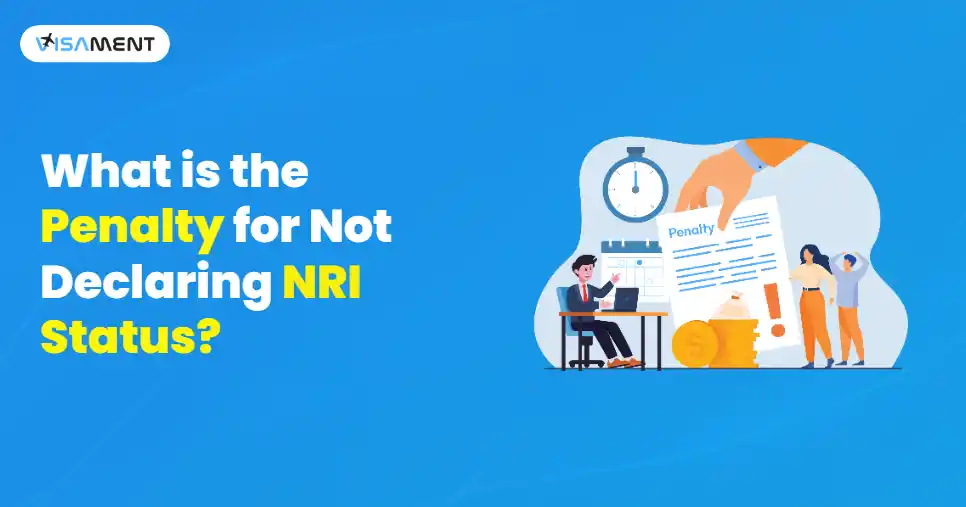
Many NRIs are unaware that keeping a resident savings account after becoming an NRI is a FEMA violation and can attract heavy penalties. Many residents leave India and stay in a foreign country for education, business, employment, etc., and their resident status changes. It is important that after being an NRI, you convert your savings account for resident Indians to an NRO bank account. While not declaring the NRI status does not have any penalty, non-conversion of the savings account can lead to heavy penalties.
The NRI full form is Non-Resident Indian, and they can enjoy some of the benefits available for resident Indians. In this blog, we have mentioned the penalty for not declaring NRI status, and you can also read the complete process for converting your account with a list of all the necessary documents required for it.
Two main laws can determine the NRI status. They are:
According to the Income Tax Act, if the person can fulfil the following conditions, then he/she will be considered a resident indian:
According to the guidelines of the Foreign Exchange Management Act, NRIs are those people who go outside India and live there indefinitely for the purpose of education, business, employment, etc. Also, as per this act, an OCI or PIO is also considered an NRI.
NOTE: If any of the Indian citizens do not fulfil the above conditions, then they will not be considered an NRI, and they are required to comply with all the ITA and FEMA rules made for NRIs.
 Also Want to Know About Financial Mistakes Returning NRIs Make and How to Avoid Check Now!
According to the FEMA guidelines, there is no penalty for not declaring the NRI status. It is very important that after being an NRI, you must either close your savings bank account or convert it to an NRO (Non-Resident Ordinary) bank account as soon as possible. If you fail to do this on time, then there will be legal and financial penalties imposed on you.
Under the rules of FEMA, it is considered illegal to hold a resident savings account in India after getting the NRI status, and it can lead to major penalties. If the authorities catch you with a resident savings account, then you may have to pay a fine of up to three times the bank balance in the savings account or Rs 2 lakhs (if the amount is not precise).
Additionally, a penalty of Rs 5,000 per day will be imposed, starting from the day of the first intervention, until you either convert or close your savings account.
Also Want to Know About Travel Checklist for NRIs Visiting India Check Now!Steps To Convert Your Savings Account into an NRO Account
There are two types of NRI accounts you can open in India as an NRI: NRE (Non-Resident External) account and NRO (Non-Resident Ordinary) account. In an NRE account, you can park your foreign earnings in India, and with the NRO savings account, NRIs can manage their income earned in India. This can include interest, pension, rent, dividends, etc.
Also, keep in mind that if you want to convert your present savings account, then you can only convert it to an NRO bank account.
Also Want to Know About Replace Lost or Destroyed Birth Certificate in India Check Now!NOTE: There can be some additional documents, according to your specific bank, required to convert your savings account to the NRO account.
As an NRI, there are many benefits that you can enjoy, similar to those of resident Indians. However, there are certain things that you must do after becoming an NRI, such as declaring your NRI status and converting your resident savings account to an NRO account. If you fail to do this conversion, you may have to face heavy legal and financial penalties.
After returning to India, the NRIs are considered as RNOR for the next 2-3 years, and the rules are applied to them similarly to NRIs. After this time, their status is changed to ROR, and the taxation rules applied to them are similar to those applied to residents of India.
Yes, you should definitely declare your NRI status in India by confirming your bank and other financial institutions. It is important to convert your savings account to an NRO account in India. If you do not comply with the regulations of the Indian laws, then it can lead to serious penalties.
You can submit these documents as proof of your NRI status: An employment letter, a valid employment contract, or your resident permit that indicates your overseas address.
No, the NRIs cannot have a savings account in india on their names. They have to convert their savings account into an NRE (Non-Resident External) or NRO (Non-Resident Ordinary) Account.
Under the guidelines of FEMA, if you fail to convert your NRE account to a resident savings account, then you need to pay the severe penalties for this. There will be fines up to three times the entire bank balance, Rs 2 lakhs if the amount is unclear, and there will be a Rs 5,000 daily penalty strating form the date of violation until it is corrected. There can also be income tax complications, and the account can be frozen.
Yes, the NRIs have to declare their income in India and file the income tax returns on that. They are required to pay all the taxes on the income accrued or arising in India, or it is deemed to arise or accrue in India.
Vipul Jain is the Co-Founder of Visament, a trusted platform dedicated to simplifying Indian immigration, consular, and NRI services for applicants across the globe. With extensive expertise in OCI cards, Indian passport services, visa assistance, apostille and document legalization,... See Full Bio

Talk to our documentation experts for free guidance on your application.


When you visit a website, it may store data about you using cookies and similar technologies. Cookies can be important for the basic operations of the website and for other purposes. You get the option of deactivating certain types of cookies, even so, doing that may affect your experience on the website.
It is required to permit the basic functionality of the website. You may not disable necessary cookies.
Used to provide advertising that matches you and your interests. May also be used to restrict the number of times you see an advertisement and estimate the effectiveness of an advertising campaign. The advertising networks place them after obtaining the operator's permission.
Permits the website to recognize the choices you make (like your username, language, or the region you are in). Also provides more personalized and enhanced features.
Aid the website operator to determine how the website performs, how visitors interact with the site, and whether there are any technical issues.