Related Blogs

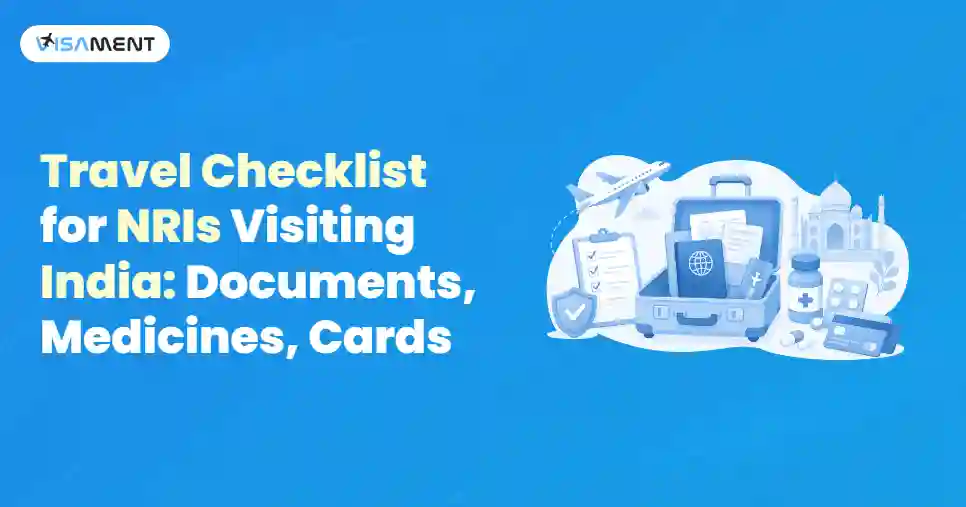
Are you an NRI planning a trip to India? If so, then before you start your journey, you must have all the necessary resources to make the trip safe and enjoyable. If it is your first time travelling to India, there are many essential things to keep in mind before planning your journey and after you land in India.
Read the blog below to learn more about the NRI visiting India Checklist and how to ensure you have a smooth and memorable journey.
Travel documents are the most important part of an NRI's trip to India. Make sure your passport is valid for at least 6 months from your travel date. If you are travelling on an Indian passport, make sure you have your visa or proof of residency for your country of residence. If you are travelling on a foreign passport, you must have your OCI card, a valid visa, and other entry permission applicable to your situation.
A few important documents that you must have with you are listed below.
Remember to keep soft copies of all the important documents on your phone.
Rules are rules wherever you go. Hence, make sure you are following all the applicable rules of international travel.
 Also Want to Know About Emergency Consular Services Provider Check Now!
India has changed drastically in the matter of payments. Online payments and NetBanking are preferred over paper currency. For NRIs, this part can be stressful because not every foreign number, bank account, or card works well with the Indian payment systems.
A few NRE/NRO-linked accounts now support UPI access better than before. Banks, too, have been expanding their options. The best way to be prepared for this situation is to carry a layered payment setup, such as:
| Payment Item | What is Recommended | How is it Helpful |
|---|---|---|
| International Credit Card | Visa or Mastercard with international usage enabled | Works for hotels, restaurants, app payments, and emergencies |
| Debit Card | Keep one backup card from a different bank account | ATM access if one card fails |
| Indian bank account card | Useful if you already have an NRE/NRO account | Useful for local spending and easier domestic banking |
| UPI Setup | Activate before travel if your bank allows NRI linkage | Useful in cities, cabs, shops and for food orders |
| Cash in INR | Keeping paper currency of small denominations | Helpful for porters, |
| Backup currency | Optional but useful for longer trips | An extra layer if the banking app does not work |
Another factor that most travellers underestimate while visiting India is healthcare. India has pharmacies in many places, and you will easily get resources in major cities. However, prescription brand names differ, and formulations vary.
If you are an individual taking regular medicines for thyroid, BP, asthma, or allergies, you must bring enough for the whole trip plus extra for delays. Keep them in their original packaging. Carry the prescription with the generic name written clearly.
A few must-have medicines for your journey are listed below.
Also Want to Know About Best Time to Visit India Check Now!India can feel both excellent and exhausting at the same time. If you are visiting during peak summer, you can easily get tired and irritated by the heat. If you are visiting during monsoons, you have to deal with humidity, sweat, and other things. If you land during the winter, you will be surprised by how drastically the temperatures dip.
Hence, your medicinal pouch or bag must include all the necessary items for unstable weather. These include items such as:
The best months for most casual family travels are usually October to March in most areas of the country since the weather is nice. Festive travel means higher flight fares and packed trains. April to June can be considered rough unless you are visiting hill stations or have a strong tolerance for heat.
This has become an underrated part of the NRI India checklist. Nowadays, almost everything depends on OTPs and mobile numbers, such as banking logins, card alerts, UPI, cab apps, food delivery, airport and hotel confirmations. If your Indian number is inactive, or your foreign number doesn't have a proper working roaming function, you can easily get into trouble.
To avoid such issues, follow the steps below.
India as a whole is manageable for returning NRIs if they are travelling while following all the necessary instructions. Big cities have airports, cabs, metro links, online hotel check-ins, digital payments and late-night food apps.
This is among a few non-negotiable things. Make sure you never put critical items in the checked-in luggage. You may face delays, and your bags might not arrive on time. Hence, it is better to keep one cabin bag with the things you need to function for at least 24-48 hours while you are travelling to India.
These include:
This can comprise many things, such as adapters and modern chargers. Most modern chargers are fine, but make sure you bring the correct ones. If you are carrying expensive electronics, jewellery or packaged food, be mindful of customs allowance rules and airline baggage limits. If you are carrying gold, large cash amounts or high-value goods, you must check the latest customs rules directly before you plan your travel.
Make sure to pack your clothing items realistically. Bring good outfits for occasions. Make sure you have a pair of slippers and walking shoes, light cotton clothes for summer, and something modest if you plan to visit religious places. If your trip includes trains, domestic flights, road travel, visiting a hill station or family functions, then you must pack the necessary clothing items.
Below are a few final points you should know before travelling to India.
A trip to India is much more than a vacation for NRIs. It is an opportunity to reconnect with friends, family, and the culture of India. Planning with a well-organised travel checklist can help you avoid last-minute stress and enjoy a smooth and enjoyable journey. From ensuring you have all the necessary travel documents to arranging finances, health insurance, and local connectivity, every small step contributes to a more comfortable experience.
When visiting India, NRIs must have a few core travel, financial and identification documents to ensure seamless entry, domestic travel, and banking access. These include your passport, visa/OCI documents, travel insurance and identity verification documents.
Yes, NRIs can bring medicines to India for personal use, provided the quantity is reasonable and limited to a 30-day supply. For a smooth arrival, all medicines must be declared to customs and must have a valid prescription from a doctor.
For NRIs travelling to India, the most practical and useful cards are Indian Credit cards or an NRE/NRO Debit card.
For the best experience, NRIs should use a hybrid approach by carrying a small amount of emergency physical cash while primarily relying on digital payments such as cards and UPI.
Yes, NRIs must carry both physical and digital copies of travel documents. Having both guarantees you a backup choice if your physical documents are lost, stolen, or delayed at border control.
For most basic over-the-counter medicines, a prescription is not strictly necessary if you have a reasonable quantity for personal use.
NRIs should not exchange currency before arriving in India. Indian rupees are a partially closed currency, meaning international banks and exchange centres often offer poor exchange rates.
NRIs can bring an unlimited amount of foreign currency into India. However, any amount exceeding $5000 in physical cash or $10000 in total foreign exchange must be declared to customs upon arrival.
Vipul Jain is the Co-Founder of Visament, a trusted platform dedicated to simplifying Indian immigration, consular, and NRI services for applicants across the globe. With extensive expertise in OCI cards, Indian passport services, visa assistance, apostille and document legalization,... See Full Bio

Talk to our documentation experts for free guidance on your application.



When you visit a website, it may store data about you using cookies and similar technologies. Cookies can be important for the basic operations of the website and for other purposes. You get the option of deactivating certain types of cookies, even so, doing that may affect your experience on the website.
It is required to permit the basic functionality of the website. You may not disable necessary cookies.
Used to provide advertising that matches you and your interests. May also be used to restrict the number of times you see an advertisement and estimate the effectiveness of an advertising campaign. The advertising networks place them after obtaining the operator's permission.
Permits the website to recognize the choices you make (like your username, language, or the region you are in). Also provides more personalized and enhanced features.
Aid the website operator to determine how the website performs, how visitors interact with the site, and whether there are any technical issues.