Related Blogs

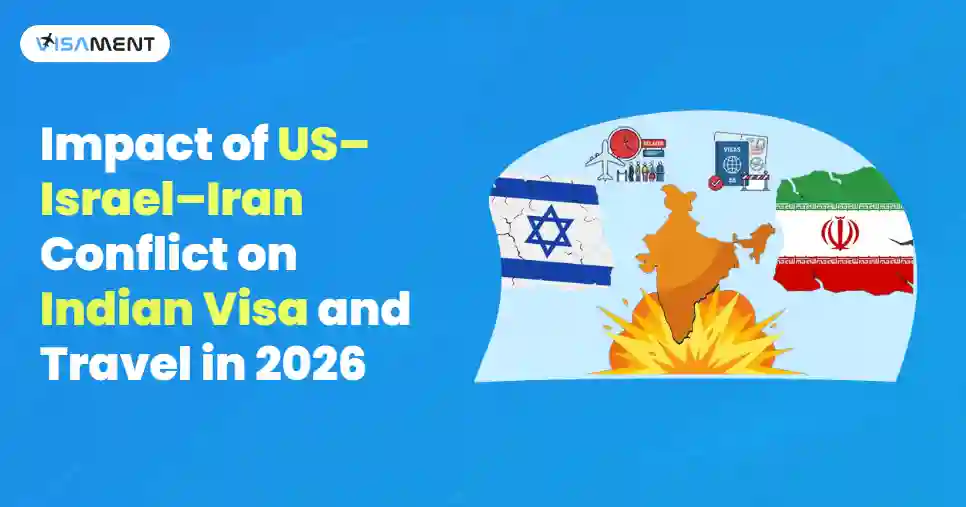
In February 2026, the US-Israel-Iran War 2026 led to global travel disturbance, aviation, or visa application process issues in the Middle East countries.
Due to their heavy gunfire and missile attacks, the airspace has been closed in the Middle East countries, causing the cancellation of flights and impacting global flight routes.
It has also impacted the Indian travellers, after the heavy missiles and military attacks, making their Indian visa application process more difficult.
In this blog, we will discuss how the Iran-Israel war has impacted the Indian visa processing, travel advisories issued by the Indian government, etc.
The Iran-Israel conflict of 2026 started when the United States of America and Israel attacked Iran on their nuclear plants and military facilities with heavy airstrikes.
Due to the heavy strikes, the supreme leader of Iran, Ali Khamenei, along with high Iranian officials, died in the first waves of strikes on February 28. This triggered hundreds of thousands of retaliatory missiles to Israel and the USA from Iran.
Iran's response with drones and missiles escalated the war in the Middle East, which has a major impact on Indian tourists and NRIs.
Currently, there is a very volatile situation between Iran and the US-Israel, which can escalate at any time, and affect international travel in 2026, connecting India, the USA, the UK, and other Middle East countries.
The Indian government has issued a safety travel advisory for the NRIs and Indian nationals.
Through this, we can see how intense the Iran-Israel war is, and affected the visa process and international travel.
Here are the real life scenerios for understand the situation accurately.
Sandeep, a man who is working in an industrial company which is located in the conflict area of the Iran-Israel war.
For which the Indian authorities have issued a travel advisory and advised to prepare for evacuation by the Indian embassy.
Now, Sandeep needs to arrange all the documents and contact the authorities so that he can leave the country as soon as possible on an evacuation flight.
Just like Sandeep, many Indian nationals and NRIs have been safely moved to a secure place via emergency evacuation flights.
Rohit, an engineer who is working in Iran, is stuck due to the ongoing Iran-Israel-US war. Then, a travel advisory was issued by the Indian authorities to leave Iran urgently, as tension between the two countries has escalated.
So, his company has arranged an evacuation flight to move the workers safely out of Iran. As there are only limited seats, he had no other option but to leave the country.
In this case, Rohit has broken his contract and is forced to leave Iran due to conflicts.
The ongoing Iran-Israel Conflict 2026 has not completely stopped the Indian visa process, but has created many challenges for Indian travellers.
Due to the war, there are fewer embassies which are operating, which makes the Indian visa application process slow.
It resulted in:
To get a visa approval in the Middle Eastern countries, you need to face more security measures, which include:
In most of these situation government provides an emergency and evacuation visa for Indian residents and NRIs.
This also helps to minimise the high number of tourist and business visa applications.
 Also Want to Know About Iran-Israel War 2026 means for Indian Visa and OCI Cardholders Check Now!
The higher impact of the Iran-Israel war on Indian visas is on the aviation system, making most of the flight routes disrupted.
Most of the airspace in the Middle Eastern countries is suspended for the safety of Indian travellers.
It includes countries like:
The Iran-US-Israel war caused the cancellation of more than 20,000 international flights in 2026. It caused a major impact all over the world.
Your Indian Adventure Starts with a Click – Apply for Your Indian tourist visa Today!
Now, flights will take long routes, which automatically leads to a rise in flight tickets and travel costs.
It not only affected flight travel cost, but also had a high spike in the crude oil prices globally. Due to the US-Israel-Iran war, Global oil prices have jumped, leading to an increase in aviation fuel costs.
Given below are some of the major impacts on Indian tourists and NRIs due to the ongoing war.
Most of the Indian tourists and NRIs who are planning a trip to Iran or Israel have cancelled their plans.
It is also announced by the Indian government in the travel advisories to avoid unnecessary travel to Iran or Israel.
For example, if any religious or cultural trip to Iran has to be postponed due to safety reasons.
All the NRIs (Non-resident Indians) living in the Middle East have also been impacted due to the war, and the Indian government has also issued a travel advisory for them.
This is not the first time we have done this. We have seen before, like the operation Sindh, where we can see the courage and readiness of the Indian government to act during these types of situations.
Most of the Indian travellers were left stranded in the Iran-Israel war because of the low availability of flights.
After the Indian government announced additional flights of Air India to help the stranded travellers and to mange situation in Gulf countries.
Also Want to Know About Can OCI Cardholders Face Travel Restrictions During Global Conflicts? Check Now!At the time of war, there can be various risk factors and safety concerns which all people need to be aware of.
War can be an invitation to the following risks:
Taking all the Safety precautions is the biggest defensive option a country can have in these types of war crises, which includes:
Here are some of the key points that an Indian traveller should consider at the time of war.
If you are in the territory which is affected by war, then you need to wait and regularly check all the updates by the Ministry of External Affairs (MEA), or the Indian embassy for any safety advisories on war.
If possible, try to maintain a distance from the area which is affected by war. Postpone all your travel plans to Iran, Israel, or any Gulf countries.
You need to have backup routes to move out of the Iran-Israel War hub and go to a safe country using a transit hub like Europe and Southeast Asia.
Make sure you have travel insurance, which is most important during times of war situations.
Your travel insurance should have the following:
You need to carry and collect all the necessary documents which can be useful at the time of war.
Currently, the Iran-Israel war remains uncertain. There is no possibility of where it can go in the future.
However, if the war continues to go like this, then it can create high tensions among the Middle Eastern countries and Gulf nations.
It can lead to:
If the war slows down, then we can see:
The Iran-Israel war has a major impact on Indian visa processing, causing delays in the visa process, along with the shutdown of the airspace of Middle East countries.
Due to the war, all international flights are disrupted, which has led to high air flight prices and limited flight routes.
All the Indians nationaals in Iran are advised to follow all the travel advisories issued by the Indian authorities for the ongoing war between the US, Israel, and Iran.
The Iran and Israel war has impacted the Indian visa process, resulting in long processing times, delays and long flight times. Indian travellers have faced many problems, including global travel restrictions, closed airspace in the Middle East and Gulf countries, and flight delays.
Yes, the Indian visa has also been affected due to the Iran-Israel war, which is not completely shut down, but has resulted in more processing time in visa applications and delays in the visa process. Furthermore, the Indian embassies have also operated in Iran, only in limited regions because of war, leading to process in low number of visa applications.
No, making travel plans to Iran or Israel is not a proper option right now, as both countries have on going war right now. It is uncertian that whether it will end peacefully or create high tension among the neighbouring countries.
The flight prices in the Middle East countries have increased because of the closed airspace in the Middle East region, long flight routes, high prices of fuel, avaition cost beacuse of the spike in global oil prices. All these reasons made international travel more expensive for Indian travellers.
All the flights from India to Europe, including the US and Middle East countries, are affected by the Iran-Israel war. So to avoid these countries flight have to go through the long route, which results in long travel time and limited seats with high airfares.
Yes, the flight, which was planned to pass through the areas of war such as the UAE, Bahrain, Iran, Iraq, Israel, Qatar, has been cancelled. So now the airliners are taking longer routes, which results in more fuel and longer flight times.
If an Indian travellers planned for an international flight, then the first thing he or she needs to to di to get travel insurance which covers all flight costs, medical, and war evacuations in case of emergency. Furthermore, they also need to check all the updates of the Indian government and travel advisories by the Indian authorities. Avoid booking flight tickets on laast minute as it can have higher prices. always stay updated of fligfht routes, and avoid going to high-tension areas.
Yes, all Indian travellers and NRIs need to have a valid travel insurance, which is highly suggested during times of war. It covers all your flight cancellations, provides medical emergency coverage, and covers any flight delay or an evacuation flight in case of any emergency, such as war or conflict among countries or any region.
NRIs in the Middle East are affected by war, such as faing maany tracvel restriction due to closed airspace or due to safety concerns. For them, the Indian government is taking all the measures to provide them all the assistance through the Indian embassies by monitoring their situations.
Yes, all Indian travellers can travel internationally despite the ongoing conflict between Iran and Israel, but they need to plan their trip carefully and avoid going to the conflict areas. Also, they need to check all the regular updates and change their travel plans according to the conditions.
Vipul Jain is the Co-Founder of Visament, a trusted platform dedicated to simplifying Indian immigration, consular, and NRI services for applicants across the globe. With extensive expertise in OCI cards, Indian passport services, visa assistance, apostille and document legalization,... See Full Bio

Talk to our documentation experts for free guidance on your application.


When you visit a website, it may store data about you using cookies and similar technologies. Cookies can be important for the basic operations of the website and for other purposes. You get the option of deactivating certain types of cookies, even so, doing that may affect your experience on the website.
It is required to permit the basic functionality of the website. You may not disable necessary cookies.
Used to provide advertising that matches you and your interests. May also be used to restrict the number of times you see an advertisement and estimate the effectiveness of an advertising campaign. The advertising networks place them after obtaining the operator's permission.
Permits the website to recognize the choices you make (like your username, language, or the region you are in). Also provides more personalized and enhanced features.
Aid the website operator to determine how the website performs, how visitors interact with the site, and whether there are any technical issues.