Related Blogs

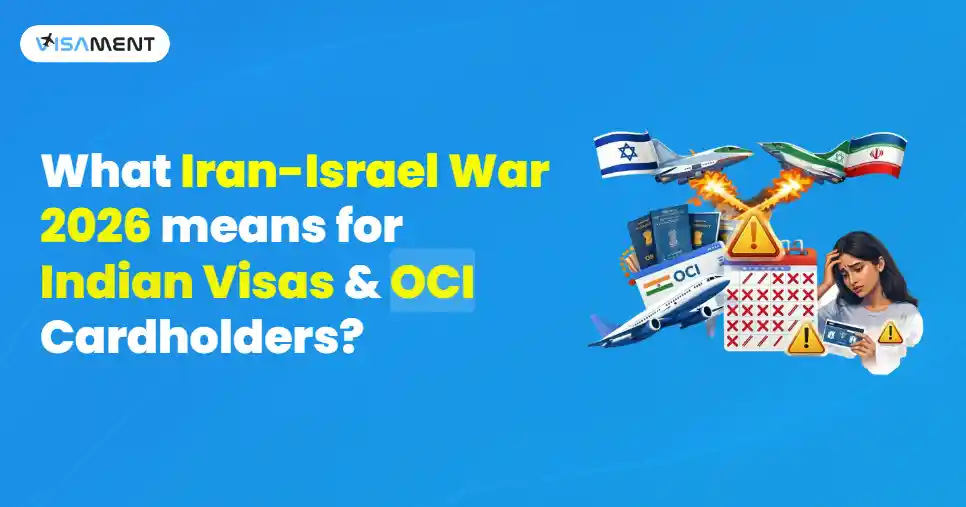
The ongoing war between Iran and Israel has affected global trade and travel routes. It is due to the high tension rising in middle east country affecting their economies.
Additionally, because of heavy missile attacks by the USA, Israel, and Iran, the immigration system has also been affected globally. It results in travel disruption for OCI cardholders and long Indian visa processing.
In this blog, we will see more about the war situation that is impacting Indian visa and OCI cardholders, and see what precautions Non-Resident Indians (NRIs) and foreign nationals can take to overcome this situation.
It is a conflict that started on February 28, 2026, when the United States of America and Israel both launched heavy missiles on the country of Iran. In this attack, Iran lost their major leader Khamenei and several high rank official.
In response to this attack, Iran has launched heavy missiles and drone attacks on the USA and Israel, which escalated this war further and turned it into a border regional crisis.
This war resulted in the:
During the war, Indian visa processing has faced many challenges, which are given below in detail.
Due to the Iran-Israel war in 2026, Indian visa processing has faced many issues because of slow visa processing.
This is because most of the Indian embassies and Indian consulates are in the conflict area, which are closed. So only the remaining embassies and consulates are operating, which takes time to process the Indian visa applications.
Here are some of the reasons why visa processing is delayed.
It all resulted in the long processing time for the Indian visa application in the Middle Eastern countries.
The Indian mission in the Middle East countries, like Iran and the nearby area, is working under a huge threat.
It is all because of the high amid rising tension between the Iran-Israel war. The Indian government has also advised all its citizens, NRIs, and foreign nationals to follow the guidelines and avoid going to high-risk regions and to stay in contact with the Indian embassy.
Given below are the reasons that caused this disruption in the Indian embassy.
The Iran-Israel war impact on Indian visa resulting in the disruption of flights and travel routes globally.
The Middle East is an important transit hub for most of the Middle Eastern nations, like Dubai, Doha, and Abu Dhabi. It has significantly affected travel for Indian citizens who are travelling to the US and Africa.
Mohit, an NRI who is working in Dubai planning to travel to New Delhi in March 2026. However, due to the US-Iran-Israel war in 2026, his flight is cancelled, and the airspace between Middle Eastern countries is closed.
Then he had no option left apart from booking a new flight by paying an expensive flight ticket via an alternative Istanbul route.
At the same time, His friend, who has an OCI card, also faced travel delays and provided extra documentation in anticipation of having visa-free entry to India.
On the other side, Mohit's cousin in Tehran registered with the Indian embassy for the emergency evacuation.
This provides that even if you have complete documents like an OCI card or an Indian visa, a global crisis can impact your travel plans, as Mohit was affected.
An OCI (Overseas Citizen of India) can get visa-free entry to India and live, work or stay in India for an indefinite time period.
However, due to the war situation, OCI cardholders' travel has also been impacted due to this Iran-Israel war.
Most of the OCI cardholders are suffering travel disruption due to the ongoing war in middle east countries. Despite having an visa-free access, they cannot enter India.
Here are the common reasons why OCI cardholders are suffering from war:
The war's impact on OCI cardholders led to high security and more documentation. It results in many concerns, like
The Indian government also advises OCI cardholders to carry all necessary travel documents.
OCI cardholders and NRIs face a large amount of evacuation support from the Indian government. Along with that, they are also provided with a relief helpline support number to contact in case of an emergency. Over a thousand OCI cardholders and NRIs have been evacuated from the Gulf countries.
The OCI cardholders who have been affected by this should do the following:
The Indian government has announced several relief measures for the OCI, NRIs and foreign nationals regarding the ongoing Middle East conflict.
The Indian government has announced visa extension for foreign nationals so they can stay in India for a longer period of time due to the lack of flights.
If any of the foreign nationals overstay in India, then he or she will not pay penalties as the Indian government has waived all the penalties.
Indian authorities have also started assisting the foreign nationals via the FRRO (Foreigners Regional Registration Office). You can ask for any query and support at the FRRO related to your visa.
The Government of India has announced many helpline numbers and evacuation operations for the NRIs, OCI cardholders, and Indian Visa holders in middle east countries.
The amid high tension Iran-Israel war of 2026 had a major impact on the Indian travellers who are doing their work in the Gulf nations.
The impact includes:
According to the sources, over 2 lakh Indians have been safely evacuated from the Middle East regions. Through this, we can see how much Indian travellers and NRIs have been disrupted during the conflict.
If you are an OCI cardholder or an Indian visa holder stuck in the conflict area, then you need to follow the points given below to stay safe.
You need to check updates from the Indian embassy, the Ministry of External Affairs (MEA), and your airlines or travel agencies during any crisis time. This will help you to get an idea of what to do next and how to be safe in the conflict regions.
Note: Do not rely on any unreliable sources; always check the information or guidelines from the official, legal, and verified sources.
Make sure that if you are planning a trip with your friends or family, then you should follow the points given below.
If you are stuck in the conflicted area, then you need to:
During this time, you need to keep all your documents with you. So keep all your documents ready, such as:
The Government of India has issued travel advisories for Indian nationals and Non-Resident Indians (NRIs), in which they advised to:
By following the Indian advisories, you can stay safe during the ongoing Iran-Israel war in 2026.
Stop worrying about delays. Apply now and get Indian Counsellor Services.
Chat NowAccording to the current situation, there is uncertainty remaining about the Iran-Israel war. Whether it can end peacefully with an understanding of both nations, or it can escalate more dangerously.
It is a long-term plan, but the Indian government are taking all the measures on how to tackle these war crises, and to improve the immigration system.
Indian authorities have also started to take protective initiatives, such as the IVFRT program. It improves the visa and travel process through modernisation. However, Indian visa holders and OCI cardholders can still face:
The Middle East crisis has impacted the OCI travel Indian visa processing due to closed airspace, high flight tickets, and several other reasons.
However, the Indian government has issued a safety travel advisory for Indian nationals, NRIs, and OCI cardholders, in which they are advised to stay safe and take precautions during the war.
Avoiding going to the conflict areas, staying indoors, and registering with the Indian embassy for evacuation are some of the tips through which you can stay safe during the war.
For more information, you can contact the Indian embassies, local authorities, or check the real-time updates from the official and verified sources.
No, the Indian visa processing has not stopped but has been delayed due to the ongoing Iran-Israel war, through which most of the Indian embassies are in the conflict area, resulting in a heavy workload on the leftover embassies.
Yes, an OCI cardholder can still travel to India. However, they can face many issues such as long aviation time, flight cancellations, and delays in flights due to closed airspace in the Middle East countries.
Yes, over a hundred flights have been impacted due to the war, which resulted in the cancellation, re-routing, or flight delay.
If you are stuck in the conflict area, then you need to contact the local authorities or the Indian embassies and follow the travel advisory and local guidelines by the authorities.
Yes, due to the Iran-Israel war crisis, the Indian government is providing overstay waivers and visa extensions to the foreign nationals.
According to the Indian travel advisory, you should avoid going to the Middle East countries because it is not safe to go.
Vipul Jain is the Co-Founder of Visament, a trusted platform dedicated to simplifying Indian immigration, consular, and NRI services for applicants across the globe. With extensive expertise in OCI cards, Indian passport services, visa assistance, apostille and document legalization,... See Full Bio

Talk to our documentation experts for free guidance on your application.


When you visit a website, it may store data about you using cookies and similar technologies. Cookies can be important for the basic operations of the website and for other purposes. You get the option of deactivating certain types of cookies, even so, doing that may affect your experience on the website.
It is required to permit the basic functionality of the website. You may not disable necessary cookies.
Used to provide advertising that matches you and your interests. May also be used to restrict the number of times you see an advertisement and estimate the effectiveness of an advertising campaign. The advertising networks place them after obtaining the operator's permission.
Permits the website to recognize the choices you make (like your username, language, or the region you are in). Also provides more personalized and enhanced features.
Aid the website operator to determine how the website performs, how visitors interact with the site, and whether there are any technical issues.