Related Blogs


If you live outside India and need an Indian bank account, choosing between an NRE and NRO account is one of the first decisions to make. The right account depends on where your money comes from, how you plan to use it in India, and whether you need to transfer funds abroad.
The NRI account opening process generally involves selecting the appropriate account, completing the bank's application and KYC requirements, submitting supporting documents, and completing the verification required by the bank.
An NRI bank account is an account maintained in India by a person who qualifies as a non-resident under the applicable foreign-exchange rules. The Reserve Bank of India (RBI) recognises several account categories for non-residents, including NRE, NRO and FCNR(B) accounts.
For most NRIs managing money in India, the main choice is between an NRE vs NRO account.
An NRE (Non-Resident External) account is a rupee-denominated account available to eligible NRIs and PIOs. An NRO (Non-Resident Ordinary) account is also a rupee account and is generally used for bona fide transactions and income in India.
The two accounts are not interchangeable. Your choice should depend primarily on the source and intended use of your funds.
| Feature | NRE Account | NRO Account |
|---|---|---|
| Full form | Non-Resident External | Non-Resident Ordinary |
| Currency | Indian rupees | Indian rupees |
| Typical purpose | Managing eligible overseas funds in India | Managing income and transactions arising in India |
| Who can generally open | Eligible NRIs and PIOs | Persons resident outside India, subject to applicable rules |
| Joint holding | Subject to applicable rules and bank conditions | Joint holding is possible subject to applicable rules |
| Repatriation | Subject to applicable rules | Subject to applicable limits and conditions |
For example, an NRI who wants to maintain eligible overseas earnings in India may consider an NRE account. An NRI receiving rental income or other legitimate income arising in India may need an NRO account.
The exact tax and repatriation treatment should be checked against current rules before opening or transferring funds.
Eligibility depends on the applicant's residential status and the applicable RBI and FEMA framework.
Under RBI guidance, an NRI is a person resident outside India who is a citizen of India. Certain PIO/OCI cardholders who are resident outside India may also be eligible for specified NRI banking facilities.
An NRE account is available to eligible NRIs and PIOs, while an NRO account can generally be opened by a person resident outside India for permitted rupee transactions.
Banks may apply additional KYC and documentation requirements depending on the applicant's circumstances, nationality, country of residence and account type.
The exact documents for NRI account opening vary by bank, but applicants should generally be prepared to provide documents that establish identity, residential status and address.
Common requirements may include:
Valid passport
Proof of NRI status, such as a visa, work permit or residence permit where applicable
Overseas address proof
Permanent address proof
PAN or applicable tax documentation
Recent passport-size photograph
Completed and signed account-opening form
Additional KYC or tax-residency information requested by the bank
Some banks may also request additional documents for non-face-to-face applications. Documents issued in a foreign language may require certified translation or attestation, depending on the bank's procedures.
Because documentation rules can differ between banks, applicants should check the current requirements of their chosen bank before submitting the application.
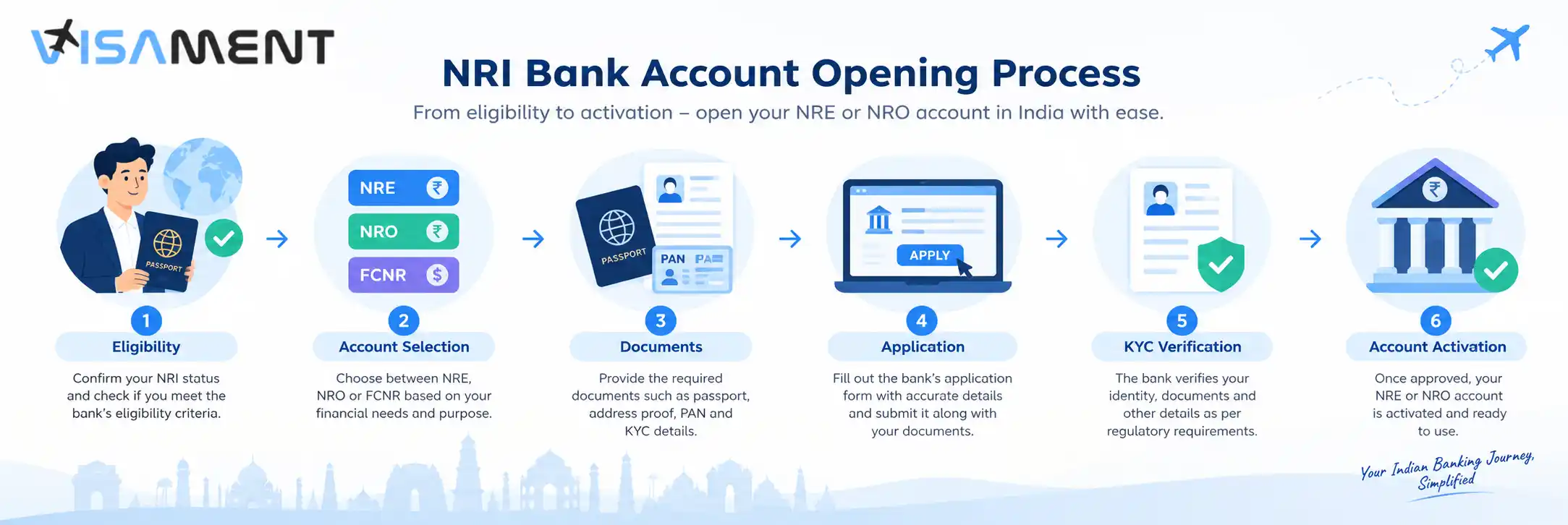
The NRI account opening process usually follows these steps:
Before applying, establish that you are eligible to be treated as a non-resident under the applicable rules. Your residential status can affect how your existing Indian accounts must be handled.
Consider where your funds originate and what you need the account for.
If your primary requirement is to hold eligible overseas funds in India, an NRE account may be relevant. If you need to receive or manage legitimate income arising in India, an NRO account may be more appropriate.
Some NRIs may need both accounts for different financial purposes.
Compare banks based on factors that matter to you, such as account features, digital banking facilities, overseas support, documentation process and availability of services in your country of residence.
Do not choose a bank solely because its application appears simpler online. Verify the current NRI eligibility and KYC requirements before applying.
Fill out the bank's NRI account-opening application with accurate personal, residential and tax information.
Ensure that the name, passport information, address and other details are consistent across the application and supporting documents.
Provide the documents requested by the bank. Depending on the bank and application method, documents may need to be self-attested, notarised, attested by an Indian embassy/consulate or verified through another approved process.
The bank reviews the application and supporting documents and completes its required KYC and verification checks.
The exact process differs between banks, particularly for applicants applying from outside India.
Once the bank approves the application and completes the required formalities, the account can be activated according to the bank's procedures.
Yes, some banks allow NRIs to begin or complete account opening while living outside India, but the process is bank-specific.
For example, banks may provide online application forms, document collection services or other remote onboarding options. However, remote applications can still require identity verification, document attestation or additional proof.
An applicant should therefore check whether the selected bank supports non-face-to-face NRI account opening in their country of residence and what verification method applies.
Do not assume that an online application means the entire process will always be completed digitally.
This is an important issue for Indians moving abroad.
When a person who holds a resident account becomes a non-resident under the applicable rules, the existing resident account generally needs to be redesignated as an NRO account. RBI guidance specifically addresses the change from resident to non-resident status and the redesignation of existing accounts.
The practical process depends on the bank. If you have recently moved abroad or changed your residential status, contact your bank and update the account rather than continuing to operate a resident savings account without checking the applicable requirements.
 Also Want to Know About Best NRE Bank Accounts in India? Check Now!
Yes, an NRI may maintain both NRE and NRO accounts, subject to applicable rules and the bank's requirements.
The accounts can serve different purposes. An NRE account can be useful for eligible overseas funds, while an NRO account can be used for permitted Indian income and transactions.
Maintaining separate accounts can make it easier to manage different sources of funds, but the tax and repatriation implications should be considered before moving money between accounts.
When completing an NRI account opening application, avoid these common problems:
Choosing an account without understanding its intended purpose.
Providing an overseas address that does not match the supporting documentation.
Submitting expired passport, visa or residency documents.
Assuming every bank has identical KYC requirements.
Continuing to use a resident savings account after becoming an NRI without checking whether redesignation is required.
Assuming that all funds in an NRO account are freely repatriable.
Relying on old information about banking rules, tax treatment or repatriation limits.
Before submitting your application, keep the following ready:
Valid passport
Proof of non-resident status, where applicable
Overseas address proof
Permanent address proof
PAN or applicable tax information
Recent photograph
Completed application form
Any additional documents requested by the bank
Information about the source and intended use of funds
Checking these documents in advance can reduce avoidable delays during the verification process.
Opening an NRE or NRO account is a practical way for NRIs to manage eligible funds and transactions in India. The first step is to determine your residential status and choose the account type that matches your financial needs. You can then prepare the required KYC documents, complete the bank's application and follow its verification process.
Because banking and foreign-exchange requirements can change, always confirm the latest rules with the Reserve Bank of India and your chosen bank before submitting an application or transferring funds.
Yes, you can. Under FEMA guidelines, it is legally mandatory to either close or convert your resident accounts as soon as your residential status changes to NRI.
The interest earned on an NRE account is tax-free in India, while the interest earned on an NRO account is subject to income tax.
No, you cannot deposit your Indian income into an NRE account. These accounts are strictly reserved for income legally earned outside of India.
Yes, you can legally hold both NRE and NRO accounts together. Under RBI and FEMA guidelines, there are no restrictions on having both types of accounts to manage your finances effectively.
Yes, OCIs are fully eligible to open and maintain an NRE account in India. It allows them to deposit and manage their foreign earnings in Indian rupees.
Yes, you can deposit 10 lakhs in your NRO account since there is no legal upper limit on total deposits.
The main disadvantages of an NRO account include heavy taxation on interest, capped repatriation limits, and currency risks since funds are held in Indian Rupees.
For NRIs, both the NRE and NRO accounts offer complete tax exemption on the interest earned.
Vipul Jain is the Co-Founder of Visament, a trusted platform dedicated to simplifying Indian immigration, consular, and NRI services for applicants across the globe. With extensive expertise in OCI cards, Indian passport services, visa assistance, apostille and document legalization,... See Full Bio

Talk to our documentation experts for free guidance on your application.




When you visit a website, it may store data about you using cookies and similar technologies. Cookies can be important for the basic operations of the website and for other purposes. You get the option of deactivating certain types of cookies, even so, doing that may affect your experience on the website.
It is required to permit the basic functionality of the website. You may not disable necessary cookies.
Used to provide advertising that matches you and your interests. May also be used to restrict the number of times you see an advertisement and estimate the effectiveness of an advertising campaign. The advertising networks place them after obtaining the operator's permission.
Permits the website to recognize the choices you make (like your username, language, or the region you are in). Also provides more personalized and enhanced features.
Aid the website operator to determine how the website performs, how visitors interact with the site, and whether there are any technical issues.