Related Blogs

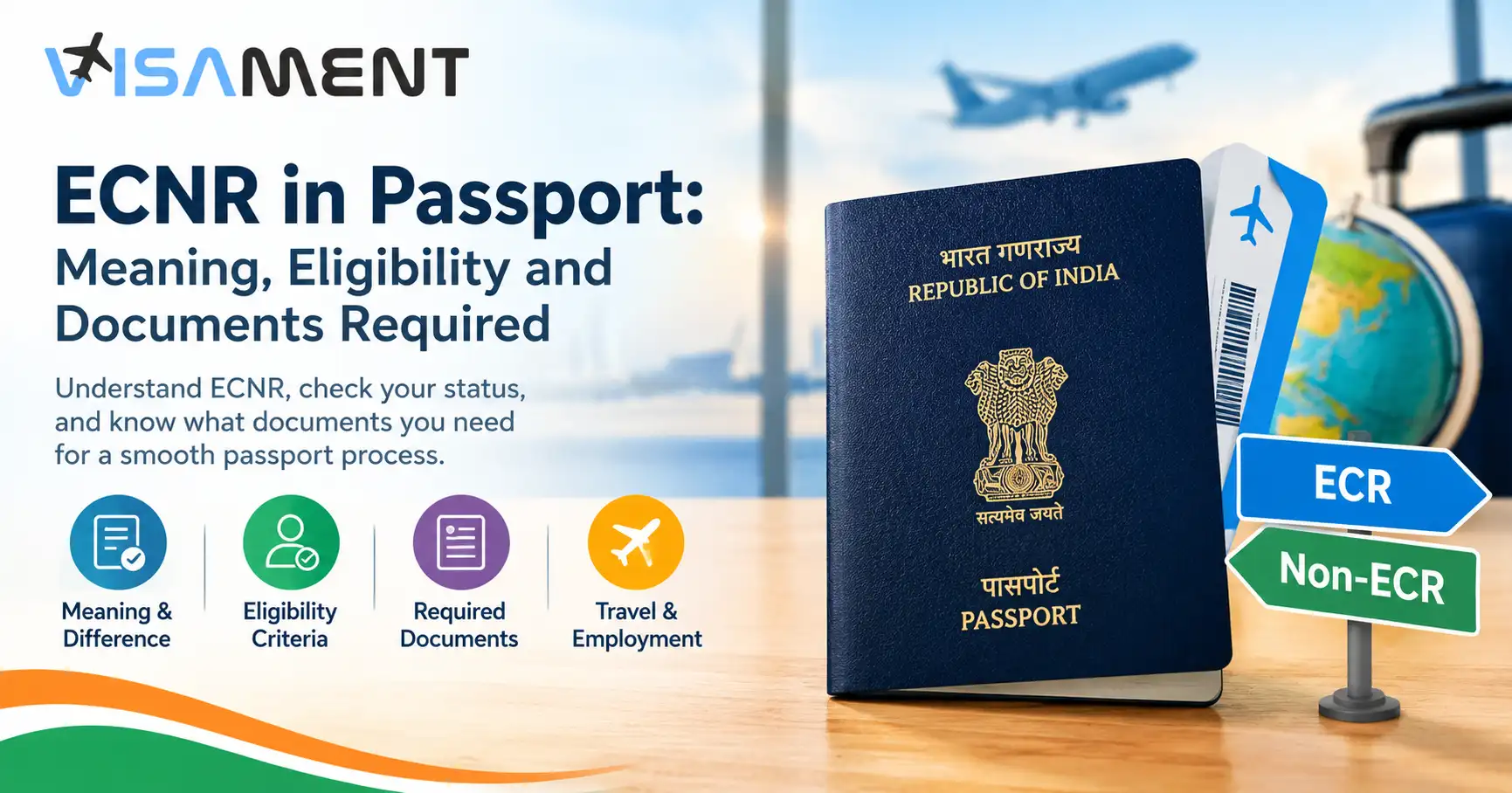
If you are checking your Indian passport for an ECNR stamp but cannot find one, there is no need to worry. ECNR (Emigration Check Not Required) is the older terminology for Non-ECR status. A separate Non-ECR endorsement is no longer printed on Indian passports. Instead, an ECR endorsement appears when emigration clearance is required.
Understanding your passport category is important, particularly if you are planning to work abroad or applying for a fresh passport. This guide explains what ECNR means, how to check your passport status, who qualifies for Non-ECR, which documents are required and what to do if your passport carries an ECR endorsement.
ECNR means Emigration Check Not Required. It was the term used for passport holders who did not need emigration clearance for overseas employment in notified countries.
The current term is Non-ECR. Passport Seva confirms that the separate Non-ECR or ECNR stamp has been discontinued. Instead, ECR status is printed on passports of applicants who fall under the ECR category. If there is no ECR endorsement, the passport holder is treated as Non-ECR.
In simple terms:
|
ECR passport |
ECNR / Non-ECR passport |
|---|---|
|
Has an ECR endorsement printed in the passport. |
Does not have an ECR endorsement. |
|
Emigration clearance is generally required for employment in notified ECR countries. |
Emigration clearance under the ECR system is not required. |
|
Certain travel for purposes other than employment does not require ECR clearance. |
No ECR clearance is required under this system. |
Important: ECR status does not prevent you from travelling abroad. It relates mainly to emigration clearance for employment in notified countries. Visa, entry and other destination-country requirements still apply.
You may qualify for Non-ECR status if you fall into one of the categories recognised by Passport Seva and can provide the required supporting documents.
The main eligible categories include:
Eligibility depends on the applicable category and the documents submitted. Check the latest Passport Seva Non-ECR document list before applying.
The documents depend on the category under which you are claiming Non-ECR eligibility. Common examples include:
|
Eligibility category |
Supporting documents |
|---|---|
|
Class 10 or higher education |
Class 10 pass certificate or higher educational qualification certificate |
|
Above 50 years of age |
Birth certificate or an accepted school-leaving/secondary-school certificate showing date of birth |
|
Income-tax payer |
Proof of income-tax assessment and actual tax payment for the last year, or the prescribed ITR statement showing tax paid, along with PAN |
|
Professional degree holder |
Certificate or proof of the recognised professional qualification |
|
Diploma holder |
Diploma certificate from the qualifying recognised institute |
|
Nurse |
Nursing qualification certificate recognised under the Indian Nursing Council Act |
|
Gazetted government servant |
Identity Certificate (Annexure A), No Objection Certificate (Annexure G) or Prior Intimation Letter (Annexure H), as applicable |
|
Permanent resident abroad |
Copy of permanent immigration visa or permanent resident card |
|
Stayed abroad for more than three years |
Passport copies and a written statement detailing dates of travel to and from India |
|
Minor applicant |
Birth certificate or another document accepted by Passport Seva for the applicant's category |
Additional documents may be needed for spouses and dependent children to establish the relationship. For example, a marriage certificate may be required for a spouse, while a birth certificate or accepted school document may be required for a dependent child.
Important for income-tax applicants: A PAN card alone does not establish Non-ECR eligibility. Passport Seva requires proof of tax assessment and actual tax payment, or the prescribed tax-return evidence with PAN. A NIL income-tax return does not qualify. Always check the official document requirements for your individual circumstances.
You can check ECNR or ECR status by looking at the relevant endorsement page in your Indian passport.
If your passport has an ECR endorsement but you now meet a Non-ECR eligibility category, you can change an ECR to Non-ECR in an Indian Passport, by applying for passport reissue and submitting the supporting documents for that category.
The general process is:
The passport office will verify your eligibility and documents. Non-ECR status is not automatic simply because you request it.
There is no separate government fee for ECNR or Non-ECR status. Applicants changing from ECR to Non-ECR must pay the standard passport reissue fee.The revised passport fees effective from 1 July 2026 are:
|
Applicant category |
Passport booklet |
Normal fee |
Tatkaal fee |
|---|---|---|---|
|
Adult (18 years and above) |
36 pages |
₹2,500 |
₹5,000 |
|
Adult (18 years and above) |
60 pages |
₹3,500 |
₹6,000 |
|
Minor (below 18 years) |
36 pages |
₹1,750 |
₹4,250 |
Minors aged 15–18 applying for a 10-year passport under the adult category are charged the applicable adult fee. Tatkaal fees shown above are inclusive of the Normal fee.
Check the official Passport Seva fee calculator for the applicable charges before applying
Say goodbye to paperwork stress! Hassle-free Indian Passport application
Apply NowThe processing time for an ECR to Non-ECR passport reissue depends on whether police verification is required.
|
Application type |
Indicative processing time |
|---|---|
|
Normal reissue without pre-police verification |
Up to 7 working days |
|
Normal reissue with police verification |
Up to 30 working days |
|
Tatkaal reissue |
Up to 3 working days |
These timelines are based on the MEA Citizen's Charter. Police verification time is excluded, and Tatkaal service is subject to eligibility and approval. Actual processing may vary depending on document verification and other requirements.
Refer to the MEA Citizen's Charter for details
An ECR passport holder generally needs emigration clearance when travelling to a notified ECR country for employment.
However, an ECR passport holder travelling for purposes such as tourism, visiting family or studying generally does not need emigration clearance under the ECR system. The traveller must still carry a valid passport and the appropriate visa or other travel documents required for the destination.
The list of notified countries and applicable rules should be checked with the Ministry of External Affairs before travelling, as official guidance may be updated.
ECNR or Non-ECR status is an important part of the Indian passport system, particularly for people planning to work abroad. It helps eligible Indian passport holders avoid the emigration-clearance process applicable to ECR passport holders travelling to notified countries for employment.
Before applying for a fresh passport or reissue, check your existing passport endorsement, confirm your eligibility and prepare the required documents. Following the latest Passport Seva guidelines can help you avoid unnecessary delays and documentation issues.
For assistance with Indian passport and documentation procedures in the USA, explore the relevant services offered by Visament.
Yes. An Indian passport holder with ECR status can travel abroad for tourism, personal visits, or other non-employment purposes without obtaining emigration clearance. However, if travelling to one of the 18 ECR-notified countries for employment, clearance from the Protector of Emigrants (PoE) is generally required.
Yes. ECNR (Emigration Check Not Required) and Non-ECR refer to the same passport status. ECNR is the older term, while the Indian Passport Seva system now uses Non-ECR to describe applicants who do not require emigration clearance under the applicable rules.
Yes. Passing Class 10 is one of the eligibility routes, but it is not the only one. Applicants below 18 years, above 50 years, certain government employees, eligible income taxpayers, and individuals meeting other prescribed criteria may also qualify for Non-ECR status.
No. ECNR status is not mandatory for travelling to Dubai for tourism or personal visits. However, Indian passport holders with ECR status travelling to the UAE for employment must obtain the applicable emigration clearance before departure.
Yes. An Indian passport holder with ECR status can travel to countries such as the USA or UK without obtaining emigration clearance because these countries are not among the ECR-notified countries. However, the traveller must meet the destination country's visa and entry requirements.
No. A PAN card is not mandatory for every Non-ECR applicant. It may be required as supporting documentation when applying under the income-taxpayer eligibility category. Applicants qualifying through educational, age, or other categories can provide the relevant supporting documents instead.
Vipul Jain is the Co-Founder of Visament, a trusted platform dedicated to simplifying Indian immigration, consular, and NRI services for applicants across the globe. With extensive expertise in OCI cards, Indian passport services, visa assistance, apostille and document legalization,... See Full Bio

Talk to our documentation experts for free guidance on your application.



When you visit a website, it may store data about you using cookies and similar technologies. Cookies can be important for the basic operations of the website and for other purposes. You get the option of deactivating certain types of cookies, even so, doing that may affect your experience on the website.
It is required to permit the basic functionality of the website. You may not disable necessary cookies.
Used to provide advertising that matches you and your interests. May also be used to restrict the number of times you see an advertisement and estimate the effectiveness of an advertising campaign. The advertising networks place them after obtaining the operator's permission.
Permits the website to recognize the choices you make (like your username, language, or the region you are in). Also provides more personalized and enhanced features.
Aid the website operator to determine how the website performs, how visitors interact with the site, and whether there are any technical issues.