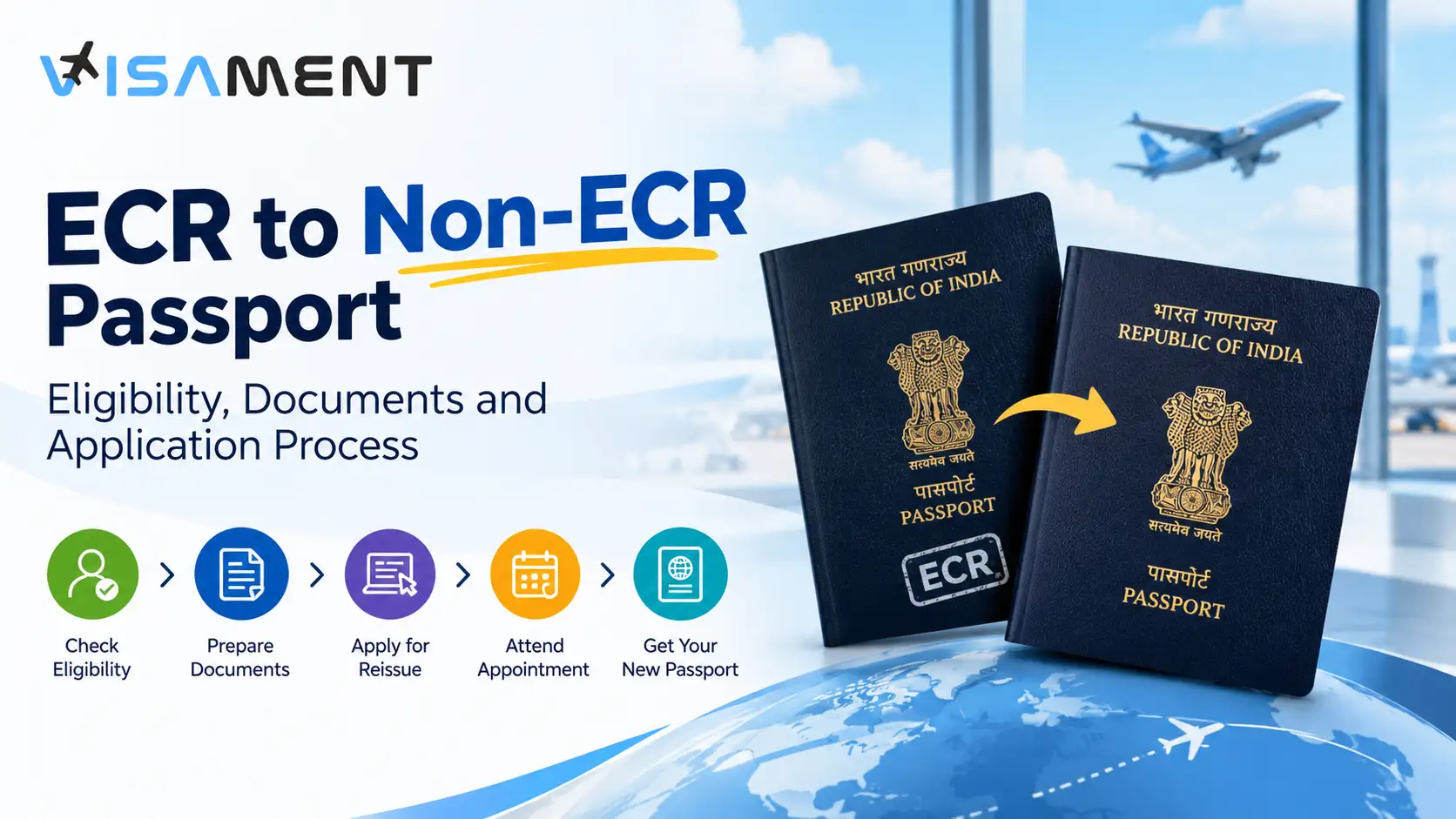
If your Indian passport carries an Emigration Check Required (ECR) endorsement, you may be eligible to change to Non-ECR status if you meet one of the prescribed categories. The process generally involves applying for passport reissue and providing documents that establish your eligibility. This guide explains who qualifies, which documents you may need, and how to proceed through the official Passport Seva system.
Key Takeaways
- Non-ECR eligibility depends on meeting an officially recognized category.
- Matriculation or a higher educational qualification is one recognized eligibility route.
- The supporting documents depend on the category under which you qualify.
- Eligible applicants can use the official passport reissue process to address ECR status.
- Non-ECR is not printed as a separate endorsement on current passports.
- ECR does not prohibit all international travel, but emigration clearance may be required for overseas employment in designated countries.
What Is ECR and Non-ECR in an Indian Passport?
ECR and Non-ECR refer to emigration clearance requirements for certain Indian passport holders travelling abroad for employment.
- ECR (Emigration Check Required): Eligible passport holders may need emigration clearance before travelling to a notified ECR country for employment.
- Non-ECR (Emigration Check Not Required): Eligible passport holders do not need this emigration clearance under the ECR rules.
Non-ECR status does not mean that a person is exempt from visa requirements, immigration checks, or the employment regulations of the destination country.
Under current passport terminology, the ECR endorsement is printed when applicable. Non-ECR status is generally indicated by the absence of an ECR endorsement rather than a separate Non-ECR stamp.
Before applying for a passport reissue, check whether your existing passport carries an ECR endorsement. Read our guide on how to check ECR or ECNR status on an Indian passport to understand how to identify your current status.
Who Is Eligible to Change an ECR Passport to Non-ECR?
You may qualify for Non-ECR status if you fall into one of the categories recognized by Passport Seva and can provide the required evidence.
Common eligible categories include:
| Eligibility category |
Supporting document examples |
| Educational qualification of matriculation (Class 10) or above |
Matriculation or higher educational pass certificate |
| Persons above 50 years of age |
Accepted birth certificate or recognized school-leaving/secondary-school certificate |
| Children up to 18 years of age |
Birth certificate or another document accepted under the applicable requirements |
| Income-tax payers |
Eligible income-tax assessment/payment proof or qualifying ITR documentation, as specified by Passport Seva |
| Professional degree holders |
Certificate proving the recognized professional degree |
| Gazetted government servants |
Applicable Identity Certificate, NOC or prior-intimation documentation |
| Spouses and dependent children of eligible applicants |
Relationship and supporting documents specified for the relevant category |
| Certain diploma holders and qualified nurses |
Recognized diploma or nursing certificate |
| Eligible seafarers and maritime personnel |
Continuous Discharge Certificate or other specified evidence |
| People who have stayed abroad for more than three years, and eligible spouses |
Passport, travel-history evidence and relationship proof, where applicable |
| Holders of qualifying permanent immigration status abroad |
Permanent resident card or qualifying immigration visa |
Important: Eligibility depends on the category you claim and the documents accepted for it. This table is a summary, not a complete substitute for the official requirements. Check the relevant category on the official Non-ECR documents page before applying.
Can a Class 10 Pass Applicant Get Non-ECR Status?
Yes. Passing matriculation or holding a higher educational qualification is a recognized category for Non-ECR status. Applicants using this route should prepare the matriculation or higher educational pass certificate specified by Passport Seva.
For example, an applicant whose existing passport carries ECR and who has passed Class 10 can check the official document requirements and apply for passport reissue if eligible. The passport authority will assess the submitted documents.
Documents Required to Change ECR to Non-ECR
The documents you need depend on your eligibility category and the details of your existing passport.
Prepare the following as applicable:
- Existing Indian passport: Keep your current passport available and prepare the required copies.
- Proof of Non-ECR eligibility: For example, a matriculation certificate, higher educational certificate, professional degree, or other accepted category-specific document.
- Age proof: If you are applying under the age-above-50 category, provide a document accepted by Passport Seva.
- Income-tax documents: If applying as an income-tax payer, submit the specific assessment, payment or return documents required for your category.
- Relationship proof: Spouses and dependent children claiming eligibility through another person may need accepted marriage or birth documentation.
- Additional supporting documents: Government employees, eligible seafarers, people who have stayed abroad for more than three years, and qualifying permanent residents may need category-specific evidence.
The official Passport Seva reissue document advisor lets you check the requirements based on your application type, applicant category, employment type, address details and Non-ECR eligibility.
Carry the original documents and one set of self-attested photocopies when instructed to attend your appointment. The relevant Passport Office may require additional documents.
How to Change an ECR Passport to Non-ECR
If you are eligible, follow these steps to apply for passport reissue.
Step 1: Check Your Non-ECR Eligibility
First, identify the category under which you qualify. Review the official document list and confirm that you have acceptable evidence.
For example, if you qualify through education, check that you have the relevant matriculation or higher educational pass certificate. If you qualify through age, employment or another category, check its specific documentation rules.
Step 2: Apply for Passport Reissue
Visit the official Passport Seva portal and follow the instructions to register or log in, complete the passport reissue application, and submit it.
Select the appropriate Non-ECR eligibility response in the application when prompted. Provide accurate information and check your entries before submission.
Step 3: Pay the Applicable Fee and Book an Appointment
Follow the portal's instructions to pay the applicable passport reissue fee and book an appointment, where required.
Fees and appointment availability can vary according to the application type and service selected. Check the official portal for the current fee rather than relying on an old estimate.
Step 4: Attend the Appointment With Your Documents
Attend your scheduled appointment at the designated Passport Seva Kendra (PSK) or Post Office Passport Seva Kendra (POPSK), as applicable.
Bring your existing passport, the documents proving your Non-ECR eligibility, and any other documents specified by the official document advisor or your jurisdictional Passport Office.
Your application and documents will be checked according to the applicable procedures. Follow any additional instructions issued by the passport authorities.
Step 5: Track Your Passport Reissue Application
After submission, monitor your application through the official tracking facility. Processing time can vary depending on the case, verification requirements and the relevant Passport Office.
Once your reissued passport arrives, check the details carefully and confirm that the ECR endorsement is no longer present if your application was approved for Non-ECR status.
Does Changing ECR to Non-ECR Mean You Can Travel Anywhere Without Restrictions?
No. Non-ECR status relates to emigration clearance under the applicable Indian rules; it does not remove other travel requirements.
An ECR passport holder travelling to a notified ECR country for employment may need emigration clearance. Travel for purposes other than employment is treated differently under the applicable guidance, so check the rules relevant to your destination and purpose.
Even with Non-ECR status, you may still need:
- A valid visa or work permit for your destination.
- A passport that meets the destination's validity requirements.
- Compliance with local employment and immigration laws.
- Any additional documents required by the airline or destination authorities.
Before travelling for work, consult the Ministry of External Affairs' emigration guidance and verify the latest rules for your destination.
Common Mistakes to Avoid
Avoid these mistakes when preparing your application:
- Submitting the wrong evidence: A document must support the specific eligibility category you claim.
- Assuming everyone needs a Class 10 certificate: Other recognized categories may apply, depending on your circumstances.
- Confusing eligibility with approval: Meeting a category's criteria does not remove the need to complete the official application process.
- Ignoring additional document requirements: The passport office may require further evidence depending on the application.
- Following outdated instructions: Older guidance may refer to a separate ECNR stamp that is no longer used.
- Assuming an ECR passport prevents all travel: The relevant rules depend on the destination and purpose of travel.
If your application is delayed or the passport office does not accept your evidence, follow the instructions provided by the authority. Review the stated reason, check the current document requirements, and contact the relevant passport office if clarification is needed.
Chat to Support on Whatsapp
Stop worrying about delays. Apply now and get Indian Counsellor Services.
Chat Now Conclusion
Changing an Indian passport from ECR to Non-ECR starts with confirming eligibility and identifying the correct supporting documents. If you qualify, follow the official passport reissue process, complete the required formalities, and check the status of your reissued Indian passport.
Use Passport Seva and Ministry of External Affairs guidance as your primary references because eligibility, documentation, and application procedures must follow current official requirements.