Related Blogs

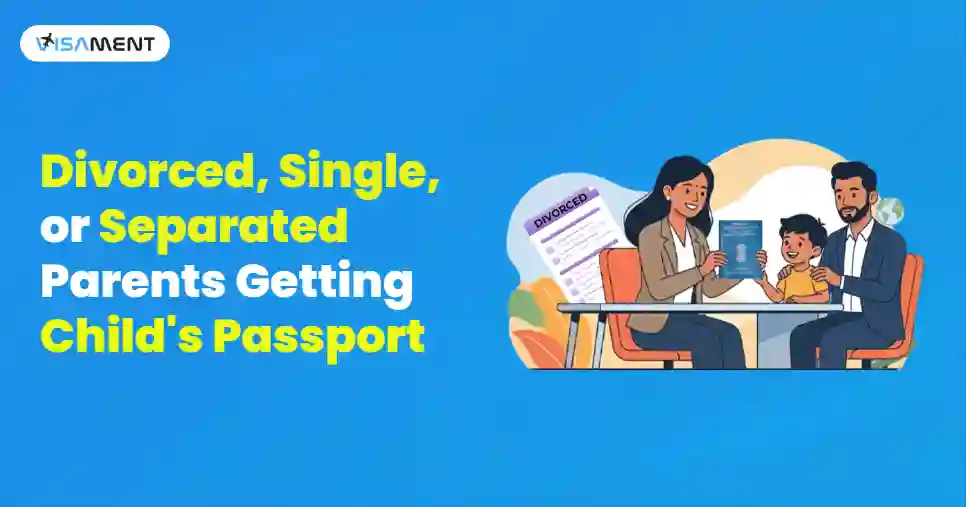
Obtaining a Child's Passport seems to be an easy process, but not in some specific circumstances. In cases where the parents are divorced, separated, or a single parent, getting a passport for the child can be very complicated. The issue occurs when one of the parents refuses to cooperate and is still a legal parent of the child.
In this blog, we have mentioned all the different situations and provided the solution for getting the child's passport. You can learn about the application process, processing time, and different annexures. Locate your situation and get the solution for your child's passport.
When you need an Indian passport for your children. The process should be easy- but if you are separated, divorced, a single parent, or have some non-traditional family situation, you may have heard these scary words: "Both parents must be present".
The NRI families face the following:
The regulations of the Indian passport specifically look for complex family situations. The system recognises the following:
The important thing is to know which of the procedures is applied to your situation and how you can document your case accurately.
 Also Want to Know About Indian Passport Rules in 2026 for New Applications and Renewals? Check Now!
Instead of using the normal Annexure D (signatures of both parents are required), the passport manual provides three options for the special situations:
When to use:
What it does:
Important: Even if the name of the father is present on the child's birth certificate, if he was never involved, then you can independently proceed with the correct documents, but it is subject to verification and the discretion of the passport authorities.
When to use:
1. You are married currently (not separated or divorced)
2. Spouse is not available for legitimate reasons:
What it does:
Important: This Annexure is not for the separated or divorced parents. They should use Annexure H.
When to use:
What it does:
Important: If you have the proper documentation of custody, then there is no need for your ex-spouse's cooperation.
Say goodbye to paperwork stress! Hassle-free Indian Passport Application Service
Apply NowHere are the specific family situations and their detailed solutions:
Your legal situation: You have the sole custody of your child, and the refusal from your ex-spouse is considered legally irrelevant.
Required documents:
Strategy: You need to present your case to the passport authorities strongly. You have the legal custody, which provides you with the right to obtain travel documents. If they still deny, then escalate the issue to the senior or get a specific court order.
Common Issue: "Divorce Decree doesn't explicitly mention passports".
Solution: You need to argue firmly that sole custody includes the authority to make all the major decisions for the child. If required, return to the court and get the clarifying order stating "The mother/father is authorised to obtain a passport for the minor child without consent of the other parent." In some cases, passport authorities may still require explicit permission unless it is clearly mentioned.
Your Situation:
Your legal authority: The mother is given the primary rights for the child born out of wedlock as per Indian laws. The Supreme Court supports that the child is not allowed to be penalised for the circumstances of birth.
Required documents:
If the father's name is present on the birth certificate but he is uninvolved, you need to use Annexure C and give a proper explanation that he was never involved in the child's life. If you have any evidence that you attempted to contact him, then include that also.
Your rights: The passport of the child cannot be refused based on absence after you have been a sole parent.
The complications: If you are still legally married, then both parents have equal rights, but they practically refuse to cooperate.
Different types of separation and their solutions:
If you have written a separation agreement:
If you have custody and a judicial separation order:
If informally separated:
For NRI separated parents:
Your challenge: The relationship has broken down, but technically, you are still married, so both parents have equal rights.
Best approach: During the divorce proceedings, you should obtain an interim custody order.
File an application for a specific order in the family court handling your divorce: "Pending final disposal of divorce proceedings, the mother/father is authorised to obtain a passport for minor child [name] without the consent of the respondent."
Why the court grants this:
Timeline: Around 2-4 months for an interim order, then complete the passport application.
Alternatively, if divorce is abroad, you need to file parallel custody proceedings in the Indian court. If the divorce happened in a foreign country, India can grant the custody orders for an Indian child citizen.
The citizenship question: If the child born to you is in the country with birthright citizenship, they face a choice.
Option 1: Indian Passport & Citizenship
Requirements:
Complication: If a child also takes abroad citizenship, their Indian citizenship is automatically terminated because India does not allow dual citizenship.
Option 2: Foreign Citizenship & OCI
Choice for most NRI families:
OCI benefits:
OCI limitations:
Strategic factors for decision:
Issue: Foreign divorce decrees are not automatically recognised in India, unless they satisfy the conditions under Indian law.
What to do:
Get Recognition from Indian Court
Use the Indian Court Order for Passport
Why this matters: Without the recognition of the Indian court, there is very limited effect of your foreign divorce for Indian bureaucratic purposes.
Planning tip: You should start the foreign divorce recognition process just after the divorce and not at the time of passport application. This helps in avoiding the last-minute complications.
Also Want to Know About Passport Police Verification Process in India? Check Now!The direct answer to this question is No. Now, let's understand why:
The names of the biological parents cannot be replaced for the following reasons:
Why this policy exists:
NOTE: The only way the name of the step-parent can appear on the child's passport is through legal adoption.
Here are some of the common issues that parents have to face while applying for their child's Indian passport:
When you hear "We Need Both Parents Present," despite having the custody of the child:
Strategy to Response:
If they persist:
Legal Position:
Argument you should make: Here is the exact argument you should present:
"Sole custody inherently includes authority to make all major decisions for the child, including obtaining travel documents. This is implicit in the custody grant and doesn't require explicit enumeration."
If unsuccessful: Go to the court that granted you the divorce and obtain a supplementary order mentioning the passport authority.
Court Language to request: "The [Mother/Father] is authorised to obtain an Indian passport for the minor child without the requirement of consent from the other parent."
They are partially correct: For bureaucratic purposes, foreign divorces require Indian court recognition.
Solution: You need to file a declaratory suit in an Indian court. This is a routine proceeding, and the courts grant these on a regular basis.
Timeline: 6-18 months
Immediate Solution: Despite being divorced, if both parents cooperate, then some passport offices accept the foreign decree in case of no disputes. This method can be risky and inconsistent.
The actual timeline depends on different circumstances:
Add passport processing time: 6-12 weeks
This section contains some of the challenges faced by the NRI families:
Obtain the Indian passport for your child as per your situation and follow all the regulations as mentioned above. You may need to obtain a specific court order, use a particular annexure, or use a completely different procedure. As the process involves a lot of legality, you can also get help from experts. You can visit Visament to get assistance from professionals with many years of experience. They can help you 24/7 on the platform and provide you with an Indian passport for your child.
If you have legal custody, then you can get the passport. You can use Annexure H along with your divorce decree, presenting custody. If the passport office still refuses to provide you with the passport, you need to obtain a specific court order. If you have custody, the refusal by your ex is considered legally irrelevant.
You don't need to come to India. You can complete the proceedings using the Power of Attorney. Your advocates can manage the court appearances. You can book the passport appointment at the consulate located in your country of residence.
The processing time depends on your situation: Need court order first: 6-9 months With existing custody documents: 2-3 months Complex proceedings: 12-24+ months
It will not work directly. For foreign divorces, Indian court recognition is required first. You need to file a declaratory suit, submit the US decree, and then obtain an Indian court order. Then, you can proceed with the passport, and the processing time is 6-18 months for recognition.
You need to use Annexure C in this situation. You should explain in the affidavit that although his name is present on the birth certificate, he was never involved, and also provide the proof of sole caregiving. According to the Supreme Court, practical caregiving matters more than just a biological connection.
Yes, it can be harder. The best approach you can follow is to obtain an interim custody order during the divorce proceedings or file for judicial separation. If you are separated informally, then you need to provide a comprehensive affidavit regarding the situation, though the success is less certain.
Vipul Jain is the Co-Founder of Visament, a trusted platform dedicated to simplifying Indian immigration, consular, and NRI services for applicants across the globe. With extensive expertise in OCI cards, Indian passport services, visa assistance, apostille and document legalization,... See Full Bio

Talk to our documentation experts for free guidance on your application.
When you visit a website, it may store data about you using cookies and similar technologies. Cookies can be important for the basic operations of the website and for other purposes. You get the option of deactivating certain types of cookies, even so, doing that may affect your experience on the website.
It is required to permit the basic functionality of the website. You may not disable necessary cookies.
Used to provide advertising that matches you and your interests. May also be used to restrict the number of times you see an advertisement and estimate the effectiveness of an advertising campaign. The advertising networks place them after obtaining the operator's permission.
Permits the website to recognize the choices you make (like your username, language, or the region you are in). Also provides more personalized and enhanced features.
Aid the website operator to determine how the website performs, how visitors interact with the site, and whether there are any technical issues.