Related Blogs

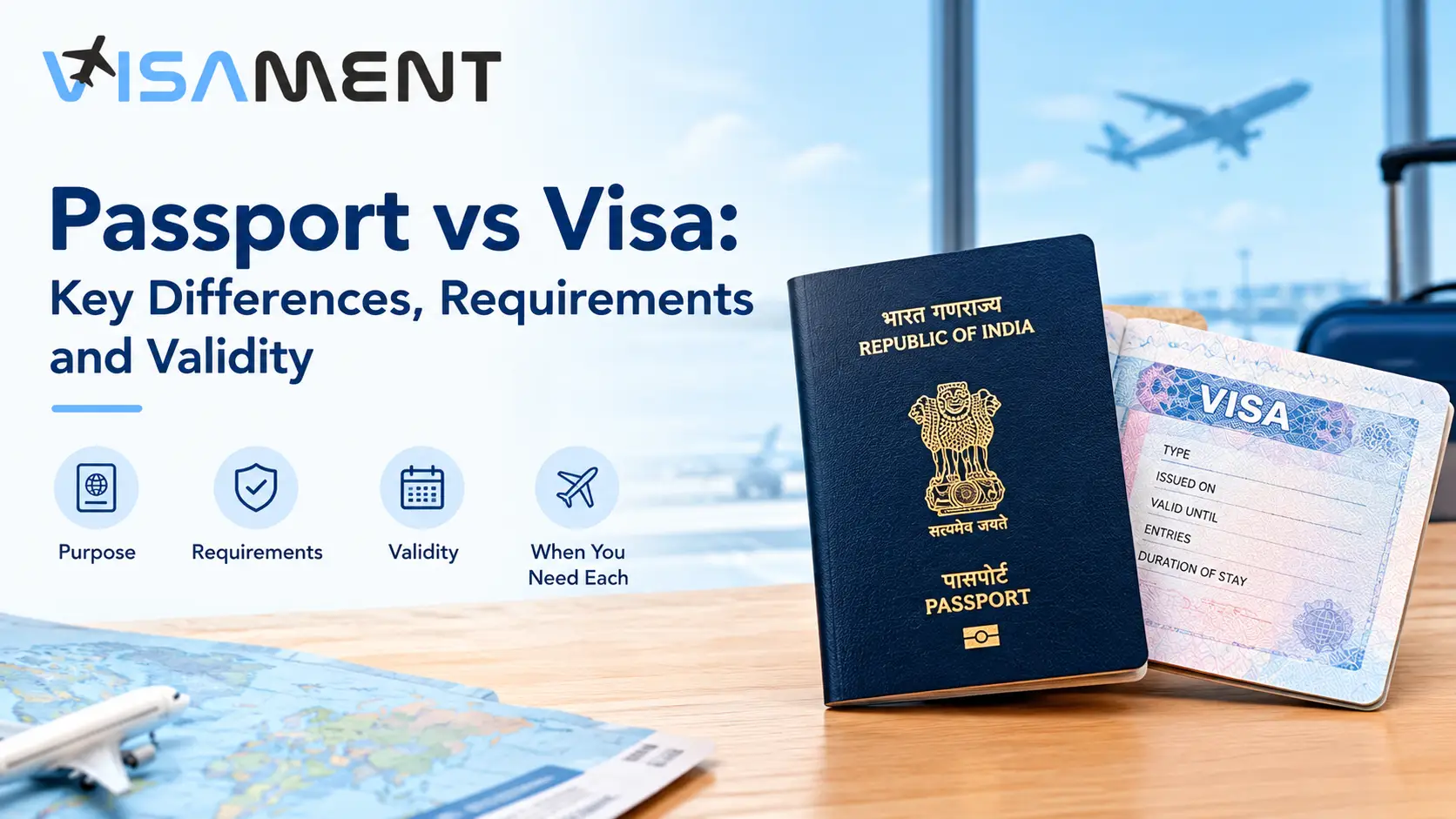
A passport and a visa are both important travel documents, but they serve different purposes. A passport identifies you and establishes your nationality, while a visa provides authorization under another country's rules for a particular visit or purpose. Whether you need a visa depends on your nationality, destination, and travel plans. Understanding the difference between a passport and a visa can help you prepare the correct documents, avoid common travel mistakes, and check the entry requirements before departure.
The main difference between a passport and a visa is their purpose. A passport is an official travel and identity document issued by a government, while a visa is authorization granted under a destination country's immigration rules.
|
Feature |
Passport |
Visa |
|---|---|---|
|
Purpose |
Identifies the holder and establishes nationality |
Authorizes or permits travel, entry, or stay under specified conditions |
|
Issuing authority |
The holder's government |
The destination country's authorized government or immigration authority |
|
Who needs it? |
Generally required for ordinary international travel, subject to applicable exceptions |
Required when the destination's rules say it is necessary |
|
Validity |
Has an expiry date and may be subject to remaining-validity requirements |
Has validity dates or conditions determined by the issuing authority |
|
Format |
Usually a physical booklet or another officially accepted travel document |
May be a physical stamp, sticker, document, or electronic authorization |
|
Main consideration |
Identity, nationality, and travel-document validity |
Eligibility, purpose of travel, and destination-specific conditions |
A passport and a visa are not interchangeable. A valid passport does not automatically give you permission to enter every country, and a visa does not replace the need for an acceptable travel document when one is required.
For more information about obtaining a passport, read the passport application guide. For visa-related guidance, explore the visa guide.
A passport is an official document issued by a government to identify its holder and establish their nationality. It is commonly used for international travel and may be required by airlines, border authorities, and other relevant agencies.
A passport typically contains information such as:
For example, an Indian citizen travelling to another country will generally need a valid Indian passport or another travel document accepted under the relevant rules.
A passport does not, by itself, establish a right to enter every foreign country. The destination may also require a visa, an electronic travel authorization, or other supporting documents.
If your passport is expiring or needs replacement, consult the relevant government guidance on passport renewal or reissue before planning your journey.
A visa is authorization issued under a country's immigration rules that allows a traveller to seek entry, transit, or stay for a specified purpose and under applicable conditions.
Depending on the destination, a visa may be issued as a stamp or sticker in a passport, as a separate document, or electronically. The exact format and legal effect vary by country.
Common visa categories include:
The type of visa required depends on the purpose of travel and the destination's rules. A tourist visa, for example, does not automatically authorize employment.
An electronic visa, commonly called an e-Visa, is processed or issued electronically under the relevant country's system. It is not the same as visa-free entry, and an approved e-Visa may still have specific conditions.
Learn more about the differences between e-Visas and regular visas.
Most ordinary international travellers need an acceptable passport or travel document, but whether they also need a visa depends on their nationality, destination, purpose of travel, and applicable entry rules.
Consider these examples:
Example 1: Travelling to a country that requires a visa
An Indian citizen planning a tourist trip to a destination that requires Indian passport holders to obtain a tourist visa will generally need both a valid passport and the appropriate visa. They must also satisfy any additional entry conditions.
Example 2: Travelling to a visa-exempt destination
An Indian citizen may be eligible to visit certain destinations without obtaining a visa in advance. However, visa-free entry may have limits on the permitted stay and may still require a valid passport, return or onward travel evidence, or other documents.
Visa requirements can change, so travellers should verify the rules for their specific nationality and destination before departure.
Passing through an airport in another country does not always eliminate visa requirements. Some travellers need a transit visa or must satisfy additional conditions, depending on their nationality, airport, itinerary, and whether they pass through immigration.
Check the destination country's official immigration website or embassy guidance before booking connecting flights.
Passport validity and visa validity are different, and neither should be confused with the permitted duration of stay.
For example, a visa might allow a traveller to seek entry during a specified period, while the permitted stay for an individual visit may be shorter. The exact rules depend on the country and visa category.
Some destinations require a passport to remain valid for a minimum period beyond the intended arrival or departure date. There is no universal rule that every country requires six months of remaining passport validity.
Travellers should check the destination's passport-validity requirements and confirm that their visa, if required, is suitable for their intended trip.
The answer depends on the country that issued the visa and the destination's rules. Some countries allow travellers to use an eligible valid visa in an expired passport alongside a new valid passport, subject to specific conditions. Other situations may require different arrangements.
Do not assume that a valid visa can automatically be transferred to a new passport. Check the relevant immigration authority's guidance before travelling.
For further information, read the guide to travelling with a valid visa in an expired passport.
No. Possessing a valid passport and visa does not automatically guarantee admission into a destination country.
A visa may allow a traveller to travel to a port of entry and request permission to enter, but the relevant border authorities determine admission under the country's laws and procedures. For example, the U.S. Department of State explains that a U.S. visitor visa does not guarantee entry into the United States.
Depending on the destination, border officials may check the traveller's documents, purpose of visit, eligibility, and compliance with applicable entry conditions.
Travellers should therefore treat a passport and visa as essential parts of travel preparation, not as a guarantee that every entry requirement has been satisfied.
Before leaving your home country, use this checklist to confirm that your travel documents meet the destination's requirements.
If your passport is close to expiry, check whether renewal or reissue is necessary before travelling. The appropriate process depends on the issuing country and your circumstances.
Stop worrying about delays. Apply now and get Indian Counsellor Services.
Chat NowThe key difference between a passport and a visa is that a passport identifies the traveller, while a visa provides authorization under a destination country's rules for a particular visit or purpose. Whether you need both documents depends on your nationality, destination, and travel plans.
Before travelling, verify passport validity, visa requirements, permitted stay, and transit conditions through official government sources.
You can also seek expert assistance from Visament, which has years of experience and can help you apply for a passport and visa. They can help you meet all requirements and understand the importance of both documents.
No. A passport is an official travel and identity document, while a visa is authorization governed by the destination country's immigration rules. A traveller may need both, depending on the journey.
Yes, if the destination's rules permit visa-free entry or another applicable arrangement. Travellers must still meet passport, transit, and other entry requirements.
Many conventional visa applications require a valid passport or another accepted travel document. The exact requirements depend on the country, visa category, and applicant's circumstances.
No. Visa on arrival involves obtaining a visa at an eligible arrival point, subject to the country's conditions. Visa-free entry means an eligible traveller does not need to obtain that visa for the permitted visit.
Not necessarily. Visa validity and passport validity are separate matters, but whether a visa remains usable after passport expiry depends on the destination's rules and the specific circumstances.
No. Border authorities determine whether a traveller meets the destination's admission requirements. A visa does not remove the need to comply with other applicable entry conditions.
Vipul Jain is the Co-Founder of Visament, a trusted platform dedicated to simplifying Indian immigration, consular, and NRI services for applicants across the globe. With extensive expertise in OCI cards, Indian passport services, visa assistance, apostille and document legalization,... See Full Bio

Talk to our documentation experts for free guidance on your application.



When you visit a website, it may store data about you using cookies and similar technologies. Cookies can be important for the basic operations of the website and for other purposes. You get the option of deactivating certain types of cookies, even so, doing that may affect your experience on the website.
It is required to permit the basic functionality of the website. You may not disable necessary cookies.
Used to provide advertising that matches you and your interests. May also be used to restrict the number of times you see an advertisement and estimate the effectiveness of an advertising campaign. The advertising networks place them after obtaining the operator's permission.
Permits the website to recognize the choices you make (like your username, language, or the region you are in). Also provides more personalized and enhanced features.
Aid the website operator to determine how the website performs, how visitors interact with the site, and whether there are any technical issues.