A Schengen visa cover letter helps explain why you are travelling, how long you plan to stay, how your trip will be funded, and other relevant details of your application. If you are unsure what to write or how to structure the letter, a practical template can help you organize the information clearly. This guide explains what to include, provides a customizable sample, and shows you how to check your letter against your application documents before submission.
Key Takeaways
- A Schengen visa cover letter explains your travel purpose, itinerary, funding arrangements, and relevant personal circumstances.
- Whether a separate cover letter is required depends on the instructions of the consulate handling your application.
- Your travel dates, destinations, accommodation, and financial information should match your supporting documents.
- A template is a starting point; personalize it using accurate information about your own trip.
- An invitation letter and a sponsorship letter serve different purposes from the applicant's cover letter.
- A well-written letter can clarify your application but cannot guarantee visa approval.
What Is a Schengen Visa Cover Letter?
A Schengen visa cover letter is a personal letter submitted with a visa application when requested or considered appropriate. It summarizes the reason for the visit and helps explain the applicant's travel arrangements and relevant circumstances.
For example, a tourist might describe a planned holiday across France and Italy, explain where they intend to stay, and identify who will pay for the trip. An applicant visiting relatives might explain the purpose of the visit and refer to relevant host documentation.
Is a cover letter compulsory for every Schengen visa application? No universal requirement applies to every application in the same way. Check the current instructions and supporting-document checklist of the consulate responsible for your application. The European Commission's Schengen visa application guidance is a useful starting point.
A cover letter does not replace required evidence, such as financial documents, accommodation information, or travel medical insurance where applicable.
What Should a Schengen Visa Cover Letter Include?
A good letter is concise, organized, and consistent with the rest of your application. Include the following information where relevant and follow any additional instructions issued by the consulate.
- Applicant details: Full name, contact information, and other identifying details appropriate for the application.
- Recipient and date: The relevant embassy, consulate, or visa section, plus the letter's date.
- Travel purpose: Tourism, business, visiting family or friends, or another stated purpose.
- Travel dates and itinerary: Intended arrival and departure dates, destinations, and a brief explanation of the planned route.
- Accommodation: Where you intend to stay, consistent with your supporting documents.
- Funding arrangements: Whether you will pay your own expenses or receive financial support from another person or organization.
- Personal circumstances: Relevant employment, study, self-employment, or other details that help explain your situation.
- Supporting documents: Refer to relevant evidence where it helps clarify your application.
- Closing: A polite request for consideration, followed by your name and signature where appropriate.
Avoid adding unnecessary personal information or lengthy descriptions of every planned activity. The purpose is to explain your circumstances clearly, not repeat the entire application file.
How to Write a Cover Letter for a Schengen Visa
Follow these steps to prepare your letter.
- Check the consulate's instructions. Confirm the correct destination, jurisdiction, submission requirements, and current document checklist.
- Explain why you are travelling. State the purpose of your visit and your intended dates.
- Summarize your itinerary. Mention the main destinations and accommodation arrangements without reproducing a detailed day-by-day schedule.
- Explain who will fund the trip. Describe your own funding or the sponsor's contribution accurately.
- Include relevant personal circumstances. Explain your employment, studies, business activity, or other circumstances when they are relevant to the application.
- Refer to supporting evidence. Identify relevant documents where useful, especially if you need to clarify an unusual circumstance.
- Review the details. Compare your letter with your application form, itinerary, accommodation evidence, and financial documents.
If your trip includes multiple Schengen countries, explain the intended route clearly and ensure your application is directed to the competent consulate under the applicable rules.
For additional preparation, consult the Schengen visa rules for Indian applicants if you are applying from India.
Schengen Visa Cover Letter Template and Sample
Use the following template as a starting point for a tourist visa application. Replace every bracketed field with accurate information and remove any section that does not apply. Check the relevant consulate's instructions before submitting it.
[Your Full Name]
[Your Address]
[Your Email Address]
[Your Contact Number]
[Date]
To: The Visa Officer
[Embassy or Consulate Name]
Subject: Cover Letter for Schengen Visa Application
Dear Visa Officer,
I am writing to support my application for a short-stay Schengen visa for tourism. I intend to travel to [destination country or countries] from [intended arrival date] to [intended departure date] for a holiday.
During my planned visit, I intend to visit [main destinations and brief travel plans]. My accommodation arrangements are [brief description of hotels, other accommodation, or host arrangements], as reflected in the supporting documents provided with my application.
The expenses for my trip, including transportation, accommodation, meals, and other travel costs, will be covered by [myself / sponsor's full name and relationship / sponsoring organization]. I have included the relevant financial and sponsorship evidence applicable to my circumstances.
I am currently [employed as a job title at company name / self-employed as a profession / studying at institution name / retired]. [Briefly explain relevant circumstances, such as approved leave or ongoing professional or educational commitments, where applicable and supported by evidence.]
I have enclosed the supporting documents relevant to my application, including [list the applicable documents]. I confirm that the information provided in this letter is accurate and consistent with my application and supporting evidence.
I respectfully request that my Schengen visa application be considered. I will comply with the applicable visa conditions and the authorized period of stay.
Thank you for your time and consideration.
Yours sincerely,
[Your Full Name]
[Signature, if required]
Important: This is an illustrative template, not an official Schengen form. Adjust it to your actual circumstances and the consulate's instructions. Do not claim to have booked accommodation, obtained leave, or arranged funding unless those statements are true.
How to Adapt the Letter to Different Travel Situations
The basic format can remain the same, but the explanation should reflect the purpose of the trip and the evidence available.
1. Tourism
Explain your holiday plans, intended travel dates, main destinations, accommodation, and funding.
For example: “I plan to visit Paris and Rome during my annual leave. I will cover my travel expenses using my personal savings, supported by the financial documents submitted with my application.”
Use this wording only if it accurately describes your circumstances.
2. Sponsored travel
Clearly state the sponsor's identity, relationship to you, and the expenses they will cover. Refer to the applicable sponsorship letter and financial evidence. Some consulates may require a prescribed sponsorship or accommodation form.
3. Business travel
Explain the business purpose, intended meeting dates, inviting organization, and who will pay for the trip. Include the relevant invitation and employment or business documents requested by the consulate.
4. Visiting family or friends
Explain whom you intend to visit, your relationship with the host, and your accommodation arrangements. Refer to the relevant invitation or host documents where applicable.
5. Students, Self-employed applicants, and retirees
Describe your actual circumstances briefly. A student may explain their course and approved absence; a self-employed applicant may describe their business; a retired applicant may explain their retirement and funding arrangements. Provide supporting evidence where required.
A cover letter should explain these circumstances, not replace the dedicated supporting documents.
Common Mistakes to Avoid
Before submitting your letter, check for the following problems:
- Inconsistent dates: The dates in the letter should agree with your application and intended travel arrangements.
- Unclear funding: Explain who will pay for the trip and ensure the financial evidence supports the statement.
- Unexplained itinerary: If you intend to visit several countries, summarize the route clearly.
- Copied templates: Remove placeholders and any details that do not apply to you.
- Unsupported claims: Do not state that you have approved leave, confirmed bookings, or a sponsor unless the information is accurate.
- Confusing supporting letters: An applicant's cover letter does not replace an invitation letter or a required sponsorship document.
- Ignoring local instructions: Check the latest checklist for your destination and application location.
Final Checklist Before Submitting Your Cover Letter
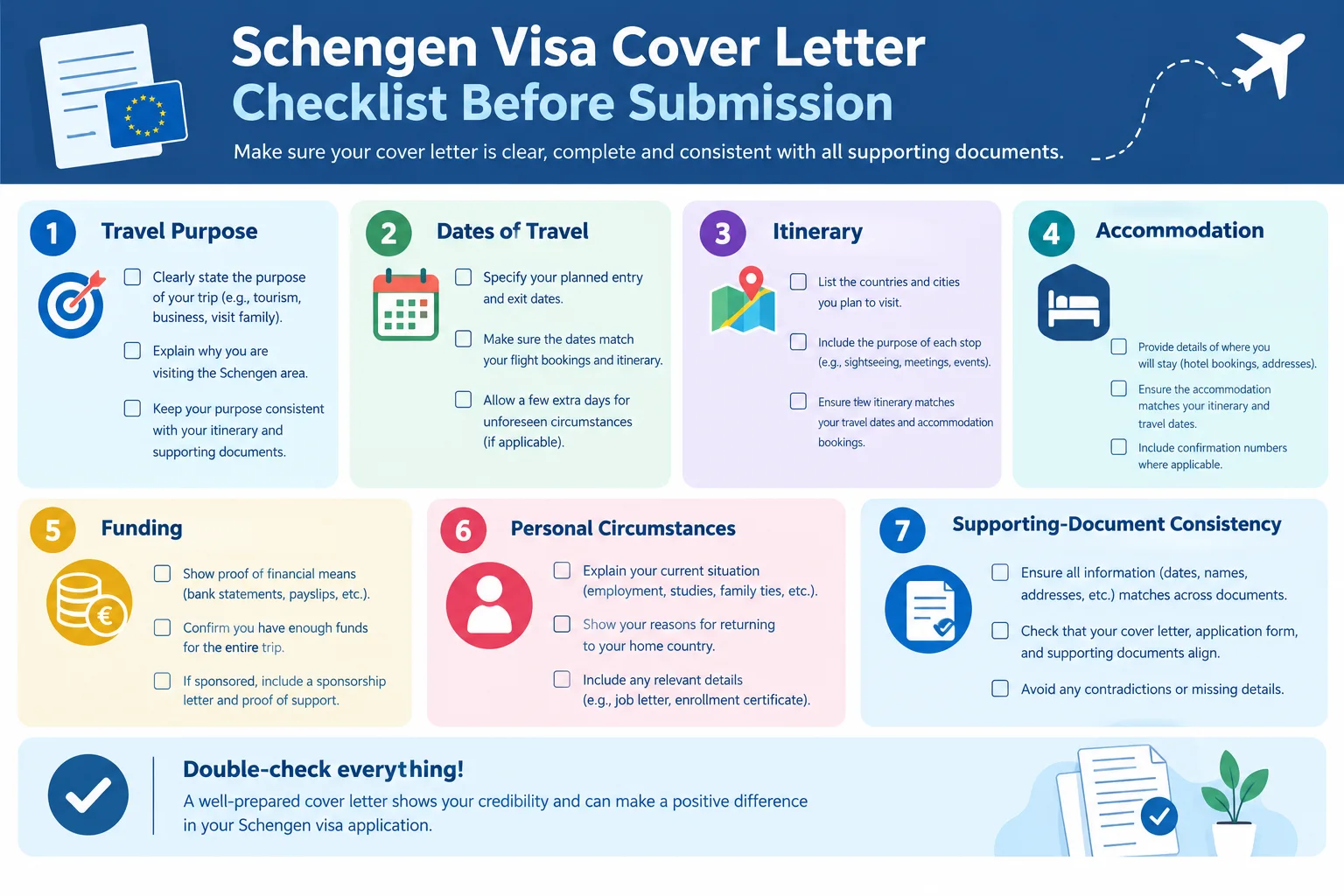
Use this checklist to complete your final review.
- My personal details and intended travel dates are accurate.
- My travel purpose and itinerary are clearly explained.
- My accommodation arrangements match the supporting evidence.
- My funding explanation matches my financial or sponsorship documents.
- My employment, study, or other personal circumstances are described truthfully.
- My letter agrees with the application form and other documents.
- I have checked the latest instructions from the responsible consulate.
- I have removed all placeholders and signed the letter if required.
For the legal basis and supporting-document framework, consult the EU Visa Code and the European Commission's official Schengen visa guidance.
Conclusion
A well-prepared Schengen visa cover letter clearly explains your travel purpose, itinerary, funding arrangements, and relevant personal circumstances. Use a template to organize your information, personalize it to your situation, and check it against the documents required by the consulate handling your application.
If you need additional help preparing your application documents or need other consular services, you can explore Visament. Professional assistance is optional, and no service or cover letter can guarantee visa approval.