Related Blogs

If you are planning a European holiday, comparing the easiest Schengen visa countries can help you understand historical visa refusal trends before preparing your application. However, a country with a lower refusal rate does not automatically offer a higher chance of approval for every traveller.
This guide compares country-level Schengen short-stay visa statistics for 2025, published by the European Commission in 2026. It explains how to interpret refusal rates, what the figures mean for Indian applicants, and how to choose the correct country for your genuine travel itinerary.
The term easiest Schengen visa country usually refers to a destination with a comparatively low historical refusal rate for short-stay visa applications. It is not an official visa category, and no country guarantees approval because its past refusal rate was low.
The refusal rate indicates the proportion of decided visa applications that were refused during a reporting period. When comparing countries, use figures from the same year and check that the statistics use equivalent definitions.
Application volumes, applicant profiles and the consulates handling applications can differ significantly between countries. A lower national refusal rate does not necessarily mean that the application process is less strict or that an individual traveller has a better chance of approval.
According to the European Commission's official short-stay visa statistics, more than 12 million applications were received globally in 2025. The Commission reported a worldwide refusal rate of approximately 14.6%.
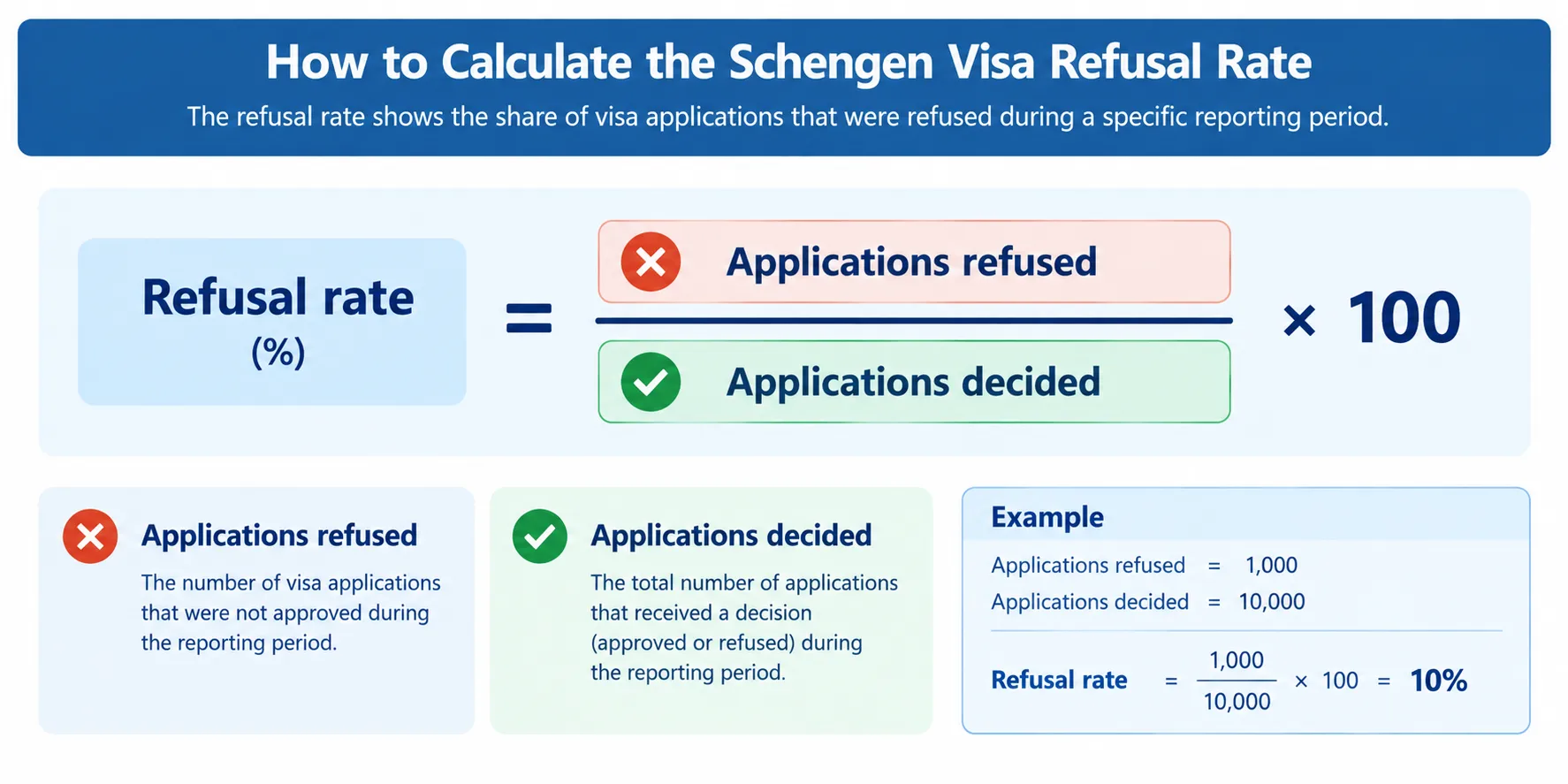
The refusal rate is calculated by dividing refused applications by the total number of applications decided, then multiplying the result by 100.
Formula:
Refusal rate = (Applications refused ÷ Applications decided) × 100
For example, if a consulate decides 10,000 applications and refuses 1,000, its refusal rate is 10%.
The following comparison uses the 2025 calendar-year destination-country statistics reported from European Commission data. The countries are arranged approximately from lower to higher refusal rates; percentages are rounded. These are historical outcomes, not a ranking of guaranteed approval chances.
|
Rank |
Schengen country |
2025 refusal rate |
|---|---|---|
|
1 |
Slovakia |
9.6% |
|
2 |
Italy |
10.8% |
|
3 |
Romania |
11.5% |
|
4 |
Austria |
11.9% |
|
5 |
Latvia |
12.3% |
|
6 |
Bulgaria |
12.5% |
|
7 |
Switzerland |
12.5% |
|
8 |
Hungary |
13.0% |
|
9 |
Germany |
13.1% |
|
10 |
Finland |
13.4% |
|
11 |
Iceland |
13.8% |
|
12 |
Czechia |
14.2% |
|
13 |
France |
14.2% |
|
14 |
Greece |
14.5% |
|
15 |
Spain |
14.6% |
Source: European Commission, short-stay visa statistics for 2025. Rates are rounded. Check the official dataset for the underlying counts and definitions before republishing the table.
Slovakia recorded the lowest refusal rate among the countries in this comparison in 2025. The figure makes it a useful country to include in a statistical comparison, but it does not establish that Slovakia is the easiest destination for every nationality or applicant profile.
Consider Slovakia if Bratislava or another part of the country genuinely forms your main destination. Do not choose it solely because of its historical refusal rate.
Italy's 2025 refusal rate was comparatively low despite the country's substantial application volume. It is relevant to travellers whose genuine itinerary includes destinations such as Rome, Florence or Venice.
Prepare an itinerary that reflects your actual plans, with supporting accommodation and financial evidence. Italy's national figures should not be interpreted as a personal approval probability.
Romania recorded an 11.5% refusal rate in 2025. Its inclusion reflects its place in the reported short-stay visa statistics, rather than a guarantee of simpler processing.
Applicants should check the current official application instructions and ensure that Romania is the appropriate country through which to submit their application.
Austria also recorded a relatively low refusal rate in 2025. Travellers whose main destination is Vienna, Salzburg or another Austrian location can use the figure as background when researching their trip.
The application still needs to satisfy the applicable requirements. A low historical refusal rate cannot compensate for inconsistent information or insufficient supporting evidence.
Latvia's refusal rate was 12.3% in 2025. Travellers planning a genuine visit to Riga or other Latvian destinations may find the statistic useful when comparing historical outcomes.
The figure should be read alongside the reporting year and application volume, not as proof that Latvian applications are automatically easier.
Bulgaria recorded a 12.5% refusal rate in the 2025 comparison. It is another destination whose statistics can help travellers understand differences in historical visa outcomes.
Before applying, confirm the relevant consular jurisdiction and the current requirements for your travel purpose.
Switzerland's refusal rate was also 12.5% in 2025. It is a relevant comparison for travellers planning a genuine visit to destinations such as Zurich, Geneva or the Swiss Alps.
Switzerland participates in the Schengen short-stay visa system. Applicants should still provide an itinerary and supporting documents that accurately reflect their plans.
Hungary recorded a 13.0% refusal rate in 2025. The figure places it among the countries with comparatively lower refusal rates in this list.
Travellers planning a visit to Budapest or elsewhere in Hungary should review the applicable official instructions rather than assuming that the national statistic predicts the outcome of their application.
Germany's 2025 refusal rate was 13.1%. Germany also received a substantial volume of applications, making it important to consider the number of applications alongside the percentage.
Applicants should prepare evidence that supports their travel purpose, accommodation arrangements, finances and intended stay.
Finland recorded a refusal rate of 13.4% in 2025. The statistic can help travellers compare historical outcomes, but it does not show that Finnish authorities apply less stringent requirements to individual applicants.
Apply through Finland when it is the appropriate destination under the consulate-selection rules.
Iceland has frequently appeared in older articles about countries with low Schengen visa refusal rates. Its 2025 rate, however, was 13.8%, demonstrating why rankings should be refreshed instead of repeating older claims.
The 2025 figure is a more appropriate basis for a current comparison than Iceland's frequently quoted 2.2% refusal rate from 2023.
Czechia recorded a 14.2% refusal rate in 2025. Travellers whose main destination is Prague or another Czech location can consider the statistic as one element of their research.
It should not outweigh the actual itinerary, applicable requirements or quality of the application.
France recorded a 14.2% refusal rate in 2025 and handled a large volume of applications. A national percentage alone does not explain the circumstances behind individual decisions.
If France is your main destination, prepare your application according to the instructions of the relevant French consulate or authorised application centre.
Greece recorded a 14.5% refusal rate in 2025. Travellers planning a genuine visit to Athens, the Greek islands or other Greek destinations can use the figure to understand the historical context.
The statistic is not evidence that Greece is easier or harder for every nationality.
Spain's refusal rate was approximately 14.6% in 2025. Its large application volume makes it another useful point of comparison.
Applicants planning a visit to Spain should select the correct consulate and provide consistent evidence of the trip rather than relying on the country-level rate alone.
Important: These rankings compare reported destination-country outcomes. They do not rank countries by approval probability for Indian nationals specifically, nor do they establish that one country's assessment is more lenient than another's.
Indian travellers should distinguish between two types of statistics: refusal rates for applications lodged in India and refusal rates for a destination country across its worldwide consulates. These measure different things and cannot be used interchangeably.
The European Commission reported approximately 1.15 million Schengen short-stay visa applications from India in 2025. That figure reflects substantial demand, but it does not reveal an Indian applicant's individual likelihood of approval.
For Indian applicants, a meaningful comparison should use the same reporting year and verified data specific to Indian applicants wherever available. Avoid relying on a worldwide ranking to conclude that a particular country is easiest for Indians.
Before applying, check:
For more detailed information about regulations, eligibility and current procedures, read Visament's guide to Schengen visa rules for Indians.
 Also Want to Know About Cover Letter for Schengen Visa Application? Check Now!
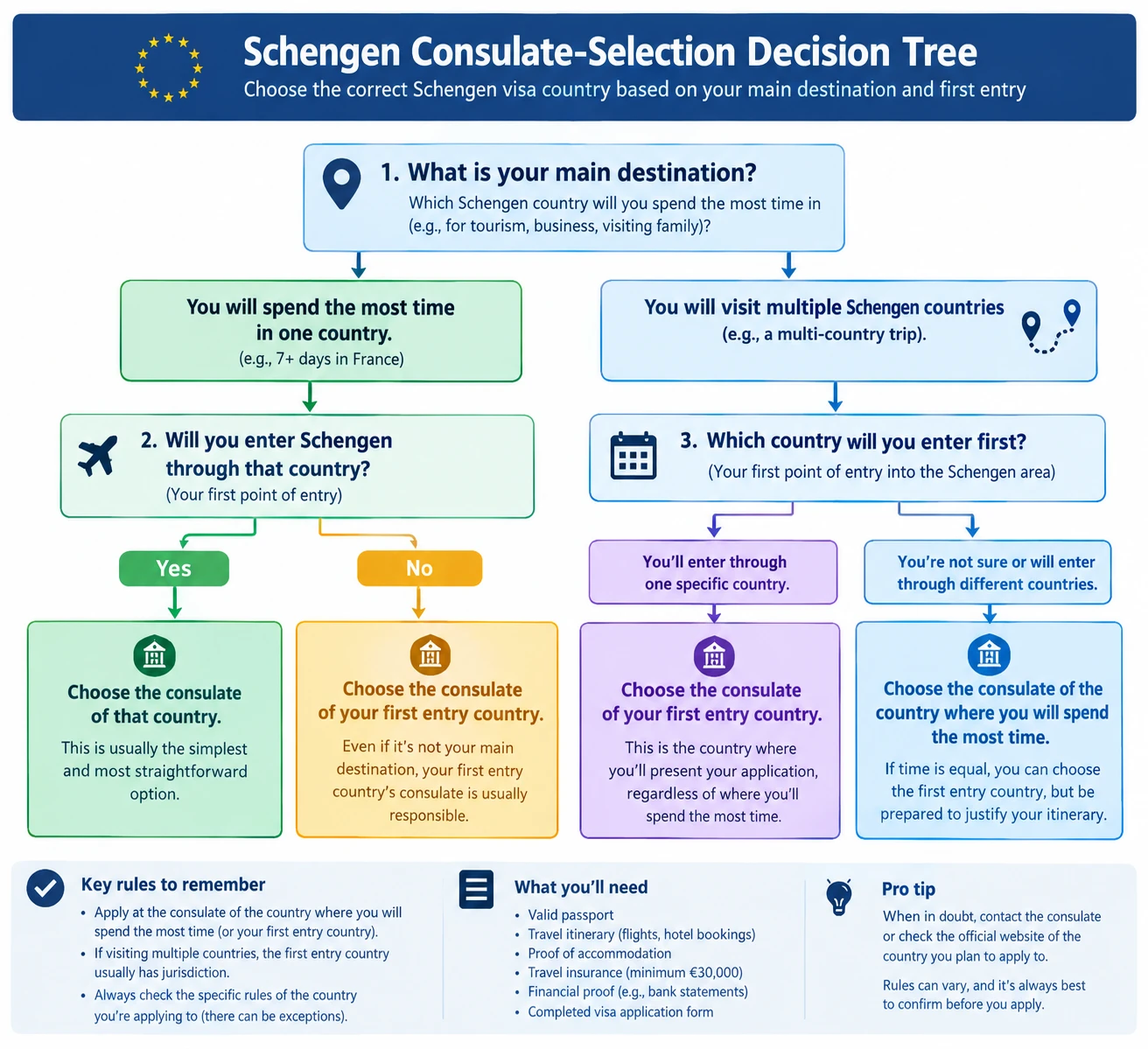
No. You cannot freely choose a Schengen country simply because it has a lower refusal rate. You must follow the applicable rules for determining which country is responsible for your application.
The general rules are:
For example, suppose you plan to spend six nights in Italy and three nights in Switzerland. Italy is generally the main destination for your trip, so you should apply through the appropriate Italian consulate.
If you intend to spend four nights in Italy and four nights in Switzerland, the first-entry rule generally determines the responsible country.
Do not create a misleading itinerary or book an unrelated destination just to target a lower refusal rate. Your application should reflect your actual travel plans.
A country's historical refusal rate is only one piece of context. A well-prepared application should clearly support the purpose of your trip and satisfy the applicable requirements.
Before submitting your application, check the following:
No checklist can guarantee approval. Consulates assess applications individually, and applicants should consult the latest official guidance for their destination.
Also Want to Know About Cheapest Countries to Visit from India Check Now!
Use the following checks when comparing the easiest Schengen visa countries:
The Commission's dataset provides historical application and visa figures by destination country and consular location. Reviewing the underlying data helps avoid repeating rankings that no longer reflect the latest reporting year.
Also Want to Know About Malaysia Digital Arrival Card Check Now!The easiest Schengen visa countries are best understood through current, comparable refusal-rate statistics—not promises of easy approval. Slovakia, Italy, Romania, Austria and Latvia recorded comparatively low refusal rates in the 2025 comparison, but those figures do not predict the outcome of an individual application.
Choose the correct consulate based on your actual itinerary, check the latest official requirements and prepare consistent supporting documents. If you need help organising your application, Visament can provide guidance through its available visa assistance services.
In the 2025 comparison presented above, Slovakia had the lowest refusal rate at 9.6%. This is a historical country-level figure, not a guarantee that an individual application will be approved.
No. A country's refusal rate reflects historical outcomes across many applications. Individual decisions depend on the applicant's circumstances and the applicable visa requirements.
There is no universally easiest country for all Indian applicants. Compare verified statistics for Indian applicants where available, and apply through the country that is responsible for your genuine itinerary.
No. You generally apply through your sole or main destination. If you will spend equal time in multiple Schengen countries, the country of first entry generally determines where to apply.
A complete application with consistent travel plans and appropriate supporting evidence is essential. Follow the relevant consulate's current requirements and do not rely on a country's historical refusal rate as a substitute for preparation.
Vipul Jain is the Co-Founder of Visament, a trusted platform dedicated to simplifying Indian immigration, consular, and NRI services for applicants across the globe. With extensive expertise in OCI cards, Indian passport services, visa assistance, apostille and document legalization,... See Full Bio

Talk to our documentation experts for free guidance on your application.



When you visit a website, it may store data about you using cookies and similar technologies. Cookies can be important for the basic operations of the website and for other purposes. You get the option of deactivating certain types of cookies, even so, doing that may affect your experience on the website.
It is required to permit the basic functionality of the website. You may not disable necessary cookies.
Used to provide advertising that matches you and your interests. May also be used to restrict the number of times you see an advertisement and estimate the effectiveness of an advertising campaign. The advertising networks place them after obtaining the operator's permission.
Permits the website to recognize the choices you make (like your username, language, or the region you are in). Also provides more personalized and enhanced features.
Aid the website operator to determine how the website performs, how visitors interact with the site, and whether there are any technical issues.