Related Blogs

Planning an international trip from India does not always mean applying for a visa before departure. Several destinations allow Indian ordinary passport holders to enter without a traditional visa, although the permitted stay and entry conditions vary by country. The Ministry of External Affairs (MEA) currently lists destinations including Barbados, Bhutan, Dominica, Malaysia, Maldives, Nepal, Thailand and others under its visa-free category for Indian nationals.
This guide explains which destinations currently offer visa-free entry, how visa-free travel differs from visa on arrival and eVisa arrangements, and what Indian travelers should check before booking flights.
Last reviewed: August 20, 2026. Visa and entry rules can change without notice. Always verify the latest requirements with the destination country's immigration authority or embassy before traveling.
The MEA's current visa-facility information for ordinary Indian passport holders identifies 27 destinations under its visa-free entry category. However, “visa-free” does not mean that every traveler can enter with no conditions. Some destinations have specific eligibility requirements, while others require an online registration or authorization.
| Destination | Visa-free stay/arrangement | Important condition |
|---|---|---|
| Angola | 30 days | Subject to destination entry requirements |
| Barbados | 90 days | Tourism and business; normal conditions apply |
| Belarus | 30 days | Specific financial, insurance and onward-travel conditions apply |
| Bhutan | No stated limit | Entry documentation and applicable permits still apply |
| Dominica | 180 days | Subject to normal immigration requirements |
| Cook Islands | 31 days | Return ticket required |
| Dominican Republic | Conditional | Indian travelers must meet specified eligibility conditions, including qualifying third-country entry status |
| Grenada | 90 days | Normal visitor requirements apply |
| Haiti | 90 days | MEA notes that the practice is not based on a bilateral visa-free agreement |
| Jamaica | 30 days | Subject to entry requirements |
| Kazakhstan | 14 days | Non-extendable according to MEA |
| Kyrgyzstan | 7 days | Special conditions apply, including eligible long-term visas and entry through Manas International Airport |
| Malaysia | 30 days | Visa-free facility currently listed until December 31, 2026 |
| Maldives | 90 days | Subject to immigration requirements |
| Montserrat | 180 days | Subject to visitor-entry conditions |
| Nepal | No limit | Indian nationals have special entry arrangements |
| Niue | 30 days | Return ticket required |
| Philippines | 14 days | Specific conditions apply |
| Rwanda | 30 days | Subject to normal entry requirements |
| Saint Lucia | 6 weeks | Return ticket required |
| Saint Vincent and the Grenadines | 30 days | Passport, accommodation, funds and return-ticket conditions apply |
| Samoa | 60 days | General visitor conditions apply |
| Senegal | 90 days | Destination-specific entry requirements apply |
| Seychelles | 90 days | Travel Authorization is required and may involve a fee |
| Thailand | 60 days | Tourism/short business; Thailand Digital Arrival Card registration is required |
| Trinidad and Tobago | 90 days | Subject to normal immigration requirements |
| Vanuatu | 30 days under the visitor arrangement | General conditions apply |
The MEA information is specifically for ordinary Indian passport holders. Its published list also warns travelers to cross-check information with the relevant foreign embassy or consulate because entry rules can change.
Some destinations listed as visa-free still require travelers to complete an authorization or registration before departure.
For example, Indian nationals visiting Hong Kong can travel visa-free for up to 14 days after completing the free Pre-arrival Registration (PAR). The Hong Kong Immigration Department states that the Indian passport must be valid for at least six months. PAR is generally valid for six months and can support multiple visits of up to 14 days during that period.
Similarly, the MEA lists Seychelles as visa-free for Indian nationals but notes that a Seychelles Travel Authorization is required. Therefore, travelers should not interpret “visa-free” as meaning that no pre-travel action is necessary.
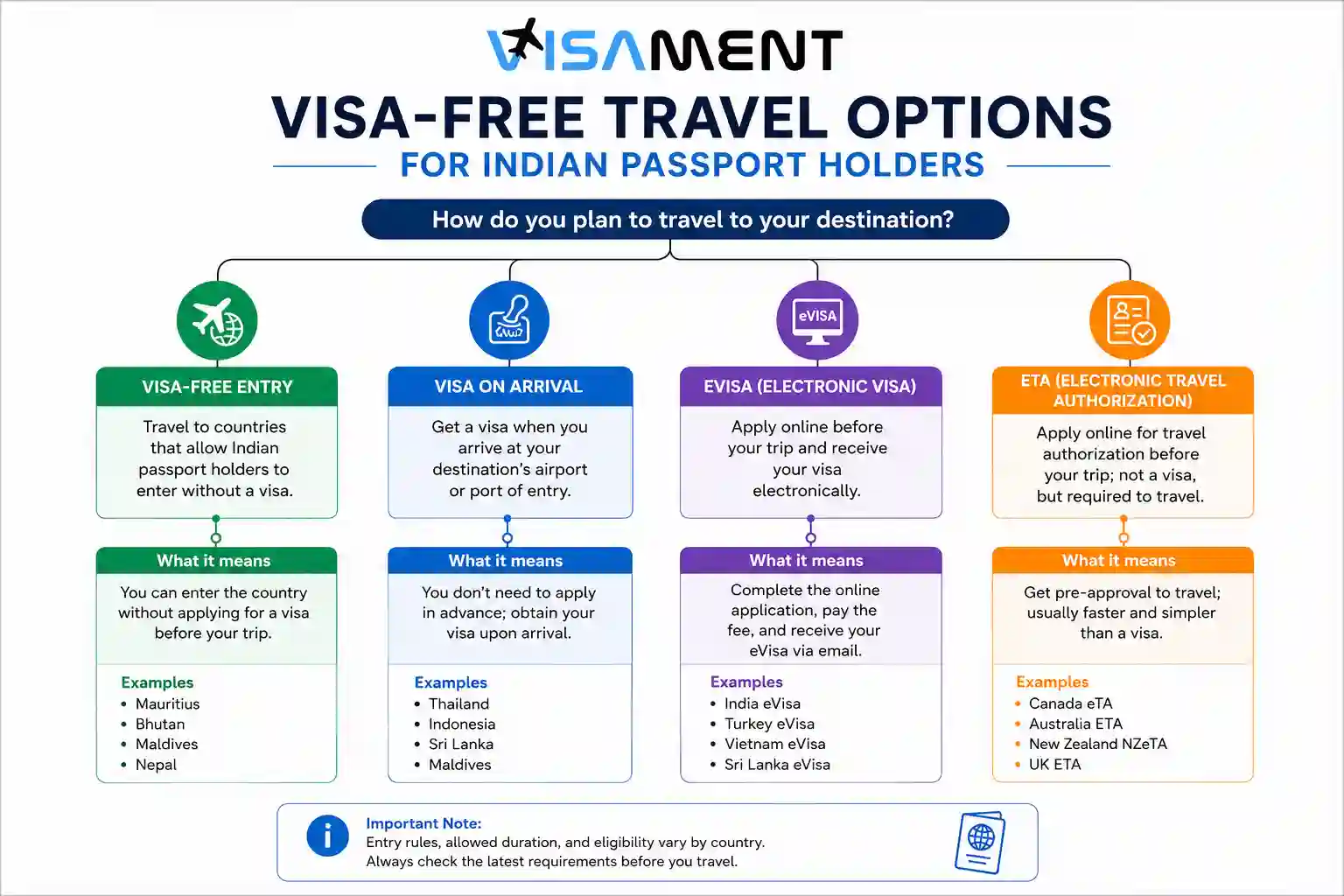
These four terms describe different travel arrangements. Understanding the difference is important because many online “visa-free country” lists combine them.
| Entry type | What the traveler normally does |
|---|---|
| Visa-free | No visa application is normally required before travel, subject to the destination's conditions |
| Visa on arrival | The traveler obtains a visa after reaching the destination |
| eVisa | The traveler applies for and receives an electronic visa before traveling |
| eTA / travel authorization | The traveler completes an online authorization before travel; it is not the same as visa-free entry |
The MEA maintains separate categories for visa-free entry, visa-on-arrival facilities, and eVisa facilities for Indian ordinary passport holders.
For example, Indonesia is not simply a visa-free destination for ordinary Indian passport holders under the current MEA classification; it appears under visa-on-arrival and eVisa facilities. Indonesia's immigration authority also lists Indian nationals among those eligible for its Visa on Arrival system.
Singapore provides another useful example. Ordinary Indian passport holders generally require a visa to enter Singapore. However, eligible Indian travelers transiting through Singapore may qualify for the separate 96-hour Visa-Free Transit Facility (VFTF) if they meet its conditions. That transit facility should not be confused with general visa-free tourism.
If you are specifically looking for destinations where a visa can be obtained after arrival, use a dedicated visa-on-arrival guide for Indian passport holders rather than treating those destinations as visa-free.
Visa-free entry removes the need for a traditional visa, but it does not remove immigration requirements.
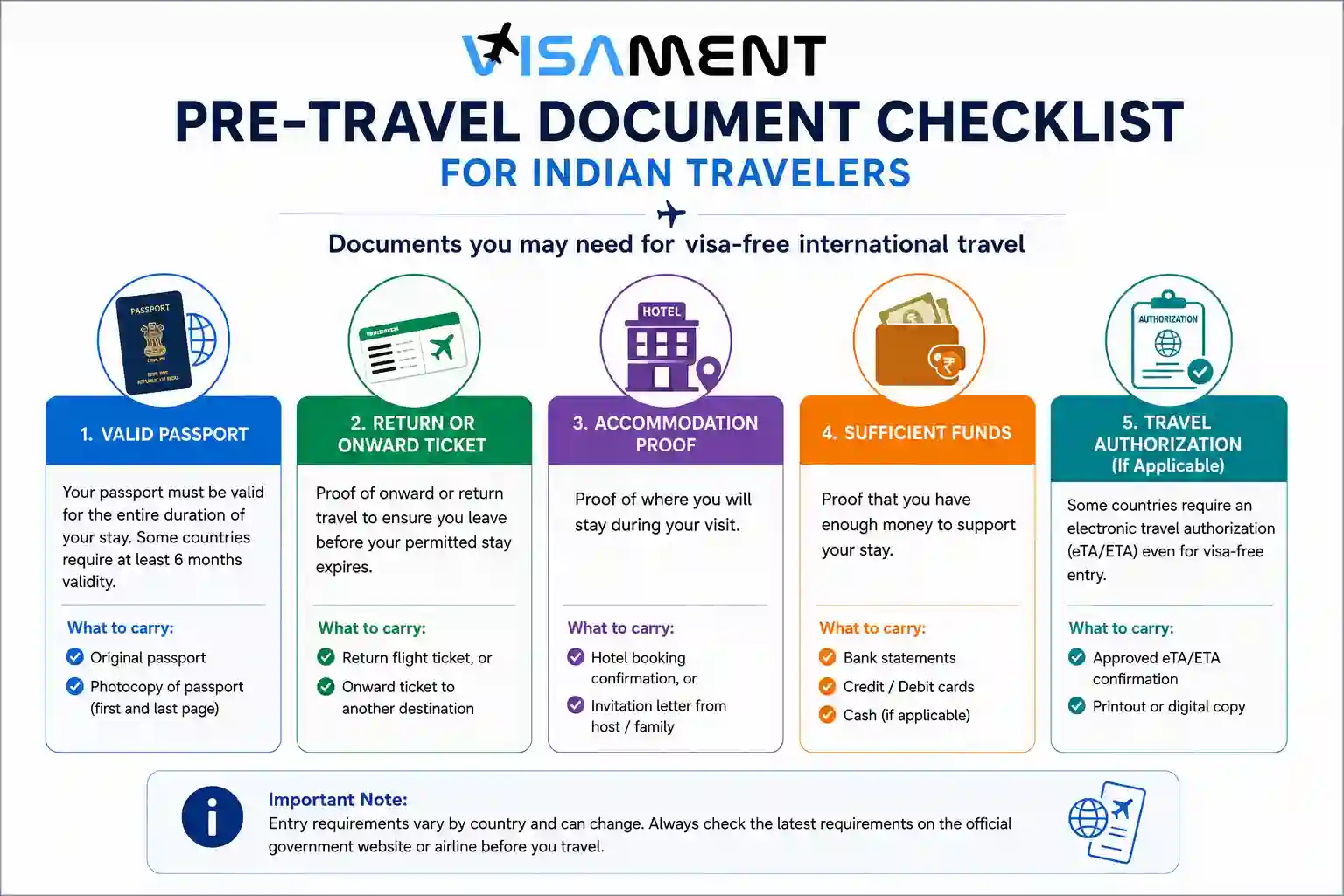
Depending on the destination, an Indian traveler may need:
The exact requirements depend on the destination. For example, Hong Kong requires Indian nationals using its visa-free arrangement to hold an Indian passport valid for at least six months and complete PAR before visiting or transiting, subject to stated exceptions.
The Philippines also illustrates why travelers should read the conditions rather than relying on a simple “visa-free” label. The MEA states that eligible Indian tourists can receive visa-free entry for 14 days subject to conditions including passport validity, confirmed accommodation, proof of financial capacity, and return or onward travel. A separate 30-day arrangement applies to Indian nationals holding qualifying visas or residence permits from specified countries.
There is no single visa-free stay period for Indian travelers. The permitted period is determined by the destination and may also depend on the purpose of travel and specific eligibility conditions.
For example, the current MEA list shows stays ranging from 14 days in Kazakhstan to 180 days in Dominica and Montserrat, while Nepal and Bhutan have different arrangements listed without a fixed numerical limit in the MEA table. Malaysia's 30-day visa-free facility is currently listed through December 31, 2026.
A traveler should therefore check three things before booking:
Whether the destination is actually visa-free for an Indian ordinary passport.
The maximum permitted stay.
Whether the permitted stay applies to the traveler's purpose and circumstances.
Do not assume that a visa-free entry can automatically be extended or converted into another immigration status.
Visa policies can change, so a third-party list should not be your final source before an international trip.
Use this verification process:
Step 1: Check the MEA visa-facility information.
The Ministry of External Affairs provides a useful starting point for identifying countries offering visa-free, visa-on-arrival, and eVisa facilities to Indian ordinary passport holders.
Step 2: Check the destination country's immigration authority.
Look for the official page covering visitors, entry requirements, visa exemptions or immigration rules.
Step 3: Check the destination's embassy or consulate in India.
This is particularly important when the country has special conditions for Indian passport holders.
Step 4: Check pre-travel registrations.
A destination may be visa-free but still require an online authorization or arrival form. Hong Kong's PAR requirement for Indian nationals is one example.
Step 5: Check transit requirements separately.
A traveler can be eligible to enter the final destination without a visa but still need a transit visa or authorization for a connecting country.
Step 6: Recheck shortly before departure.
Immigration policies can change after flights and accommodation have been booked.
The MEA itself advises Indian nationals to cross-check visa information with foreign embassies/consulates because the information can change and external-source data may not always remain current.
A visa exemption generally allows an eligible traveler to seek entry without obtaining a traditional visa, but the final admission decision remains subject to immigration requirements at the border.
An immigration officer may check the traveler's passport, purpose of travel, accommodation, onward or return travel and ability to meet applicable conditions.
Many destinations require a passport to remain valid for a specified period beyond the intended stay. The requirement is not universal, so check the destination's current rule rather than assuming six months applies everywhere.
Your final destination may be visa-free while your connecting airport is not. A traveler flying from India through another country must check whether the connection requires a transit visa or whether an applicable transit exemption exists.
Visa-free entry normally permits a defined period of stay. Remaining beyond that period can lead to immigration problems, penalties or difficulties with future travel.
Some destinations have additional eligibility requirements. Belarus, Kyrgyzstan, the Philippines and Seychelles, for example, have conditions or formalities that make their arrangements different from a completely unrestricted visa exemption.
The list of destinations and their conditions should be treated as date-sensitive information. A country can change its visa policy, permitted stay, or pre-arrival requirements after a travel article has been published.
For Indian passport holders, visa-free international travel can make planning a short overseas trip considerably simpler, but visa-free does not mean requirement-free. The permitted stay, passport validity, return-ticket requirements, financial conditions, and online authorizations can vary substantially between destinations.
The safest approach is to use the current MEA visa-facility information as a starting point and then verify the destination's official immigration rules before departure. If a country offers visa on arrival or an eVisa rather than genuine visa-free entry, treat that as a separate category when planning your trip.
As of 2026, Indian passport holders can travel to around 55–60 countries visa-free, visa-on-arrival, or with an eVisa facility, depending on the latest immigration policies.
The world’s strongest passport is currently the passport of Singapore, offering visa-free or visa-on-arrival access to the highest number of countries.
Serbia was one of the European countries that removed visa-free entry for Indian nationals in recent years.
No, the United Kingdom is not visa-free for Indian citizens. Indians need a valid UK visa before travelling.
For Indian travellers, Nepal is one of the most affordable international destinations because Indian citizens do not require a visa to enter the country. Along with zero visa costs, Nepal offers budget-friendly accommodation, transportation, and food, making it an excellent choice for cost-conscious travellers.
Indians can apply for an e-Visa by visiting the official visa website of their destination country, filling out the online application form, uploading the required documents, and paying the visa fee online. Once approved, the e-Visa is sent via email and can be presented digitally or as a printed copy during travel.
Yes. Visa-free eligibility does not guarantee admission. Travelers must still satisfy the destination's immigration and entry requirements.
Some do. The requirement depends on the destination. For example, the MEA specifically notes return-ticket requirements for certain visa-free arrangements, including Niue and Saint Vincent and the Grenadines.
Vipul Jain is the Co-Founder of Visament, a trusted platform dedicated to simplifying Indian immigration, consular, and NRI services for applicants across the globe. With extensive expertise in OCI cards, Indian passport services, visa assistance, apostille and document legalization,... See Full Bio

Talk to our documentation experts for free guidance on your application.


When you visit a website, it may store data about you using cookies and similar technologies. Cookies can be important for the basic operations of the website and for other purposes. You get the option of deactivating certain types of cookies, even so, doing that may affect your experience on the website.
It is required to permit the basic functionality of the website. You may not disable necessary cookies.
Used to provide advertising that matches you and your interests. May also be used to restrict the number of times you see an advertisement and estimate the effectiveness of an advertising campaign. The advertising networks place them after obtaining the operator's permission.
Permits the website to recognize the choices you make (like your username, language, or the region you are in). Also provides more personalized and enhanced features.
Aid the website operator to determine how the website performs, how visitors interact with the site, and whether there are any technical issues.