Related Blogs

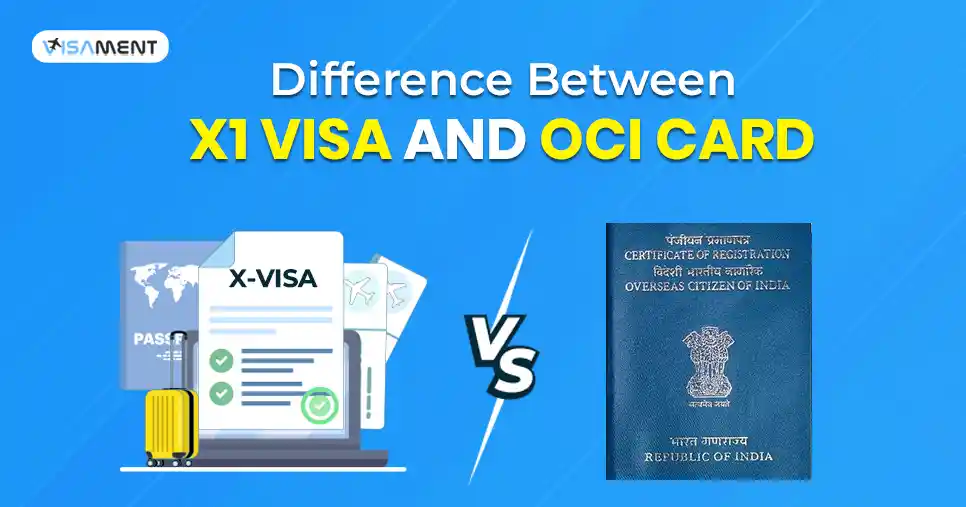
The X1 visa and OCI card both provide options for foreign nationals or persons of Indian origin to stay in India for an extended period, but their purposes are very different from each other. They come with different benefits and limitations.
In this blog, we have broken down the difference between the X1 visa and the OCI card. You can also understand their advantages and disadvantages. This blog will help you a lot in case you are confused about which one to choose.
An X1 Visa is a type of entry visa issued to foreign nationals by the Indian Government who want to stay in India for specific non-tourist purposes.
The X1 visa can be applied for in the following common use cases:
 Also Want to Know About X1 Visa Rejection Reasons and Fixes? Check Now!
The Overseas Citizen of India (OCI) Card is a lifelong visa. This immigration status is issued to the eligible foreign nationals of Indian Origin. It is granted by the Ministry of Home Affairs, and it provides multiple benefits to its Indian origin cardholders.
Here is the detailed comparison between the X1 Visa and the OCI card:
| Features | X1 Visa | OCI Card |
|---|---|---|
| Purpose | Issued for temporary stays, such as spouses or dependent family members | Designed for lifelong connection or long-term stay in India for people of Indian origin. |
| Registration Requirements | If staying more than 180 days, FRRO registration is mandatory | No registration needed, regardless of stay period |
| Validity | Usually valid for 6 months to 5 years (can be extended) | Lifetime Validity |
| Entry & Exit Flexibility | Restrictions, depending on issuance, usually require renewal | Unlimited multiple entries without the need for a visa |
| Work and Employment Rights | Not Permitted | Can work in most sectors except restricted areas |
| Financial and Economic Benefits | Limited advantages, treated as a foreign national | Parity with NRIs in:
|
| Cost | Generally lower cost | Higher fee (one-time) but long-term value |
| Citizenship Status | No pathway to Indian Citizenship | Not exact citizenship, but provides lifelong residency and privileges |
| Application Process |
|
|
Maria is a Spanish citizen, and she marries Raj, who is an Indian citizen. Now, she wants to move to India quickly, so she applied for an X1 visa through the Indian Government.
With the help of an X1 visa:
After some time, she becomes eligible for an OCI card. She applied for it through the Ministry of Home Affairs.
With the help of an OCI card:
| X1 Visa Advantages | OCI Card Advantages |
|---|---|
| The processing time of this visa is quick. | It has lifetime validity and provides multiple entries. |
| It is best for the short-term stay requirements. | There is no need for repeated visa applications. |
| The documentation process is also quite easy. | It provides many work and investment opportunities to its holders. |
| There are no requirements for registration. |
| X1 Visa Disadvantages | OCI Card Disadvantages |
|---|---|
| It grants a stay for a limited duration. | The processing time for this is longer. |
| It does not provide any employment rights. | The initial cost is higher. |
| It requires registration with FRRO. | It does not provide full Indian Citizenship. |
The selection between an X1 visa and an OCI card completely depends on your situation:
Both the X1 visa and OCI card have different purposes and are important. The X1 visa is best for short and dependent stays, while the OCI card is for longer stays for people of Indian origin who want to maintain strong bonds with India.
Before you choose the way to get entry in India, you should carefully evaluate the eligibility, long-term plans, and duration of stay. If you are eligible for an OCI card, then it is recommended to go for it as it is a better option. It provides a lifetime validity and so many benefits.
You may visit the official website of Visament for expert assistance if you need. They are professionals with many years of experience and can help you with better decision-making and its application.
Yes, you can apply for an OCI card while holding an X1 Visa in India, but you need to meet all the eligibility criteria and the required length of stay.
If you are eligible, then an OCI card is better than an X1 visa due to its advantages. The OCI card provides you with lifelong multiple entries to India, whereas the X1 visa is a long-term visa (up to 5 years) and requires renewals.
Generally, the X1 visa holders are not permitted to work in India. As per recent guidelines, they can apply for conversion to an Employment visa while being in India to work legally.
No, the OCI cardholders are not required to register with the FRRO authorities, regardless of how long they stay in India.
Vipul Jain is the Co-Founder of Visament, a trusted platform dedicated to simplifying Indian immigration, consular, and NRI services for applicants across the globe. With extensive expertise in OCI cards, Indian passport services, visa assistance, apostille and document legalization,... See Full Bio

Talk to our documentation experts for free guidance on your application.



When you visit a website, it may store data about you using cookies and similar technologies. Cookies can be important for the basic operations of the website and for other purposes. You get the option of deactivating certain types of cookies, even so, doing that may affect your experience on the website.
It is required to permit the basic functionality of the website. You may not disable necessary cookies.
Used to provide advertising that matches you and your interests. May also be used to restrict the number of times you see an advertisement and estimate the effectiveness of an advertising campaign. The advertising networks place them after obtaining the operator's permission.
Permits the website to recognize the choices you make (like your username, language, or the region you are in). Also provides more personalized and enhanced features.
Aid the website operator to determine how the website performs, how visitors interact with the site, and whether there are any technical issues.