Related Blogs

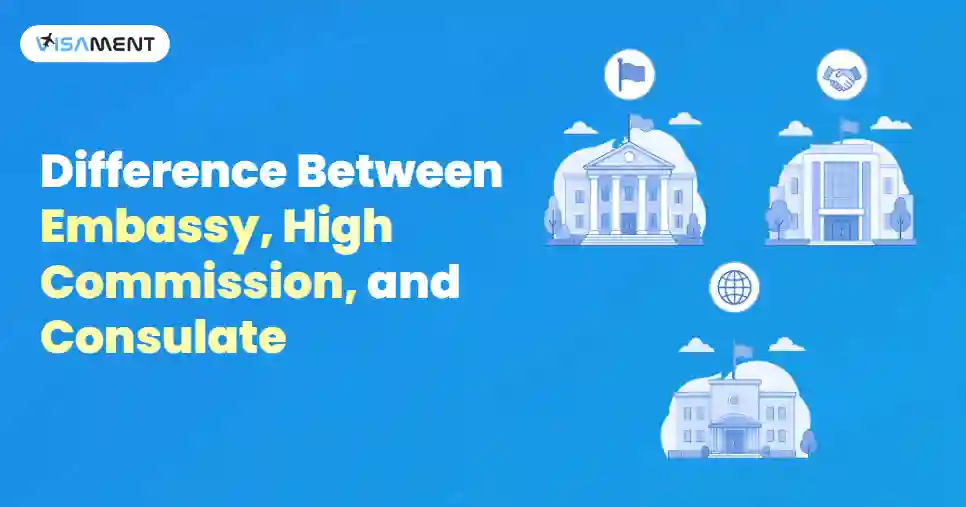
When you are dealing with consular, Immigration services, or any travel problem, you have heard the terms Embassy, High Commission, and Consulate. They are not all the same, all have different levels, purposes, responsibilities, and represent each country's interest in foreign.
Seeing the difference between Embassy, High Commission, and Consulate is important for students, businessmen, travellers, and Non-Residents Indian (NRIs). If you are applying for passport renewal, an OCI card, a visa, or need any foreign assistance, then knowing which office you need to call can save a lot of time, and also your application will be properly handled.
In this blog, we will see the difference between an embassy, a high commission, and a consulate, and see their roles differently, and help you to determine which is best for you according to your needs.
An embassy is the highest-ranking diplomatic mission in a country that is located in another nation. It acts as an official representative of the country's government and takes all responsibility for political, economic, and diplomatic relations with the host country.
These Embassies are generally located in the capital city, as it needs to work closely with the host country's central government and ministries. The Embassy has a had which is known as an Ambassador, who is the official representative of the country's head of state or government.
Along with this, it also helps in strengthening bilateral relations. Embassies also help to safeguard the interests of their citizen in foreign countries and promote investment and trade. They also make educational and cultural exchanges and help during emergencies.
As some of the Embassies also provide passport and visa services, and other consular functions that are handled by consulates situated in other cities.
A High Mission is a diplomatic mission which does the similar function to the embassy but only operates between the countries that are members of the Commonwealth of Nations. Rather than ambassadors, Commonwealth nations appoint High Commissioners to lead their diplomatic mission.
Let's understand it as an example: India has a High Commission in countries like the United Kingdom, Canada, Australia, Singapore, and New Zealand, while having embassies in countries like the United States of America, France, and Japan.
High Commissions also represent the home government and strengthen diplomatic relations, promote trade and investment, protect citizens in a foreign country, and take new initiatives for educational and cultural purposes. The minor difference between a High Commission vs Embassy is that a High Commission reflects historical ties with the Commonwealth nations.
A Consulate is a diplomatic entity established in major cities, excluding the host country’s capital. Unlike embassies and high commissions, consulates focus on delivering consular services instead of building diplomatic relationships.
This includes helping citizens with various needs such as renewing passports, applying for visas, providing Overseas Citizenship of India (OCI) and Person of Indian Origin (PIO) services, issuing Police Clearance Certificates (PCC), handling birth and marriage registrations, document attestation, and providing emergency travel help.
In addition to serving citizens, consulates actively support local businesses by promoting trade and investment opportunities within their regions. Most consulates operate under the supervision of either an embassy or a high commission, led by a Consul General or Consul, and their presence in regional centers promotes the availability of government services for citizens living outside the capital city.
Here is the table mentioned below that will help you to see the clear difference between Embassy, High Commission, and Consulate.
| Features | Embassy | High Commission | Consulate |
|---|---|---|---|
| Purpose | Represents the country abroad | Represents a Commonwealth country among Commonwealth nations in another country | Provides Regional Consular services |
| Head | Ambassador | High Commissioner | Consul General or Consul |
| Location | Capital city of country | Capital city of country | Cities outside the country capital |
| Primary function | Diplomacy and bilateral relations | Diplomacy among Commonwealth nations | Citizens' assistance and consular services |
| Reports to | Home Country Government | Home Country's Government | Embassy or High Commission |
| Services | Diplomatic affairs, Consular services, and Emergency Assistance | Same as Embassies with Consular oversight | Passport, OCI. Visa, PCC, Document attestation, or any emergency support |
| Countries | Non-Commonwealth Nations | Commonwealth Nations | Any country where regional offices are required. |
As embassies, high commissions, or consulates represent their home country in foreign countries, their responsibilities are different. Embassies and High Commissions are focused more on diplomacy and Government relations, as on the other side, Consulate primary focus is on providing citizens consular services.
The major difference between these diplomatic missions is in their primary functions and scope of jurisdiction. An embassy serves as the chief diplomatic mission between two countries, responsible for managing and nurturing official government relations. Similarly, a high commission operates similarly but is especially given to dealings between Commonwealth nations, highlighting their shared historical and diplomatic bonds.
On the other hand, a consulate provides a localized role, focusing more on practical help for citizens and foreigners, including processing passports, visas, and other consular services.
Leadership structures also can be different among these missions: Embassies are led by Ambassadors, High Commissions are governed by High Commissioners, and Consulates are led by Consul Generals or Consuls. Typically, embassies and high commissions are located in the capital cities of host countries, whereas consulates are positioned in major urban centers for improved accessibility.
Here are some of the major differences between an between consulate vs Embassy for passport renewal and visa applications:
As every diplomatic mission has different responsibilities, they work together to make the international relationship stronger and support the citizens in foreign countries.
The primary functions include:
Embassies, High Commissions, and consulates together provide a smooth diplomatic relationship and make the government services easily available to citizens.
The contact office is majorly depends on what type of service you are looking for.
If you are not sure about which office belongs to your jurisdiction, then you need to go to the official website and check for the country's embassy or high commission. There you will see the list of the relevant consulate for your region.
In summary, embassies, high commissions, and consulates represent important elements of a nation's diplomatic framework, each serving different purposes. Embassies and high commissions are primarily focused on maintaining governmental relationships and protecting national interests, while consulates provide everyday services to citizens and travelers.
Knowing these differences will help you identify the proper jurisdiction, whether it involves applying for a passport, getting emergency assistance, or dealing with official documentation in foreign countries. By contacting the correct diplomatic mission, you can have a smoother process and get quicker results when getting government services abroad.
An embassy is for managing diplomatic relations between governments, while a consulate provides consular services such as passports and visas.
High Commissions refer to diplomatic missions between Commonwealth countries, with functions that are closely similar to those of embassies.
Yes, consulates typically handle passport renewals and visa services, providing consular assistance within their jurisdiction.
An embassy is led by an Ambassador, a High Commission is led by a High Commissioner, and a Consulate by a Consul General or Consul.
Yes, both provide similar diplomatic and consular services; the major difference is that countries are members of the Commonwealth.
Generally, passport renewals should be submitted to the Consulate for your region or via an authorized service provider.
Vipul Jain is the Co-Founder of Visament, a trusted platform dedicated to simplifying Indian immigration, consular, and NRI services for applicants across the globe. With extensive expertise in OCI cards, Indian passport services, visa assistance, apostille and document legalization,... See Full Bio

Talk to our documentation experts for free guidance on your application.
How to Apply for a US Visitor Visa (B1/B2 Visa): Step-by-Step Guide
20 Most Common Reasons for Visa Rejection and What to Do Next
Visa Guide 2026: Types, Requirements & Application Process
Understanding US Visa Benefits: Types, Eligibility & Key Advantages
Documents Required for UK Visa Application: Complete Checklist


When you visit a website, it may store data about you using cookies and similar technologies. Cookies can be important for the basic operations of the website and for other purposes. You get the option of deactivating certain types of cookies, even so, doing that may affect your experience on the website.
It is required to permit the basic functionality of the website. You may not disable necessary cookies.
Used to provide advertising that matches you and your interests. May also be used to restrict the number of times you see an advertisement and estimate the effectiveness of an advertising campaign. The advertising networks place them after obtaining the operator's permission.
Permits the website to recognize the choices you make (like your username, language, or the region you are in). Also provides more personalized and enhanced features.
Aid the website operator to determine how the website performs, how visitors interact with the site, and whether there are any technical issues.