An Indian birth certificate can be an important document in an OCI application, but not having an Indian birth certificate does not automatically make you ineligible for an OCI Card. The documents you need depend on the basis of your OCI eligibility and whether you need to prove your own Indian origin or your relationship to an Indian parent, grandparent, or great-grandparent.
The Government of India's current OCI guidance allows several types of evidence to establish Indian origin, including an Indian passport, domicile or nativity certificate, certain OCI/PIO documents, and other supporting evidence. However, when OCI eligibility is based on an Indian ancestor, you must also establish the required family relationship.
Key Takeaways
- An Indian birth certificate is not the only possible evidence of Indian origin for an OCI application.
- The appropriate documents depend based on your OCI eligibility.
- If you are claiming OCI through an Indian parent, grandparent, or great-grandparent, you generally need evidence establishing both Indian origin and the family relationship.
- The OCI authorities specifically recognize documents such as an Indian passport, domicile certificate, nativity certificate, and certain OCI/PIO documents as evidence of Indian origin.
- A foreign-issued birth certificate can be used as relationship evidence in applicable cases, subject to authentication or apostille requirements.
- Requirements can differ depending on whether you are applying based on your own former Indian citizenship, Indian ancestry, a parent who is an Indian citizen, or a spouse relationship.
- Always check the current requirements before submitting your application because document requirements and procedures can change.
Is an Indian Birth Certificate Required for an OCI Card?
No, an Indian birth certificate is not universally required for every OCI application.
The current OCI guide lists different categories of supporting evidence depending on the applicant's circumstances. For proving Indian origin, the OCI authorities identify documents including a copy of an Indian passport, domicile certificate, nativity certificate, certain PIO/OCI documentation together with evidence of Indian origin, and other proof substantiating the claim.
The important distinction is between proving Indian origin and proving a family relationship.
For example, if you are a former Indian citizen applying for OCI based on your own Indian citizenship, your previous Indian passport and related citizenship documents may be central to your application.
If you are a foreign citizen claiming OCI through an Indian parent or grandparent, however, you may need documents that connect you to that person. In that situation, a birth certificate can be particularly important because it may establish the parent-child relationship.
Therefore, the absence of an Indian birth certificate does not by itself answer whether you qualify for OCI. The key question is what other acceptable documents establish your eligibility and, where necessary, your relationship to the Indian-origin person.
What Can I Use Instead of an Indian Birth Certificate?
The alternatives depend on the purpose for which the birth certificate would have been used.
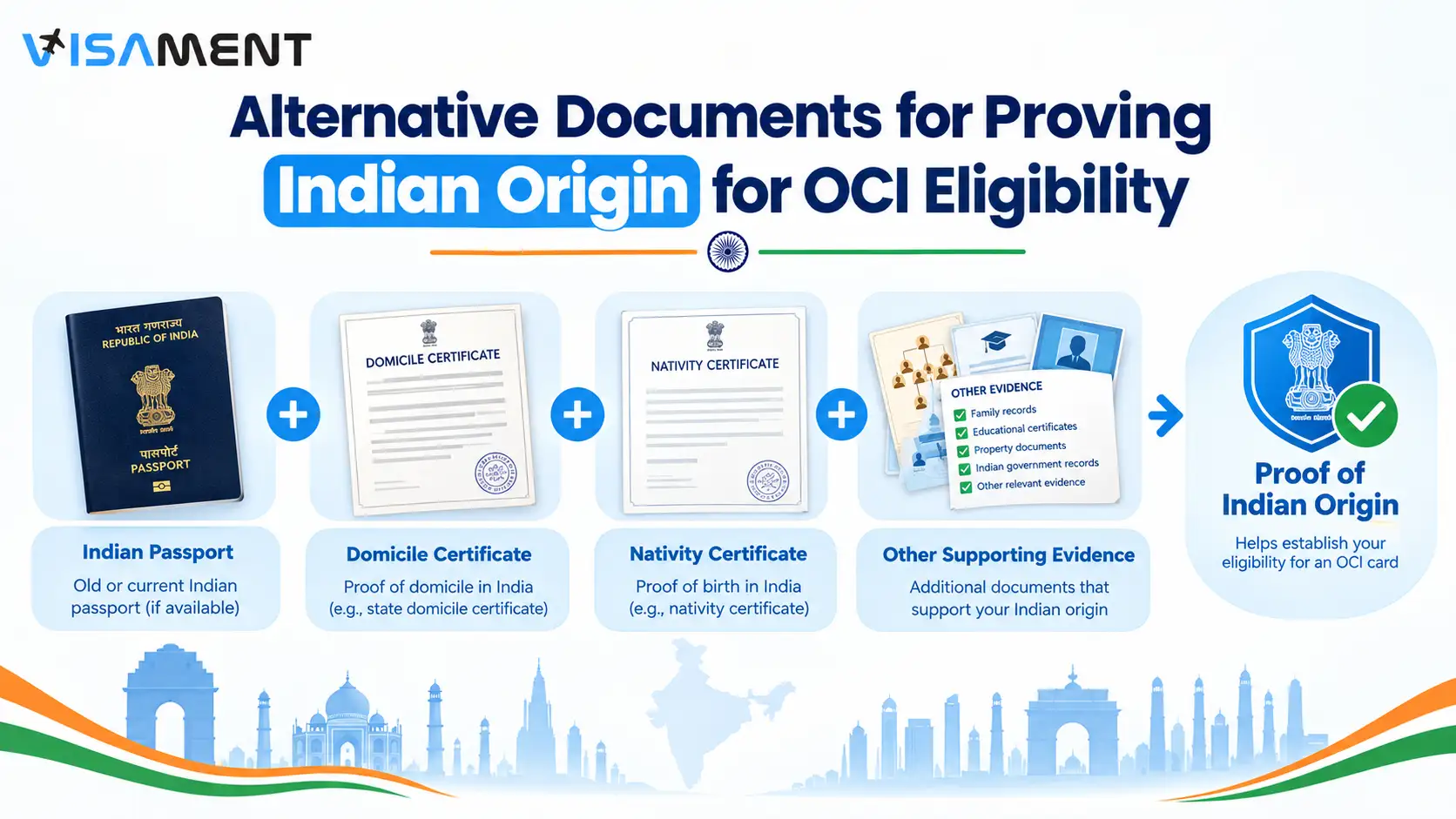
For evidence of Indian origin, the OCI authorities list several possibilities, including:
- Indian passport
- Domicile certificate issued by the competent authority
- Nativity certificate issued by the competent authority
- Parent's or spouse's PIO/OCI card together with documents proving Indian origin, where applicable
- Other evidence that substantiates the claim of Indian origin
The OCI also notes that applicants may, in appropriate circumstances, submit a certificate of residence or place of birth of themselves or their parents, grandparents, or great-grandparents from the First Class Magistrate or District Magistrate of the concerned place.
This means that an applicant should not assume that an unavailable Indian birth certificate automatically ends the OCI application process.
However, an alternative document is not necessarily interchangeable with a birth certificate in every situation. If the document is being used to prove a family relationship, the authorities may require evidence specifically establishing that relationship.
Get Expert Help for Your OCI Card Online Application!
Have questions? Our experts guide you through every step of the Online OCI Card Application – no confusion, no delays.
Consult an Expert Today What If I Am Applying for OCI Through My Indian Parent or Grandparent?
This is where the distinction becomes especially important.
If your OCI eligibility is based on an Indian parent, grandparent, or great-grandparent, the OCI authorities require evidence of that person's Indian origin and evidence of your relationship to that person.
For example, suppose your grandfather was an Indian citizen, and you are applying for OCI based on that ancestry. You would generally need a documentary chain that connects:
You → Your parent → Your grandfather
The exact documents will depend on your circumstances, but birth certificates and other official records can play an important role in establishing this chain.
The OCI specifically identifies a birth certificate issued by the competent authority and showing both parents' names as a relationship document. It also provides requirements concerning foreign-issued birth certificates.
What If My Foreign Birth Certificate Is Available?
If you were born outside India, you may have a foreign birth certificate rather than an Indian birth certificate.
That does not necessarily prevent you from applying for OCI.
The current OCI guidance states that when a birth certificate issued by a foreign country is used as relationship evidence, authentication requirements depend on whether that country is a party to the Hague Convention of 1961. For a Hague Convention country, an appropriately apostilled document may be accepted without further attestation or apostille by another authority. For a country that is not a Hague Convention signatory, additional authentication and re-attestation by the relevant Indian Mission may be required.
Therefore, applicants should not simply replace an unavailable Indian birth certificate with an unauthenticated foreign document and assume it will be accepted.
What If I Cannot Find My Birth Certificate?
If your birth certificate exists but you cannot locate it, consider obtaining an official replacement or certified copy from the relevant birth-registration authority before preparing the OCI application.
If an Indian birth record was never issued or cannot reasonably be obtained, the appropriate approach depends on why the document is required in your particular OCI case.
For example:
- If you are proving your own former Indian citizenship, your previous Indian passport and other citizenship evidence may be more relevant.
- If you are proving Indian ancestry, you may need documents establishing both Indian origin and your relationship to the Indian ancestor.
- If you are applying as the minor child of an Indian citizen, the OCI requirements specifically identify the child's birth certificate, parents' marriage certificate, and evidence of the Indian citizenship of one or both parents.
- If you are applying on the basis of an Indian spouse, the documentation is different and focuses on the registered marriage and the relevant citizenship or OCI documentation.
This is why using a generic “OCI document checklist” without considering your eligibility category can lead to missing documents.
OCI Documents Depend on Your Eligibility Category
There is no single document that proves eligibility for every OCI applicant.
The current OCI framework recognizes several eligibility routes. These include certain former Indian citizens, children/grandchildren/great-grandchildren of qualifying Indian citizens, certain minor children of Indian citizens or eligible persons, and eligible foreign-origin spouses of Indian citizens or OCI Cardholders subject to the applicable conditions.
Your document checklist should therefore be built around your specific route.
| OCI eligibility situation |
Main documentation issue |
| Former Indian citizen |
Evidence of previous Indian citizenship and current foreign citizenship |
| Indian parent |
Evidence of the parent's Indian citizenship and the parent-child relationship |
| Indian grandparent/great-grandparent |
Evidence of Indian origin and the chain of relationship |
| Minor child of an Indian citizen |
Child's birth and parent/citizenship documentation |
| Foreign-origin spouse |
Registered marriage and relevant spouse documentation |
The table is a general guide, not a substitute for the current official document requirements.
Do I Need to Prove My Indian Origin?
Yes, if Indian origin is the basis of your OCI application, you need evidence supporting that claim.
The OCI authorities specifically list an Indian passport, domicile certificate, nativity certificate, qualifying PIO/OCI documentation with supporting evidence, and other proof substantiating Indian origin.
The strongest document will depend on your circumstances.
For instance, someone who previously held an Indian passport may have a straightforward documentary route to demonstrating former Indian citizenship. Someone whose eligibility comes through a great-grandparent may need a much longer documentary chain connecting the applicant to the qualifying ancestor.
Can a Foreign Birth Certificate Be Used for OCI?
Yes, a foreign-issued birth certificate can be relevant to an OCI application, particularly when it is being used to establish a family relationship.
The current OCI guidelines provide specific rules for foreign birth certificates used as relationship evidence. If the issuing country is a Hague Convention signatory, an appropriately apostilled birth certificate may be accepted without additional attestation or apostille by another authority. If the country is not a Hague Convention signatory, the document may require authentication in the issuing country followed by re-attestation by the relevant Indian Mission or Foreign Mission, as specified by the OCI guidance.
Applicants should also make sure that names, dates of birth, and parent information are consistent across the documents. Differences in names or other personal details can create additional document-verification issues.
What Other Documents May Help Prove Indian Origin?
Depending on the circumstances, useful evidence may include:
Indian Passport
A previous Indian passport can be particularly important for applicants who were previously Indian citizens. The current OCI document list requires a cancelled or surrendered Indian passport with a Surrender Certificate for applicants who surrendered their Indian passport in or after 2010.
Domicile Certificate
The OCI identifies a domicile certificate issued by the competent authority as one form of evidence of Indian origin.
Nativity Certificate
A nativity certificate from the competent authority may also be used as evidence of Indian origin.
Parent or Grandparent Documents
When eligibility is based on an ancestor, documents belonging to the parent or grandparent may help establish the ancestor's Indian origin. However, you also need to establish the relationship between yourself and that person.
Other Supporting Evidence
The OCI authorities allow other proof substantiating the request in appropriate circumstances. The acceptability of such evidence depends on the individual case and the applicable requirements.
What If My Documents Have Different Names?
Name discrepancies deserve particular attention.
For example, your current passport might show:
Michael Raj Sharma
while an older Indian document might show:
Raj Kumar Sharma
A difference like this can make it harder to establish that two documents refer to the same person.
If your name changed because of marriage, legal name change, spelling differences, or another reason, supporting documentation may be necessary to establish the connection between the records.
Do not assume that an officer will automatically treat documents with materially different names as belonging to the same person.
What About OCI Applications for Children?
Children have additional document considerations.
For a minor child whose parents are Indian citizens or where one parent is an Indian citizen, the current OCI lists the child's birth certificate, parents' marriage certificate (or an explanation where a marriage certificate is unavailable), and the Indian passport, domicile certificate, nativity certificate, or other evidence establishing the Indian citizenship of the relevant parent or parents.
This means that for a child's OCI application, the child's birth certificate can be especially important because it helps establish the relationship with the parent.
If you are applying for an OCI Card for a child and do not have the child's birth certificate, you should verify the current requirements with the relevant Indian Mission/Post before submitting the application rather than assuming that an alternative document will automatically be accepted.
How to Handle an OCI Application Without an Indian Birth Certificate
If you do not have an Indian birth certificate, follow a document-first approach:
- Identify your OCI eligibility category. Determine whether you qualify through your own former Indian citizenship, an Indian parent/ancestor, a parent who is an Indian citizen, or another qualifying route.
- Determine why the birth certificate is being requested. Is it intended to prove Indian origin, your date/place of birth, or your relationship to an Indian parent or ancestor?
- Collect alternative evidence where permitted. Depending on your case, this may include an Indian passport, domicile certificate, nativity certificate, or other evidence of Indian origin.
- Build the relationship chain if claiming ancestry. Make sure the documents connect you to the qualifying Indian parent, grandparent, or great-grandparent.
- Authenticate foreign documents when required. Follow the applicable apostille or attestation requirements for foreign-issued documents.
- Check the current OCI document requirements before submission. Applications are submitted through the official online OCI system, and the relevant Indian Mission/Post or FRRO handles document verification according to the applicant's circumstances.
Common Mistakes to Avoid
Assuming an Indian birth certificate is mandatory for everyone
OCI documentation varies according to the applicant's eligibility route. Do not assume that one document applies identically to every applicant.
Providing Indian-origin evidence without proving the relationship
If your OCI claim depends on a grandparent, proving that the grandparent was Indian is only part of the process. You may also need documentation connecting you to that grandparent.
Ignoring apostille requirements
A foreign-issued document may require an apostille or other authentication depending on the issuing country's status and the document's intended use.
Using inconsistent personal information
Differences in names, dates, or other details across passports, birth certificates, marriage certificates, and ancestry documents can complicate verification.
Relying on an old checklist
OCI requirements can change. Always verify the current requirements through the official OCI portal and the Indian Mission/Post responsible for your application.
Conclusion
You may be able to get an OCI Card without an Indian birth certificate. The most important factor is whether you can provide other acceptable evidence establishing your OCI eligibility.
If you are applying based on Indian ancestry, pay particular attention to two separate requirements: proof of Indian origin and proof of your relationship to the Indian parent or ancestor. A foreign birth certificate may be relevant for the relationship requirement, while documents such as an Indian passport, domicile certificate, or nativity certificate may help establish Indian origin.
Because OCI documentation is case-specific, review the current requirements on the official OCI Services portal before submitting your application.