Related Blogs

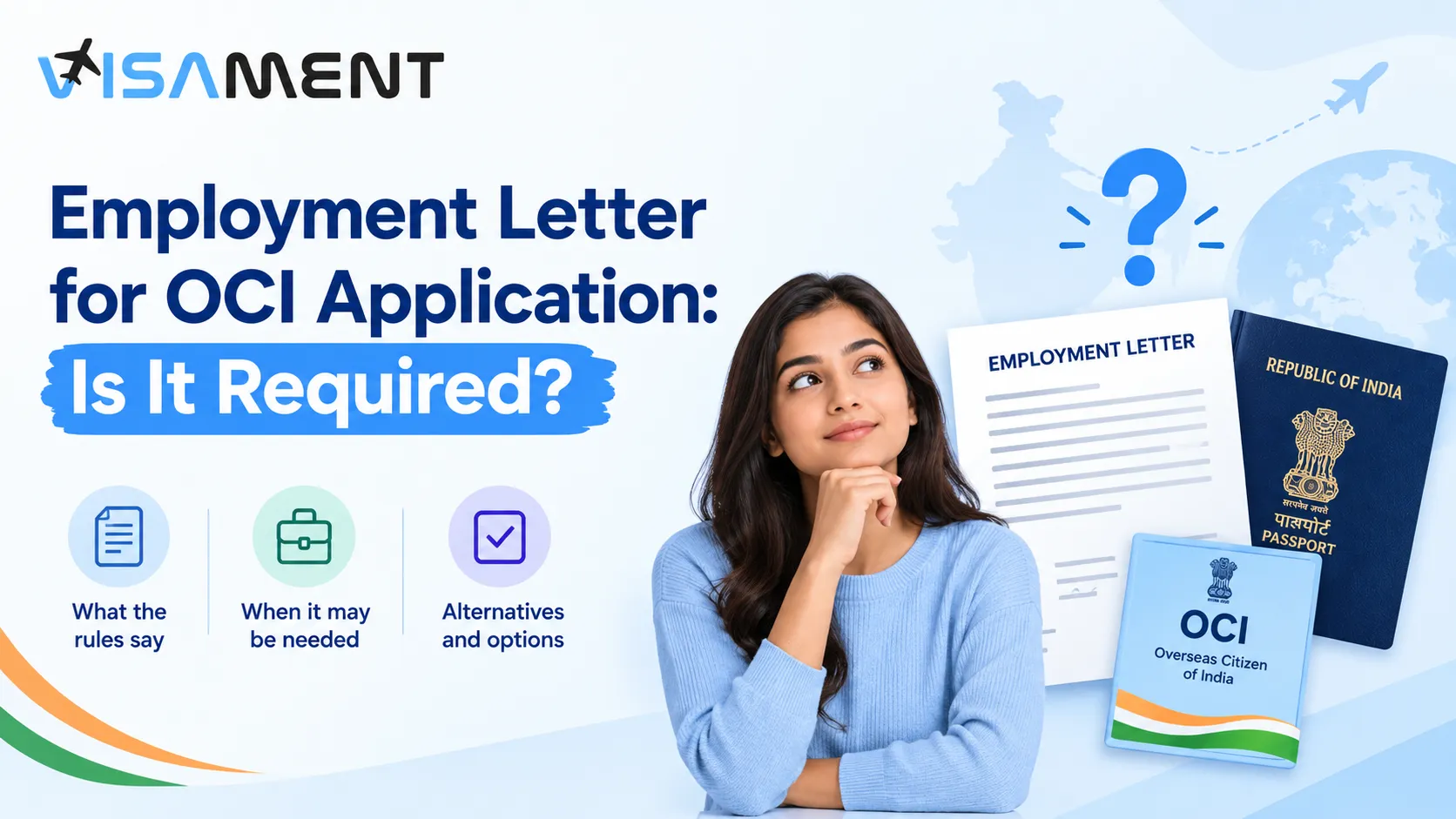
If you are preparing an employment letter for an OCI application, you may be wondering whether the document is actually mandatory and what information it should contain. The current official OCI document list does not identify an employment letter as a universal supporting document for every OCI registration application. However, occupation details form part of the OCI documentation framework, and a particular Indian Mission, Post, or FRRO may request additional evidence in an individual case.
If employment or occupation proof has been specifically requested, the safest approach is to provide an accurate, current document that clearly verifies your employment and matches the information in your application and passport.
No, an employment letter is not a standard mandatory document for every OCI registration application. The Government of India's current OCI FAQ lists supporting-document categories such as proof of present citizenship, address, Indian origin, and relationship where applicable; an employment letter is not included as a universal requirement in that list.
This distinction is important because the OCI application also collects occupation-related information. The official application rules include fields for the applicant's specific field of work, employer's address, employer's contact number, and, where applicable, the department or organization from which an applicant retired.
Therefore, providing occupation information does not automatically mean that every applicant must upload an employment letter.
If your particular application checklist, Indian Mission/Post, or FRRO specifically asks for employment or occupation proof, however, you should treat that request seriously and provide the document requested or confirm which alternative evidence is acceptable.
An employment document may be requested when additional evidence is needed to verify information provided in an application or when the relevant authority's document instructions call for it.
There is also an important distinction between a new OCI registration and an update to an existing OCI card. The OCI Miscellaneous Services guidance specifically includes a change of occupation among the services available to registered OCI cardholders and states that sufficient proof should be provided for requested changes such as occupation.
You may therefore encounter an employment or occupation document request because:
The applicable authority's current instructions should take priority over a generic employment-letter format found online.
If an employment letter has been specifically requested, it should be a clear, professional document that allows the receiving authority to verify your employment.
A practical employment letter can include:
| Information | What to include |
|---|---|
| Applicant's name | Full name matching the passport and OCI application |
| Employer | Legal/company name and contact information |
| Job title | Current position or role |
| Employment status | For example, current full-time or part-time employment, if applicable |
| Employment start date | Date employment began, if relevant to the request |
| Current employment | Confirmation that the applicant is currently employed |
| Employer address | Current business address |
| Authorized representative | Name and position of the person signing the letter |
| Date of issue | Date the employment letter was prepared |
| Signature | Signature of an authorized employer representative |
Company letterhead is advisable when available because it helps identify the employer and provides a professional means of verification. The letter should also contain genuine contact information so the employer can be identified if verification is required.
Do not add unnecessary personal or financial information simply because it appears in an online template. The document should contain information relevant to verifying employment and should follow any specific instructions issued by the authority requesting it.
An employment letter is only one possible form of employment evidence. Depending on the specific request, an authority may ask for or accept another official document, but there is no universal rule that every alternative document will be accepted for every OCI application.
Potential employment-related records can include:
These documents should be used only when they satisfy the applicable instructions. Do not assume that a payslip automatically replaces an employment letter.
If the authority specifically asks for an employment letter and your employer cannot provide one, contact the relevant Indian Mission/Post or FRRO before submitting a substitute. This is safer than uploading a document that may not satisfy the request.
Also check that the information is consistent across your documents. Differences in your name, employer, position, or employment status can create unnecessary questions during document verification.
For a salaried employee, an employer-issued letter is generally the most straightforward way to confirm current employment if such evidence has been requested. Ask HR or an authorized manager for a current letter containing accurate employment details.
A self-employed person may not have a conventional employer. If occupation proof is requested, relevant business or professional records may be appropriate, but the exact evidence should be confirmed with the authority handling the application.
An unemployed applicant should accurately report their current status. Do not create or submit an employment letter for a job that does not exist. Employment status is separate from the evidence used to establish eligibility for OCI registration.
A retired applicant should not submit a current employment letter merely to satisfy a perceived requirement. The official OCI application framework specifically provides for occupation information and asks retired applicants, where applicable, to identify the department, office, or organization from which they retired.
A student or minor may not have current employment. An employment letter should not be treated as a universal requirement simply because the applicant is applying for OCI. The relevant applicant category and current instructions determine what supporting documents are needed.
An employment letter does not establish Indian origin for OCI eligibility.
These documents serve different purposes:
| Document | Main purpose |
|---|---|
| Employment letter | Confirms employment or occupation information |
| Indian passport or other origin evidence | Helps establish the applicant's Indian-origin basis for OCI registration |
| Birth certificate | May establish relationships relevant to an Indian-origin claim |
| Foreign passport | Establishes present citizenship |
| Address proof | Establishes the address/place of application |
The official OCI FAQ separately identifies proof of present citizenship, evidence of Indian origin, relationship evidence, and address evidence among the supporting documents for registration.
Consequently, an applicant should not use an employment letter as a replacement for documents establishing eligibility or Indian ancestry.
If the Indian Mission, Post, or FRRO specifically asks you for employment proof, take the following steps:
For applicants outside India, the relevant Indian Mission/Post generally depends on the applicant's citizenship or, where the applicant lives in a country other than their citizenship country, their ordinary residence. Applicants residing in India submit originals to the jurisdictional FRRO.
Employment documentation can become more directly relevant when an existing OCI cardholder changes occupation.
The Government of India's OCI Miscellaneous Services guidance includes change of address/occupation among the services available to registered OCI cardholders. For changes to personal particulars, the guidance states that relevant documents and sufficient proof for the requested change, including occupation, should be furnished.
This is different from saying that every first-time OCI applicant must submit an employment letter.
For an occupation update, follow the current OCI Miscellaneous Services instructions and provide the supporting evidence required for the particular change. After online submission, applicants are required to present original supporting documents to the concerned Indian Mission/Post or FRRO for prior verification.
If employment proof is requested, avoid these common problems:
An employment letter for an OCI application is not a universal requirement for every applicant. The current official OCI document list focuses on evidence such as present citizenship, address, Indian origin, and qualifying relationships, while occupation information is separately part of the application framework.
If an Indian Mission, Post, or FRRO specifically asks for employment proof, provide an accurate and current document that clearly verifies your employment and follows the authority's instructions. Most importantly, do not use an employment letter as a substitute for documents that establish your OCI eligibility or Indian origin.
Because OCI requirements and local submission instructions can change, verify the latest requirements with the relevant Indian Mission/Post or FRRO before submitting your documents.
An employment letter is not identified as a universal supporting document for every OCI registration application in the current official OCI FAQ. If the relevant Indian Mission/Post or FRRO specifically requests employment proof, follow its current instructions.
If specifically requested, the letter should clearly identify the applicant and employer and confirm relevant employment details such as the current position and employment status. Including the employer's contact information, date of issue, and an authorized signature can help make the document clear and verifiable.
A payslip may provide evidence of employment, but applicants should not assume that it is automatically accepted as a substitute for an employment letter. Confirm the acceptable document type with the authority handling the application.
No. Employment evidence is separate from documents used to establish present citizenship, Indian origin, relationship, or another qualifying basis for OCI registration.
Not automatically. Applicants should accurately state their current circumstances and follow any specific request for occupation or employment evidence. A person who is unemployed or retired should not submit a document falsely showing current employment.
The OCI Miscellaneous Services guidance states that sufficient proof should be furnished for requested changes such as occupation.
Vipul Jain is the Co-Founder of Visament, a trusted platform dedicated to simplifying Indian immigration, consular, and NRI services for applicants across the globe. With extensive expertise in OCI cards, Indian passport services, visa assistance, apostille and document legalization,... See Full Bio

Talk to our documentation experts for free guidance on your application.
Documents Required for OCI Miscellaneous Services: Complete Checklist
Common Issues Faced by OCI Cardholders After the e-OCI Launch
OCI Application Number Not Found: Why It Happens and How to Fix It?
What to Do If Old Passport Details are Showing After OCI Updation?
How to Self-Attest Documents for OCI: Step-by-Step Guide


When you visit a website, it may store data about you using cookies and similar technologies. Cookies can be important for the basic operations of the website and for other purposes. You get the option of deactivating certain types of cookies, even so, doing that may affect your experience on the website.
It is required to permit the basic functionality of the website. You may not disable necessary cookies.
Used to provide advertising that matches you and your interests. May also be used to restrict the number of times you see an advertisement and estimate the effectiveness of an advertising campaign. The advertising networks place them after obtaining the operator's permission.
Permits the website to recognize the choices you make (like your username, language, or the region you are in). Also provides more personalized and enhanced features.
Aid the website operator to determine how the website performs, how visitors interact with the site, and whether there are any technical issues.