Related Blogs

If you are applying for a PAN and are unsure what to enter under Area Code, AO Type, Range Code and AO Number, the AO Code is the information you need to identify. An AO Code connects a PAN holder with the relevant tax jurisdiction and Assessing Officer. The current PAN application framework continues to include these four AO Code fields.
The important point is that you should not select an AO Code simply because the city name looks familiar. The correct code depends on the applicable jurisdiction and the applicant's circumstances. This guide explains the four parts of an AO Code, how to find the appropriate code, and how existing PAN holders can check their current jurisdiction.
AO Code for PAN card Through UTIITSL Portal
AO Code for PAN card Through Income Tax Website
AO Code for PAN card Through Proteantech (NSDL) Website
An AO Code is a combination of four fields used to identify the jurisdictional Assessing Officer for PAN-related purposes: Area Code, AO Type, Range Code, and AO Number. The Income Tax Department's current PAN form specifically provides a section for these four details.
AO stands for Assessing Officer. The Income Tax Department describes an AO as an officer responsible for matters relating to taxpayers within the officer's jurisdiction. Tax jurisdictions are organized into areas such as wards and circles, each having a jurisdictional AO.
When completing a new PAN application, the applicant therefore needs to identify the jurisdiction that applies to them rather than randomly selecting a code from a list.
An AO Code is made up of four separate fields:
| AO Code component | What it represents |
|---|---|
| Area Code | Identifies the geographical or jurisdictional area represented by the code |
| AO Type | Identifies the applicable type of Assessing Officer/jurisdiction |
| Range Code | Identifies the relevant range or jurisdictional grouping |
| AO Number | Identifies the specific AO within the applicable structure |
These four values work together to identify the applicable jurisdiction. They should be entered exactly as required by the current PAN application or official AO Code information.
The Area Code is the location-related component of the AO Code. It is not necessarily enough to know only your city; the applicable jurisdiction may depend on the precise jurisdictional classification.
The AO Type is another part of the jurisdiction identifier. Different applicant categories or jurisdictional arrangements can use different AO types.
The Range Code identifies the relevant range within the tax jurisdiction. This is one reason why several AO Codes can appear for the same city or broad geographical area.
The AO Number identifies the particular Assessing Officer or jurisdiction within the selected structure.
The four fields should be treated as one complete jurisdictional code rather than four unrelated pieces of information.
The AO Code helps associate a PAN holder with the appropriate income-tax jurisdiction. The current PAN application form includes Part D: Assessing Officer (AO Code) with separate fields for Area Code, AO Type, Range Code, and AO Number.
This does not mean that the AO Code itself determines which tax rate applies to you. Tax liability is governed by the applicable tax law and the taxpayer's circumstances. The AO Code is primarily a jurisdictional identifier.
Have questions? Our experts guide you through every step of the PAN Card Services– no confusion, no delays.
Consult an Expert TodayFinding an AO Code is easier when you approach it as a jurisdiction-matching exercise rather than a simple city search.
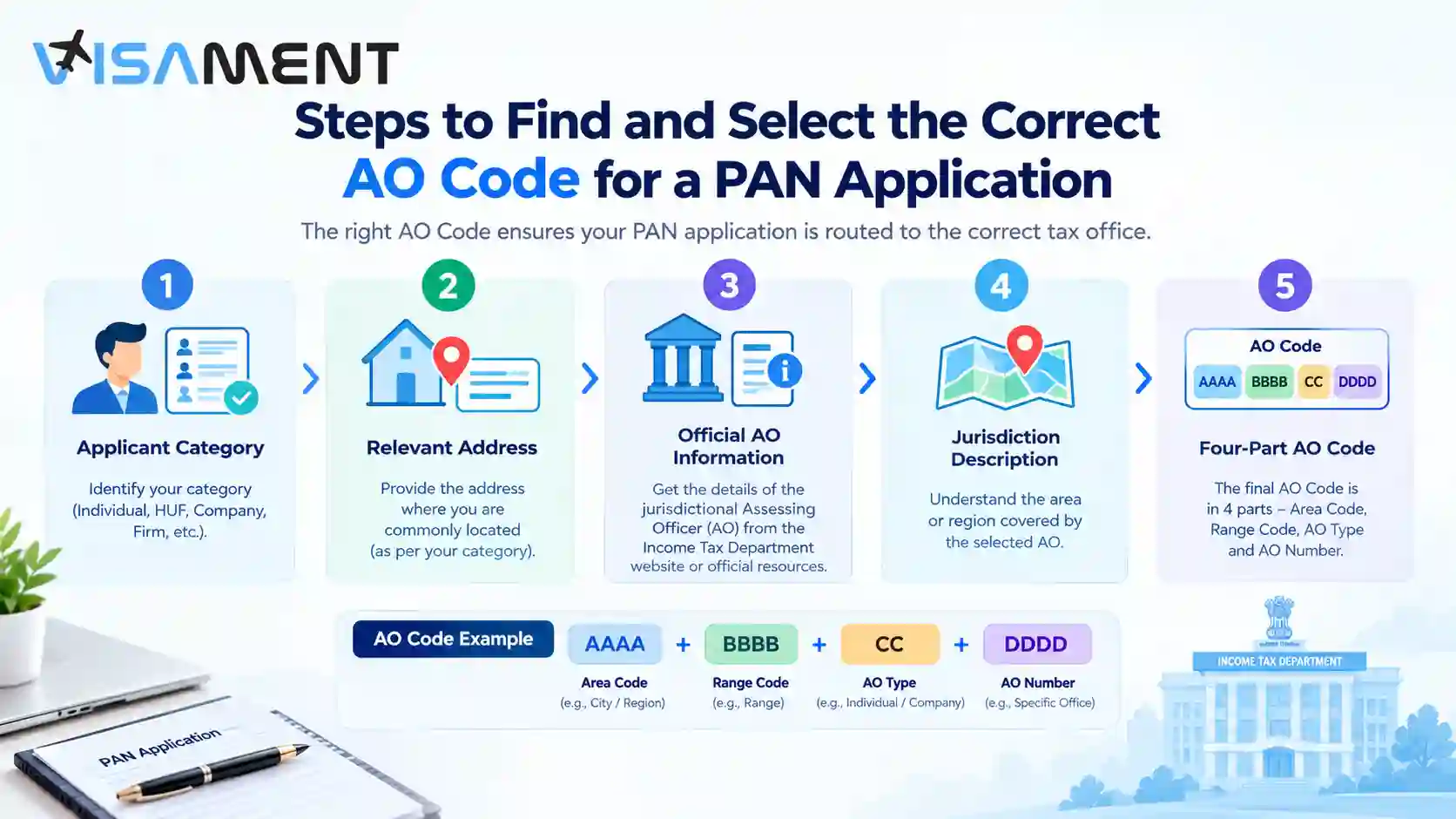
Start by determining what type of applicant you are. An individual, company, firm, trust, HUF, LLP, or other entity may have different jurisdictional considerations.
Do not assume that every PAN applicant in the same city should use the same AO Code.
Your applicable address and circumstances can affect the jurisdiction. For an individual, the relevant address may depend on the individual's income situation and the information required by the current PAN application instructions.
For non-individual applicants, the business or office address can be particularly important.
The safest approach is to follow the current instructions associated with the PAN application rather than relying on an old article or static code list.
For a new PAN application, use the current AO Code information provided through the authorized PAN application process.
Avoid relying on old spreadsheets, copied city-wise lists, or pages that have not been updated. Jurisdictional information can change, and an old code may no longer reflect the current arrangement.
If several AO Codes appear for your city, compare the jurisdiction description, not just the city name.
Look for information that matches your applicable address, applicant type, and other relevant classification. Selecting the first code in a list simply because it contains your city is not a reliable method.
Once you have identified the applicable jurisdiction, record all four components:
Area Code + AO Type + Range Code + AO Number
Check each field before submitting the PAN application.
If you already have a valid PAN, you do not need to guess your jurisdiction from an old PAN application.
The Income Tax Department provides a Know Your AO service on the e-Filing portal. It is available to registered and unregistered users with a valid PAN, and login is not required. You need your PAN and a valid mobile number for the service.
The process is:
The service can display the Area Code, AO Type, Range Code, AO Number, jurisdiction, address, and email ID of the JAO, along with the PAN card status.
This is particularly useful if you already have a PAN and want to confirm the jurisdiction currently associated with it.
Seeing multiple AO Codes for the same city is not necessarily an error. A large city can contain multiple income-tax jurisdictions, wards, or ranges.
Do not choose a code solely because the city matches.
Instead, compare the jurisdiction descriptions with your applicable address and taxpayer category. If the correct jurisdiction is still unclear, use the official Income Tax Department information or seek appropriate professional assistance rather than guessing.
A static city-wise table can also become outdated. For this reason, the current official jurisdiction information should take priority over an old list published elsewhere.
NRIs and foreign applicants require particular care because they may fall under International Taxation jurisdiction depending on their circumstances.
For foreign citizens applying for PAN, current Protean guidance states that the AO Code pertaining to the International Taxation Directorate should be used. The same guidance also provides instructions for applicants who do not know the appropriate code. Because jurisdiction and application procedures can change, foreign applicants should verify the current instructions before submitting an application.
This section should not be treated as a substitute for a complete NRI PAN application guide. If you are an NRI or foreign citizen, check the current PAN application requirements applicable to your specific situation.
| PAN | AO Code |
|---|---|
| Identifies the taxpayer's permanent account | Identifies the applicable tax jurisdiction/Assessing Officer |
| Issued as the taxpayer's PAN identifier | Consists of Area Code, AO Type, Range Code and AO Number |
| Remains associated with the taxpayer | Jurisdictional details can change |
| Used broadly for tax and financial identification | Used to identify the relevant tax jurisdiction |
An AO Code is not your PAN number. The two serve different purposes.
Yes. Your jurisdictional AO details can change when the applicable jurisdiction changes. The Income Tax Department's current guidance provides a process for transferring a PAN to a new jurisdictional AO, including where an address change results in a different jurisdiction.
Existing PAN holders can use Know Your AO to check their current jurisdiction rather than relying on an older PAN document or previously published AO Code list.
When selecting an AO Code, avoid these common mistakes:
The correct AO Code for PAN is a jurisdictional identifier made up of the Area Code, AO Type, Range Code, and AO Number. The main challenge is not memorizing these four fields but identifying the jurisdiction that actually applies to you.
For a new PAN application, use current official AO information and carefully match the jurisdiction description to your circumstances. If you already have a PAN, the Income Tax Department's Know Your AO service provides a direct way to check your current Area Code, AO Type, Range Code, AO Number, and jurisdiction.
Because AO information can change, current official sources should always take priority over outdated city-wise lists.
Every highlighted city has a unique default code. It depends on the PIN code, type of assessee, or region. However, the default AO code for the city to which the ITR belongs is for the Applicant to file ITR returns, and is mentioned by the ward, circle, and range details, which are often unknown to the applicant.
To change your AO code, you need to write an application to the Assessing Officer and submit it to the AO officer.
You can find your AO code online through the NSDL portal, UTIITSL website, and Income Tax e-filing website. Here is the simple process to find your AO code through the NSDL PAN portal. You need to go to the NSDL website and search for the AO code, select your city of residency, then see the list of AO codes according to your present city, select the appropriate AO code according to the above details, and click on the 'submit' button.
There is no AO code for students and non-employed persons on a PAN card.
To check the AO code for PAN, you need to follow the given steps: first, you need to go to the NSDL (National Securities Depository Limited) website and look for an AO code, then select your city in the list of codes, and go to the additional description and select your region that is part of AO code, then determine the AO code as in indiviual or as a company or organzation, and after choosimng the correct AO code click on the 'Submit' button.
To verify whether your PAN is active or not, you need to visit the official e-filing portal of the Income Tax website, click on the 'Verify PAN ', then enter your PAN number, full name, date of birth, mobile number, and click on continue. After receiving a 6-digit OTP on your registered mobile number, enter the OTP and click 'Validate'. You can then view the status of your PAN card, indicating whether it is operative or not.
Yes, you are eligible to change your AO code if your jurisdiction changes. It happens when you change your office address or residence. You can easily apply to change the AO code by submitting an application to your current AO.
You can check your AO code for a PAN card online by visiting the websites of NSDL, UTIITSL, or the Income Tax e-Filing. You need to look for the 'Know Your AO' or 'Search For AO Code' option.
In the AO Code, W stands for Ward and C represents Circle.
All the individuals who are not employed are required to choose a salary below a certain amount and keep the AO section blank in their PAN card applications.
The highlighted record in each city is considered the default AO code for that particular city. Some of the cities have multiple default AO codes for new assessees, depending on the PIN code, region, the type of assessee, etc. The default AO code of the city where the applicant files or intends to file the TDS return can be mentioned by the applicant who is not aware of his Ward, Circle, Range, or Commissioner details.
Students don't have any AO code, and they are not required to enter the AO code in the PAN card applications.
Vipul Jain is the Co-Founder of Visament, a trusted platform dedicated to simplifying Indian immigration, consular, and NRI services for applicants across the globe. With extensive expertise in OCI cards, Indian passport services, visa assistance, apostille and document legalization,... See Full Bio

Talk to our documentation experts for free guidance on your application.


When you visit a website, it may store data about you using cookies and similar technologies. Cookies can be important for the basic operations of the website and for other purposes. You get the option of deactivating certain types of cookies, even so, doing that may affect your experience on the website.
It is required to permit the basic functionality of the website. You may not disable necessary cookies.
Used to provide advertising that matches you and your interests. May also be used to restrict the number of times you see an advertisement and estimate the effectiveness of an advertising campaign. The advertising networks place them after obtaining the operator's permission.
Permits the website to recognize the choices you make (like your username, language, or the region you are in). Also provides more personalized and enhanced features.
Aid the website operator to determine how the website performs, how visitors interact with the site, and whether there are any technical issues.