Related Blogs

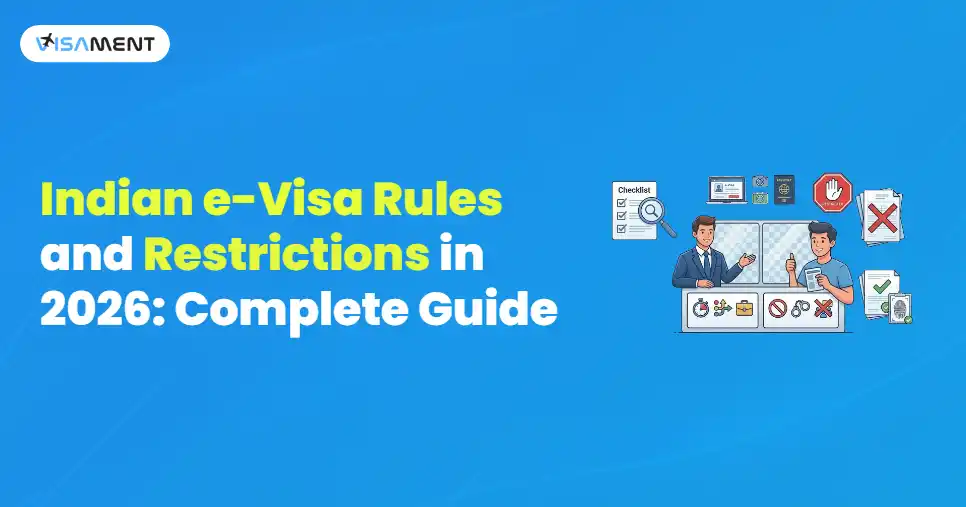
If we talk about the most visited destinations in the world, India ranks among the top destinations. From all over the world, tourists visit India to see its rich culture and heritage, for work, business purposes, or to get medical treatment.
To make the process easier, the Government of India has introduced the Indian e-visa, which allows applicants to apply for an Indian visa without visiting the embassy.
However, even after this, many applicants still face complications, including rejection or delays, when applying for the Indian e-visa due to a lack of awareness of its rules and restrictions.
In this blog, we will show you all the Indian e-visa rules and restrictions that an applicant must remember when applying for an e-visa to India. Along with his, you will also see eligibility rules, entry restrictions, and mandatory travel requirements for travellers in 2026.
Having proper knowledge about the Indian e-visa rules and restrictions is very important. This can help you to avoid visa violations or getting your Indian e-visa application rejected or delayed.
Given below are some of the Indian e-visa rules and restrictions, which an applicant must remember when applying.
1. Employment is not permitted
All individuals who hold a valid Indian e-visa, they are not allowed to get employment in India. such as:
If you are on an Indian tourist e-visa, then you are not allowed to work, and for such purposes, you must apply for an employment visa.
2. Journalism Activities Not Allowed
You cannot use your Indian e-visa for journalism activities, such as:
3. Restriction of Missionary Activities
Travellers with a valid Indian e-visa are not allowed to do missionary activities, such as:
For any religious or missionary activities, travellers need to get special permission from the Indian government.
4. Going to any restricted or protected areas
Applicants holding an Indian visa are not allowed to travel in restricted or prohibited zones or areas in India. To travel in these areas, you need to get permission from the Indian government, and then you can access these areas, such as:
All travellers who are planning to visit these areas must verify the local permit areas before going to such areas.
The Indian e visa rules for stay duration depend on the category of visa or the approval of visa.
Given below are the rules for every Indian e-visa type.
The tourist e-visa rules depend on nationality and visa validity.
You can apply for:
The permitted duration of each stay depends on the validity and conditions of the approved e-Tourist Visa. Travelers must leave India before the permitted stay period expires but may re-enter if multiple entries are allowed during the visa's validity.
If you have a business visa, then you are allowed to:
The medical e visa is used for patients and individuals who need a valid treatment in India. This visa validity depends on the seriousness of the treatment and approval conditions.
You can also get a visa extension only in some specific cases.
The Indian e-visa holders can only enter India through a valid immigration checkpoint.
Check out the Indian e-Visa rules and restrictions mentioned below.
All travellers can enter India through a valid airports and seaports.
If you enter from any unauthorised airport or seaport, then your entry may be denied.
Uploading a wrong or incorrect photo in the Indian e-Visa application can lead to rejection of your visa.
To avoid this, you need to submit a correct photo, such as:
Make sure you know all the Indian e-visa photo rules for the smooth application process.
Here are some of the Indian e-visa application restrictions that every applicant must know.
1. Details match the passport
All the details in the Indian e visa application must match the supporting documents.
Some of the common mistakes that applicant make in their Indian e-visa application are:
Any small errors can lead to the rejection or delay of the Indian visa application.
2. Duplicate application problems
Most of the applicants submit duplicate Indian e visa applications, which results in:
All the applicants who have applied for the Indian e-Visa application. They must wait for the payment confirmation before reapplying for the visa application to avoid any failures or complications.
3. Carrying the same passport during the application
All travellers with a valid Indian e visa must carry the same passport that they used for the application.
If you renewed your passport after the Indian e visa approval, then you need to carry both the new and old passports.
Have questions? Our experts guide you through every step of the Indian e-Visa Process– no confusion, no delays.
Consult an Expert TodayAll travellers arriving in India, and those who have a yellow fever vaccination, need to carry a valid yellow fever vaccination certificate. If you don't have a valid certificate, then you will be put in quarantine by the authorities upon arriving in India.
Biometric verification for the Indian e-Visa holders
When an Indian e visa application of the individual is approved by the authorities, then they need to submit their biometrics, such as:
If you failed to provide all this information and biometrics, then your Indian e visa application will be denied or rejected.
Once the applicant gets their Electronic Travel Authorisation (ETA), all the travellers need to do the following things mentioned below:
Here are the points for overstaying in India on your valid Indian e visa. Then, you need to face these complications:
 Also Want to Know About How to Correct Mistakes in Indian e-Visa? Check Now!
India currently provides various types of e-visas on the basis of travel purpose. Here is the list of Indian e-visa given below that you can apply for according to your purpose of travel.
Every visa category has its own purpose, so you must apply under the correct visa category.
There are only a limited number of activities that you can do with your valid Indian e-visa.
Here are some of the activities that you can do under the tourist e-visa.
These are the activities that you can do under a business e-visa.
Here is the list of activities that you can do under a medical e-visa.
Applicants who are looking to apply for an Indian e-visa first, they need to meet the eligibility criteria.
1. Provide a valid Passport
You need to renew your Indian passport regularly. If there are some mistakes or your passport is lost, damaged, or near the date of expiry, then you need to apply for an Indian passport renewal.
2. Nationality Requirement
The Indian e-visa is only applied by countries that are approved by the Indian government.
So, you must ensure that your country is in the list of approved Indian e-visa eligible countries.
For some countries, applicants need to visit the Indian embassy instead of applying for an e-visa because of their nationality and travel history.
3. Individual Passport Mandatory
To apply for an Indian e-visa, applicants must possess their own valid passport.
For minors, spouses, or any other individuals, you must have a separate passport.
However, an Indian e-visa is not eligible for persons whose:
4. Purpose of Visit Matches with the Visa Category
All the applicants should choose the correct visa category based on their travel plans.
Here are the examples for the correct visa category:
If you use the wrong visa type, then your Indian e-visa application can be rejected or cancelled.
Here are some of the tips through which you can apply for the Indian e-visa application smoothly and without facing any errors.
An Indian e-visa helps eligible travellers visit India for short-term stays based on the approved visa category. However, having the correct information about Indian e visa rules and restrictions is important.
Most of the travellers face some complications because of uploading incorrect documents, selecting the wrong visa category, overstaying in India, and not understanding the visa.
To avoid getting rejection or delays, you can take help from the Visament website. We provide you with a simple and hassle-free Indian e-visa application, assisting you with the documentation. By applying to us, you reduce the chances of errors and mistakes in your visa application.
Along with this, you will also get all the guidelines, rules, and restrictions for the Indian e visa application that will help you in a smooth immigration during a visit to India.
If you have a valid Indian e-visa, then you are not allowed to do activities such as employment in India, any journalism work or media reporting, missionary activities, or going to any restricted or protected areas without permission.
No, you cannot work in India on an Indian e-visa. If you want to work, then you need to apply for a separate employment visa in India.
No, you cannot extend or convert your Indian e visa. However, in some cases, it is available, but you need to provide some valid documents; the final decision is still made by the authorities.
Yes, Minors can apply for the Indian e-visa application if a child has a separate passport and all the valid documents.
Yes, all travellers need to carry a return or onward ticket as proof, which allows you to avoid any complications or issues during travel.
No, travellers with a valid Indian e-visa are only allowed through the authorized seaports and airports.
If you overstay in India on an Indian e-visa, you need to pay additional penalties, and you may not be allowed to apply for a future visa application.
Vipul Jain is the Co-Founder of Visament, a trusted platform dedicated to simplifying Indian immigration, consular, and NRI services for applicants across the globe. With extensive expertise in OCI cards, Indian passport services, visa assistance, apostille and document legalization,... See Full Bio

Talk to our documentation experts for free guidance on your application.

When you visit a website, it may store data about you using cookies and similar technologies. Cookies can be important for the basic operations of the website and for other purposes. You get the option of deactivating certain types of cookies, even so, doing that may affect your experience on the website.
It is required to permit the basic functionality of the website. You may not disable necessary cookies.
Used to provide advertising that matches you and your interests. May also be used to restrict the number of times you see an advertisement and estimate the effectiveness of an advertising campaign. The advertising networks place them after obtaining the operator's permission.
Permits the website to recognize the choices you make (like your username, language, or the region you are in). Also provides more personalized and enhanced features.
Aid the website operator to determine how the website performs, how visitors interact with the site, and whether there are any technical issues.